Affiliate Disclosure: This article contains affiliate links. If you purchase or sign up through one of these links, ToolGrowthHQ may earn a commission at no extra cost to you. This does not change how we evaluate the platforms. Our comparison focuses on pricing, features, use cases, limitations, and overall fit.
Pricing note: SaaS pricing and included features can change. The pricing discussed in this article reflects the information available when this guide was updated in August 2026. Always check the provider’s current pricing page before making a purchase.
How we evaluated these platforms: This comparison is based on publicly available pricing and feature documentation, official vendor specifications, security and compliance disclosures, and verified third-party user reviews, updated as of August 2026. We evaluate tools based on pricing structure, core feature depth, integration ecosystem, security posture, and real-world fit for specific business models — with the goal of helping you make an informed decision rather than pushing you toward either platform.
Table of Contents
- Quick Answer
- Quick Verdict
- What Is GoHighLevel?
- What Is HubSpot?
- GoHighLevel vs HubSpot: Feature Comparison
- GoHighLevel vs HubSpot Pricing
- Integrations and Ecosystem
- Security, Privacy and Compliance
- Who Should Choose GoHighLevel?
- Who Should Choose HubSpot?
- Alternatives Worth Considering
- Frequently Asked Questions
- Final Verdict
Quick Answer
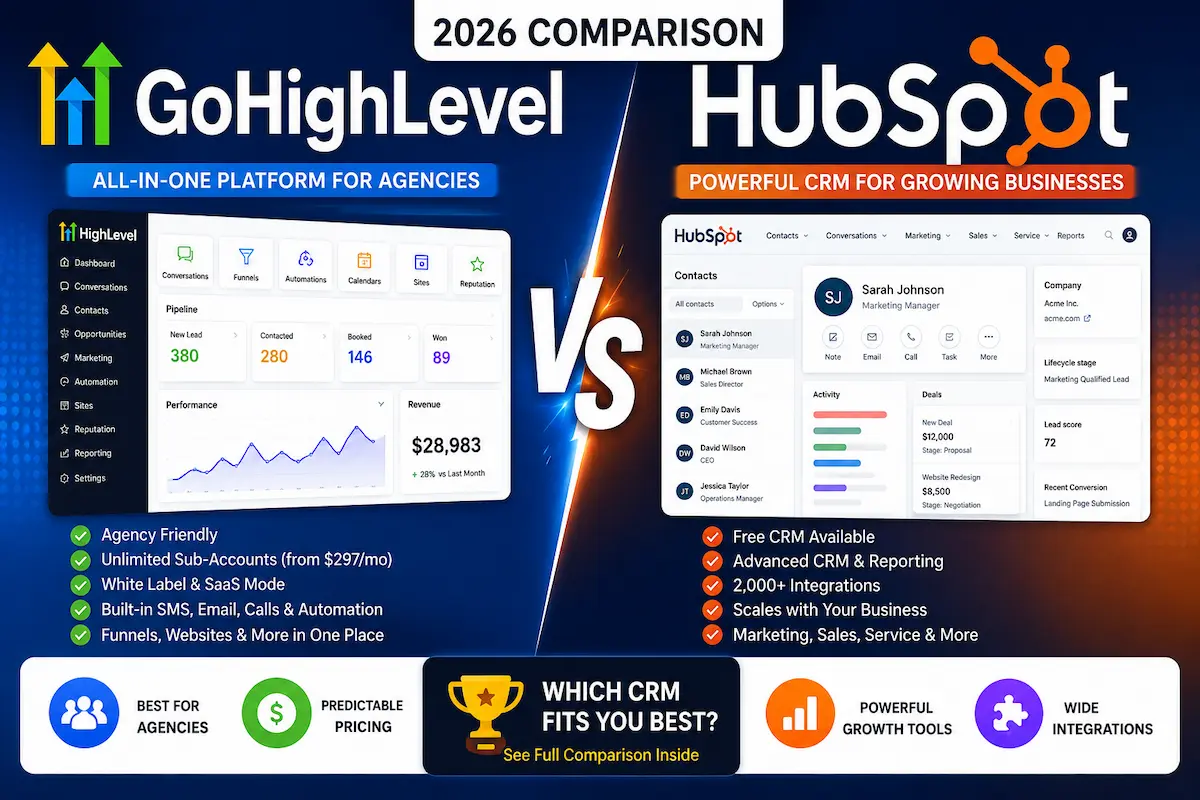
GoHighLevel is usually the better fit for agencies, consultants, and service businesses that want CRM, funnels, automation, appointment booking, messaging, and client sub-accounts in one platform. HubSpot is generally the stronger choice for businesses that want a mature CRM, broader ecosystem, structured customer data, and more sophisticated sales and marketing operations.
The biggest difference is not simply the number of features. It is the way each platform is designed to be used.
HighLevel is particularly agency-friendly because its $97/month Starter plan includes three sub-accounts, while the $297/month Unlimited plan includes unlimited sub-accounts. Its $497/month Agency Pro plan adds SaaS Mode and automated sub-account creation.
HubSpot takes a different approach. Its Customer Platform has a free tier, a lower-cost Starter option, and much more expensive Professional and Enterprise tiers as businesses need more advanced capabilities.
So if you are running an agency and managing multiple clients, GoHighLevel deserves a serious look. If you are building a sales and marketing operation inside one company, HubSpot may make more sense.
Quick Verdict
- Best for marketing agencies: GoHighLevel
- Best for managing multiple client accounts: GoHighLevel
- Best for white-label SaaS-style agency operations: GoHighLevel Agency Pro
- Best free starting option: HubSpot
- Best for structured CRM and larger sales teams: HubSpot
- Best for a broad integration ecosystem: HubSpot
- Best for funnels, automation and appointment-driven businesses: GoHighLevel
- Best overall: It depends on whether you are running an agency or a single business
GoHighLevel vs HubSpot at a Glance
| Category | GoHighLevel | HubSpot |
|---|---|---|
| Primary strength | Agency CRM, funnels and automation | CRM, sales and customer platform |
| Free plan | No permanent free plan (14-day trial) | Yes, permanent free CRM tier |
| Entry pricing | $97/month (Starter) | $0/month (Free); paid Starter from $7/seat (annual billing) |
| Starter sub-accounts | 3 | Not structured around agency sub-accounts |
| Unlimited sub-accounts | Yes, on Unlimited ($297/mo) and Agency Pro ($497/mo) | Not the core pricing model |
| White-label/SaaS mode | Yes, on Agency Pro plan only | Not its primary positioning |
| Funnels and websites | Native drag-and-drop builder | Available, aimed more at content-heavy sites |
| SMS and communications | Native SMS, email, and calling in every plan | Available through HubSpot tools and integrations, varies by product and region |
| CRM depth | Built for agency and service workflows | Built for complex, structured organizational CRM |
| Integrations | Growing native + API library | 2,000+ apps advertised on current platform page |
| Security certification | SOC 2 Type II (announced 2026) | SOC 2 Type II report available |
| Best audience | Agencies, consultants, service businesses | Growing businesses, sales teams, larger organizations |
What Is GoHighLevel?
GoHighLevel, often shortened to HighLevel or GHL, is an all-in-one sales, marketing and automation platform designed with agencies and service businesses heavily in mind.
Instead of connecting a separate CRM, funnel builder, appointment system, email platform and automation tool, an agency can manage many of those activities from one platform.
One of the most important concepts is the sub-account. A marketing agency can create separate client environments while managing them from a central agency account.
That makes the platform fundamentally different from a traditional single-company CRM.
For example, imagine an agency works with a dentist, a roofing company and a local fitness studio. Each client may need separate contacts, pipelines, calendars, websites, automations and campaigns. HighLevel’s sub-account model is designed around that type of setup.
That does not automatically make it the best CRM for every business. It simply means the platform’s structure is particularly attractive when one organization needs to manage multiple client environments.
If you want a more detailed look at the platform itself, see our GoHighLevel Review 2026.
What Is HubSpot?
HubSpot is a broader customer platform built around CRM, marketing, sales, customer service, content, operations and related tools.
One of HubSpot’s biggest advantages is that a business can start with its free CRM tools and add more functionality as its requirements become more sophisticated.
That makes HubSpot particularly attractive to a company that is building its own sales and marketing operation rather than managing separate CRM environments for dozens of clients.
HubSpot also has a large integration ecosystem. Its current Customer Platform page advertises more than 2,000 apps and web services that can connect with the platform.
The trade-off is cost and complexity. Once a business moves into more advanced HubSpot functionality, the monthly investment can become substantially higher than a basic CRM subscription.
GoHighLevel vs HubSpot: Feature-by-Feature Comparison
1. CRM and Pipeline Management
Both platforms can manage contacts, opportunities, pipelines and customer interactions.
GoHighLevel is particularly convenient when the CRM is part of a broader agency workflow. A client can have its own pipeline, calendar, automations and campaigns inside a dedicated sub-account, with unlimited contacts and users included on every plan.
HubSpot is stronger when the CRM itself is the center of a larger organizational sales operation. Its platform is designed around structured customer records and relationships between different types of business data, with reporting and permission structures built for larger teams.
Winner for agencies: GoHighLevel
Winner for complex organizational CRM: HubSpot
2. Marketing Automation
GoHighLevel puts automation close to the center of the product. Agencies can build workflows around leads, appointments, conversations, pipelines and follow-up campaigns, all included in every paid tier without separate automation add-on fees.
That can be especially useful for local businesses where speed matters. A new lead can enter a pipeline, receive follow-up communication, trigger an appointment workflow and move through different stages without requiring several separate platforms.
HubSpot also has powerful automation, particularly for businesses that need more structured sales and marketing processes — though advanced workflow automation is generally gated behind Professional-tier pricing and above.
The better choice depends on your workflow. If your main goal is fast agency-style automation at a flat monthly cost, GoHighLevel is compelling. If your workflows depend heavily on a sophisticated company-wide CRM structure, HubSpot deserves more consideration.
3. Funnels and Websites
GoHighLevel has a strong focus on funnels, landing pages, websites and lead-generation workflows, including a native drag-and-drop builder and pre-built funnel templates included at every plan level.
This is one reason it fits agencies that repeatedly build similar marketing systems for clients.
HubSpot also provides website and content tools, but its broader platform is aimed at managing the entire customer journey rather than focusing primarily on funnel deployment.
If your work revolves around lead-generation funnels, landing pages and appointment conversion, GoHighLevel may feel more natural.
If your business depends on a larger content and CRM ecosystem, HubSpot may have the advantage.
4. Messaging and Follow-Up
GoHighLevel places significant emphasis on conversations, email, SMS, calling and automated follow-up, unifying them in one inbox across every sub-account.
That can be valuable for businesses where a missed lead can mean a missed sale.
For example, a local service business may want an automated process that follows up with a prospect after a form submission, reminds them about an appointment and updates the sales pipeline when the prospect responds.
HubSpot can also support sophisticated communication workflows, but the exact features and costs depend on the HubSpot products, plan, usage and integrations involved.
5. AI Features
Both platforms have expanded their AI capabilities considerably.
HubSpot integrates AI features throughout its customer platform, including tools for content, customer service, prospecting and data-related tasks.
GoHighLevel has also expanded AI across areas such as conversations, voice, content and workflows, including AI-driven conversation replies and voice AI for appointment booking.
For most small businesses, the more useful question is not which company has more AI features. It is whether the AI tools actually reduce work inside the workflow you already use.
6. White-Label and SaaS Features
This is one of the clearest differences.
GoHighLevel’s Agency Pro plan ($497/month) includes SaaS Mode and automated sub-account creation. That makes it possible for an agency to build a software-style recurring service around the HighLevel platform, reselling access under its own brand.
HubSpot is not primarily designed around this agency white-label SaaS model.
If your business model is to sell marketing software or packaged CRM services to multiple clients, this difference can be decisive.
GoHighLevel vs HubSpot Pricing
Pricing is where this comparison becomes much more interesting because the two companies use very different approaches.
Current GoHighLevel Pricing
| Plan | Current Monthly Price | Important Difference |
|---|---|---|
| Starter | $97/month | 3 sub-accounts |
| Unlimited | $297/month | Unlimited sub-accounts |
| Agency Pro | $497/month | SaaS Mode and automated sub-account creation |
The important detail is that not every GoHighLevel plan has unlimited sub-accounts.
The $97/month Starter plan includes three sub-accounts. Unlimited sub-accounts begin with the $297/month Unlimited plan. Agency Pro costs $497/month and adds SaaS-oriented functionality.
GoHighLevel also offers optional add-ons, so your real monthly cost can be higher than the base subscription depending on what you activate. A 14-day free trial is available on paid plans, with no permanent free tier.
Before purchasing, you can check GoHighLevel’s current pricing for the latest plan details.
We also explain the plans and additional costs in more detail in our GoHighLevel Pricing Guide 2026.
Current HubSpot Pricing
HubSpot’s current Customer Platform includes a free option and paid tiers.
| Customer Platform Tier | Current Starting Price | General Positioning |
|---|---|---|
| Free | $0/month | Basic starting point |
| Starter | From $7/seat under the displayed annual pricing option | Essential marketing, sales, service, content and data tools |
| Professional | From $1,300/month | Advanced platform functionality |
| Enterprise | From $4,700/month | Advanced enterprise functionality |
HubSpot’s pricing can vary according to billing period, seats, products, usage, contacts, credits and other requirements. Its current pricing page also shows different monthly and annual starting prices for some tiers.
That is why comparing only the headline subscription price can be misleading.
Which Pricing Model Is Better?
For an agency managing several clients, GoHighLevel’s flat-fee, unlimited-sub-account structure can make budgeting easier — the same $297/month covers 5 clients or 50.
For a small company that simply wants to start with a CRM without paying immediately, HubSpot’s free tier is a major advantage.
For larger organizations, neither platform should be evaluated using the subscription price alone. You should calculate the complete cost of seats, contacts, usage, add-ons, integrations, onboarding and the features your team actually needs.
Integrations and Ecosystem
HubSpot has a major advantage in ecosystem breadth. Its current platform advertises more than 2,000 apps and web services.
That matters if your business already relies on accounting software, ecommerce systems, communication tools, analytics platforms, customer-support products or other specialized software.
GoHighLevel takes a different approach. It provides many native integrations, a public API, and Zapier/Make connectivity while trying to reduce the number of separate tools an agency needs in the first place.
This creates an interesting trade-off.
If you want one platform to handle a large portion of your agency’s marketing workflow, GoHighLevel can be attractive.
If your company already has a complex technology stack and needs a CRM that connects to many external systems, HubSpot may have the stronger ecosystem.
Security, Privacy and Compliance
Security should not be treated as a marketing checkbox when you are storing customer information inside a CRM.
HighLevel announced SOC 2 Type II certification in 2026 and states that its security and privacy program covers areas including security, availability and confidentiality. HighLevel also publishes information about GDPR, CCPA and other privacy considerations.
HubSpot also maintains a formal security and compliance program and provides a SOC 2 Type II report. HubSpot’s current infrastructure documentation also describes regional data-hosting options, including EU hosting.
One important correction to many simplified comparisons is that you should not describe HubSpot as “ISO 27001 certified” merely because its cloud infrastructure provider has ISO 27001 certification. HubSpot’s current infrastructure FAQ specifically distinguishes the company’s own certification status from the certifications held by its infrastructure provider.
For a business operating in the US or UK, the practical question is therefore not simply “Which platform is compliant?”
You should check:
- Where your customer data is stored
- Which privacy laws apply to your business
- What data-processing agreements are available
- Which integrations receive your customer data
- Whether your industry has additional requirements
- Whether the specific plan you purchase includes the compliance features you need
For sensitive industries, always verify the provider’s current legal and compliance documentation rather than relying on a third-party comparison article.
Who Should Choose GoHighLevel?
Best for: Marketing agencies, consultants, and service businesses managing multiple client accounts, coaches and course creators running funnels and appointment booking, and agencies wanting to build a white-label SaaS offer.
Not ideal for: A single company that only needs basic contact management, teams that need deep enterprise-grade reporting across departments, or businesses that want a permanent free tier before committing budget.
GoHighLevel makes the most sense when your business model looks something like this:
- You run a marketing or lead-generation agency.
- You manage several client accounts.
- You want separate CRM environments for different clients.
- You use funnels, appointment booking and automated follow-up.
- You want CRM and marketing automation in one platform.
- You want to build a white-label or SaaS-style service.
- You would rather consolidate several marketing tools than connect many separate products.
For agencies considering the platform, starting with a trial can be a sensible way to test whether the sub-account structure actually fits your workflow.
You can start the GoHighLevel trial and evaluate the platform before committing to a paid plan.
Who Should Choose HubSpot?
Best for: Single companies building an internal sales and marketing operation, businesses that expect to scale into enterprise-level reporting, and teams that depend on a large integration ecosystem.
Not ideal for: Agencies managing many separate client CRM environments, or budget-conscious teams that need advanced automation without moving into Professional/Enterprise pricing.
HubSpot may be the better choice if:
- You are primarily running one business rather than managing multiple client accounts.
- You want to start with a free CRM.
- You need a mature CRM and sales-management environment.
- Your team depends heavily on integrations.
- You expect your sales operation to become more sophisticated over time.
- You need structured reporting across a larger organization.
- You are comfortable paying more as your requirements expand.
HubSpot can be particularly appealing when the CRM is expected to become a central system for sales, marketing, service and customer data rather than simply a lead-generation tool.
GoHighLevel vs HubSpot: Real-World Examples
Example 1: A Local Marketing Agency
Suppose an agency manages 15 local businesses and provides lead generation, appointment booking, CRM management and automated follow-up.
GoHighLevel is likely the more natural fit because the agency can organize clients into separate sub-accounts and manage many marketing functions from one platform.
Likely winner: GoHighLevel.
Example 2: A Growing B2B Software Company
Now imagine a software company with a dedicated sales team, marketing department, customer-success operation and a growing technology stack.
In this situation, HubSpot’s CRM structure, reporting and integration ecosystem may be more valuable than the agency-style sub-account model.
Likely winner: HubSpot.
Example 3: A Solo Business Owner
A solo consultant who simply needs contact management and basic CRM functionality may not need all of GoHighLevel’s capabilities.
Starting with HubSpot’s free CRM can be a more sensible approach. The owner can spend money later if the business genuinely needs advanced automation.
Likely winner: HubSpot at the beginning.
Example 4: An Agency Building a SaaS Offer
An agency that wants to sell recurring CRM and marketing software packages under its own brand has a very different requirement.
GoHighLevel Agency Pro’s SaaS Mode and automated sub-account creation make it much more closely aligned with that business model.
Likely winner: GoHighLevel.
Alternatives Worth Considering
GoHighLevel and HubSpot are not the only options.
If your priority is funnel building, you may also want to compare them with ClickFunnels. Our ClickFunnels vs GoHighLevel comparison looks at how those two platforms differ.
If you are trying to choose an all-in-one marketing platform rather than a CRM specifically, our Best All-in-One Marketing Platform guide gives you a wider comparison.
For coaches and consultants, our Best Funnel Builder for Coaches guide focuses specifically on that use case.
And if affiliate marketing is your main goal, see our Best Funnel Builder for Affiliate Marketing comparison.
If you need a lower-cost, simpler alternative to either platform, tools like Systeme.io (starting around $27/month) target solo entrepreneurs who want basic funnels and email automation without agency-level pricing.
Frequently Asked Questions
Is GoHighLevel better than HubSpot?
Not universally. GoHighLevel is generally better suited to agencies and businesses that want funnels, automation and multiple client sub-accounts. HubSpot is generally stronger for businesses that need a mature CRM, broad integrations and more structured customer-data management.
Is GoHighLevel cheaper than HubSpot?
It depends on the business. GoHighLevel can be more attractive for agencies because its Unlimited plan provides unlimited sub-accounts for a fixed subscription price. HubSpot can be cheaper for a small business starting with its free CRM or lower-cost Starter tier.
Does GoHighLevel have a free plan?
GoHighLevel does not currently offer a permanent free plan. It offers a 14-day trial. Its current paid plans start at $97/month.
How many sub-accounts does GoHighLevel Starter include?
The current Starter plan includes three sub-accounts. Unlimited sub-accounts are included with the $297/month Unlimited plan and the $497/month Agency Pro plan.
Does GoHighLevel have unlimited contacts?
Yes. GoHighLevel’s current pricing information lists unlimited contacts and unlimited users across its plans. However, other usage-based features and optional add-ons can still affect your overall cost.
Which is better for agencies: GoHighLevel or HubSpot?
For a traditional marketing agency managing multiple clients, GoHighLevel is usually the more natural fit because of its sub-account architecture, automation and agency-oriented features.
Which is better for a small business: GoHighLevel or HubSpot?
There is no single answer. A small business that mainly needs a basic CRM may prefer HubSpot’s free option. A business that depends heavily on funnels, appointment booking, automated follow-up and messaging may get more value from GoHighLevel.
Can GoHighLevel replace HubSpot?
For some agencies and service businesses, yes. For every HubSpot use case, no. GoHighLevel can cover many CRM, marketing and automation requirements, but businesses that depend on specific HubSpot functionality, integrations or complex organizational CRM workflows should compare those requirements individually.
Can HubSpot replace GoHighLevel?
HubSpot can cover many CRM and marketing requirements, but it is not built around the same agency sub-account and white-label SaaS model. If your business depends on managing many separate client environments, GoHighLevel has a structural advantage.
Is GoHighLevel good for a beginner?
It can be, but beginners should not assume that having more features automatically means an easier experience. GoHighLevel is powerful, and learning the platform can take time. If you only need basic CRM functionality, a simpler or free option may be a better starting point.
Is HubSpot free?
HubSpot currently offers a free Customer Platform option with foundational CRM functionality. Paid plans become more expensive as you need additional capabilities, seats, credits and advanced features.
Can I switch from HubSpot to GoHighLevel (or vice versa) without losing data?
Both platforms support contact and data export/import through CSV files and APIs, but migrating automations, pipelines, and integrations is manual work. Before switching, map out which workflows and integrations you would need to rebuild on the new platform, since neither company offers a fully automated one-click migration between the two systems.
Final Verdict: GoHighLevel vs HubSpot
After separating the two platforms by use case, the decision becomes much clearer.
Choose GoHighLevel if you are primarily an agency, consultant or service business that wants CRM, funnels, automation, appointment booking and client management in one system.
GoHighLevel’s biggest advantage is not simply its feature count. It is the way the platform is organized around agencies and multiple client environments. The $297/month Unlimited plan is particularly important because that is where unlimited sub-accounts begin, while the $497/month Agency Pro plan adds SaaS Mode and automated sub-account creation.
Choose HubSpot if you are primarily building a CRM and customer-management system for one organization.
HubSpot’s free starting point, structured CRM, broad integration ecosystem and deeper organizational capabilities make it attractive for businesses that expect their sales and customer-management processes to become more sophisticated.
There is also a simple way to think about the decision:
- Agency + multiple clients + funnels + automation: GoHighLevel
- Single company + CRM + sales team: HubSpot
- White-label SaaS model: GoHighLevel
- Free CRM starting point: HubSpot
- Large integration ecosystem: HubSpot
- Agency-focused operating model: GoHighLevel
If you are leaning toward GoHighLevel after comparing the two, you can explore GoHighLevel directly and see whether its workflow matches the way your business operates.
If you want to understand the platform before making that decision, start with our GoHighLevel Review 2026 and then compare the current plans in our GoHighLevel Pricing Guide.
Bottom line: GoHighLevel is the stronger agency-first platform; HubSpot is the stronger organization-first CRM platform. The right choice depends less on which product has more features and more on how your business actually works.
Official Pricing and Reference Links
Because SaaS pricing and product features can change, readers should verify current information directly with the providers before purchasing.
- HighLevel official pricing
- HubSpot official Customer Platform pricing
- HighLevel security and privacy information
- HubSpot security information
Last reviewed: August 2026. Prices, features, limits, promotions and availability may change after publication.
About the Author
T. Vasireddi is the founder and editor of ToolGrowthHQ, creating practical, research-based guides on web hosting, WordPress, SaaS tools, and digital marketing.
His focus is on providing clear, accurate, and useful information to help readers make better technology and software decisions.
Connect with him:
Follow for more AI tool reviews, SaaS comparisons, and digital marketing tips.