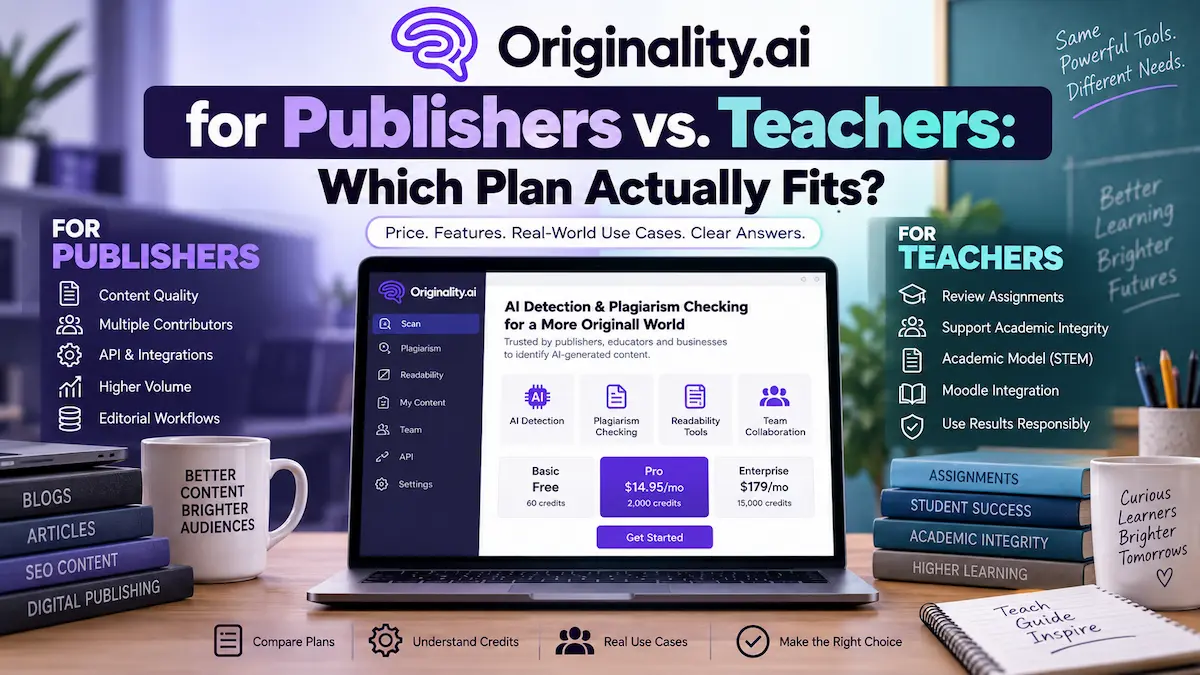
Originality.ai for Publishers is worth comparing carefully with the needs of teachers and education teams. Publishers and teachers can use many of the same features, but their requirements around volume, collaboration, integrations, and AI detection can be very different.
This guide focuses on that decision. It compares the current Originality.ai plans, explains where the Academic model fits, shows how the credit system affects real usage, and separates the needs of an individual teacher from those of a publisher or larger education organisation.
How we researched this guide: This comparison is based on Originality.ai’s publicly available pricing page, its published terms of service, its help-center documentation on credit consumption, and its published accuracy/benchmark figures, reviewed as of August 2026. We evaluate the plans based on price, included credits, feature scope, team capabilities, and how the vendor itself describes appropriate use of AI-detection results — so that teachers and publishers can match a plan to their actual workflow rather than to marketing copy.
Affiliate Disclosure: ToolGrowthHQ may earn a commission if you purchase Originality.ai through one of the affiliate links in this article, at no additional cost to you. Our recommendations are based on the features, pricing, limitations, and use cases discussed here. The affiliate relationship does not determine our conclusions.
Quick Answer: Which Originality.ai Plan Fits?
For most individual teachers: Pro is the more practical recurring subscription if you regularly check assignments and want access to AI detection, plagiarism checking, readability tools, file uploads, team features, and the Chrome extension. Occasional users may prefer pay-as-you-go credits instead.
For publishers: Pro can be enough for a solo publisher or small content team with moderate scanning volume. Enterprise becomes more relevant when you need substantially more monthly credits, API access, longer scan history, expanded team capabilities, and enterprise-level support.
For schools and universities: do not automatically assume that an individual Pro subscription is the right institutional solution. Originality.ai has a separate education offering and defines a “School Customer” around an institutional agreement.
Quick Verdict
| Use case | Most sensible starting point | Why |
|---|---|---|
| Individual teacher, regular use | Pro | Recurring credits plus broader content-checking features |
| Teacher, occasional checking | Pay As You Go | Avoids committing to a recurring subscription when usage is low |
| STEM coursework | Academic model | Designed specifically for academic STEM content, including coding and formulas |
| Solo publisher or small content team | Pro | 2,000 monthly credits and core content-integrity features |
| High-volume publisher or agency | Enterprise | 15,000 monthly credits, API access, expanded team features and longer scan history |
| School or university | Education/institutional option | Institutional requirements may differ from an individual subscription |
Originality.ai Pricing: What the Current Plans Actually Include
Originality.ai’s current public pricing page lists a free Basic option, Pro, and Enterprise. It also supports separately purchased pay-as-you-go credits.
| Plan | Current price | Included credits | Best fit |
|---|---|---|---|
| Basic | Free | 60 credits; 3 scans per day | Occasional testing and AI detection |
| Pro | $14.95/month monthly, or $12.95/month equivalent when billed annually | 2,000/month | Individuals and small teams |
| Enterprise | $179/month monthly, or $136.58/month equivalent when billed annually | 15,000/month | Agencies and publishers |
| Pay As You Go | One-time credit purchases | Purchased credits | Users with occasional or unpredictable usage |
The annual Pro price works out to $155.40 for the year, while annual Enterprise billing totals $1,638.96. Subscription credits expire at the end of the monthly billing cycle. Separately purchased credits expire two years after purchase if unused.
The public pricing page also states that additional credits can be purchased when needed. That means exceeding the included allowance does not necessarily require immediately moving to a higher subscription tier.
If you want the latest plan details before buying, you can check Originality.ai’s current pricing and plan options.
How the Credit System Changes the Real Cost
The headline price is only part of the calculation. Your actual cost depends heavily on what you scan and which checks you run.
For an AI-only check, one credit covers up to 100 words. When AI detection and plagiarism checking are both selected, the current help documentation says one credit covers up to 50 words.
For example:
- A 1,000-word AI-only scan can use up to 10 credits.
- A 1,000-word AI-and-plagiarism scan can use up to 20 credits.
- A 2,000-word document checked for both AI and plagiarism can use up to 40 credits.
These are useful planning figures, but actual consumption can depend on the checks selected and the amount of text scanned.
This distinction matters for both teachers and publishers. Someone who only runs AI checks may consume credits much more slowly than someone who routinely runs combined AI and plagiarism checks.
Originality.ai for Teachers: What Actually Matters?
A teacher usually has a different problem from a publisher. The question is less about processing hundreds of web articles and more about reviewing student assignments consistently while keeping the result in context.
Originality.ai provides an Academic model specifically designed for students and teachers. The company says the model is designed for STEM-related assignments, including coding and formulas.
For English, history, and other general writing assignments, Originality.ai’s own guidance points users toward the Lite model when minor AI-assisted editing such as spelling and grammar correction is allowed. It positions the Turbo model for situations with a zero-tolerance approach to AI-generated writing.
That makes model selection more important than simply asking whether the software is “for teachers.” The type of assignment and the institution’s AI policy should influence the choice.
The Academic Model Is Not a Universal “Cheating Detector”
Originality.ai reports 99%+ accuracy and a false-positive rate below 1% for its Academic model. It also publishes specific benchmark figures for certain AI models, including GPT-5 and DeepSeek V3.1 Chat.
Those figures are vendor-reported performance claims, not a guarantee that every student submission will receive a correct classification.
More importantly, Originality.ai’s own terms state that AI-detection outputs are probabilistic estimates and can produce both false positives and false negatives. The company explicitly says an AI-detection result should not be treated as conclusive proof that someone used or did not use AI.
For teachers, that distinction is critical. A score should be treated as one piece of evidence that may justify further review, not as the final decision.
What Teachers Can Use Beyond the AI Score
Originality.ai’s Chrome extension can work with Google Docs and provides a character-by-character replay of the writing process using revision history. It can also show information such as paste activity, contributors, revisions, word count, AI score, and plagiarism score.
That can be useful when a teacher needs more context around how a document was produced. It does not turn the replay into automatic proof of academic misconduct, however. The service’s terms still require human review and appropriate due process before taking significant action against a student.
Originality.ai also provides a Moodle plugin for educators. The plugin can scan student submissions for AI content and plagiarism and can be used within Moodle-based workflows.
If your main interest is the education use case, our broader guide to the best AI detection tools for teachers in 2026 provides a wider comparison.
When a Teacher Should Choose Pro
Pro makes sense when you regularly review assignments and want a general-purpose subscription rather than buying individual credits whenever you need them.
It includes 2,000 credits per month and access to features such as AI detection, plagiarism checking, readability and grammar tools, file uploads, site scans, team management, tags, and the Chrome extension.
It is particularly reasonable for an individual educator who has a predictable workload and expects to use the service throughout the year.
When a Teacher Should Consider Pay As You Go Instead
If you only need to check a small number of assignments occasionally, a recurring subscription may not be necessary.
Pay-as-you-go credits are purchased separately and, according to Originality.ai’s current pricing information, unused purchased credits expire two years after purchase. That makes this option potentially more suitable for irregular usage.
The important point is not that one option is universally cheaper. It is that your usage pattern should determine the plan.
Originality.ai for Publishers: Why the Calculation Is Different
Publishers often deal with a repeatable content-production process. Articles may arrive from freelancers, contributors, editors, or internal writers, and the publisher may want to run AI, plagiarism, readability, or other quality checks before publication.
For a solo publisher, Pro may be perfectly adequate. There is no reason to pay for Enterprise simply because your website is technically a “publisher.”
The case for Enterprise becomes stronger when the workflow itself becomes larger and more operational.
What Enterprise Adds for Publishers
The current Enterprise plan includes:
- 15,000 monthly credits.
- API access.
- Shareable reports.
- 365-day scan history.
- Dedicated customer success support.
- Priority support.
- Expanded team-management capabilities.
- Additional team seats.
Originality.ai specifically describes Enterprise as being ideal for agencies and publishers.
The API is particularly important for publishers that want content checking to become part of an existing workflow rather than requiring an editor to manually upload or paste every document.
However, API access alone is not a reason for every publisher to choose Enterprise. If you publish a modest number of articles and manually review them, Pro may provide enough capacity and functionality.
For a broader comparison of tools built around publishing workflows, see our guide to the best AI detection tools for publishers in 2026.
Pro vs Enterprise: The Decision Is Really About Workflow
| Question | If the answer is “yes” | Likely direction |
|---|---|---|
| Are you an individual or small team? | Yes | Start with Pro |
| Do you have moderate monthly scanning volume? | Yes | Pro may be sufficient |
| Do you need 15,000 monthly credits? | Yes | Enterprise |
| Do you need API access? | Yes | Enterprise |
| Do multiple people need a larger organisational workflow? | Yes | Consider Enterprise |
| Do you need 365-day scan history? | Yes | Enterprise |
| Do you only scan occasionally? | Yes | Consider Pay As You Go |
This is a better way to approach the decision than simply asking which plan has the lowest price per month.
Who Should Use Originality.ai (and Who Shouldn’t)
Best for:
- Individual teachers who check assignments regularly and want AI detection plus plagiarism checking in one subscription.
- Solo publishers or small editorial teams that need repeatable content-quality checks before publishing.
- Agencies and larger publishers that want to connect AI/plagiarism checking to an existing CMS or workflow through the API.
- Schools or universities evaluating an institutional AI-detection policy alongside Moodle integration.
Less ideal for:
- Anyone looking for a single AI score to serve as definitive proof of AI use or academic misconduct — Originality.ai’s own terms describe its output as probabilistic, not conclusive.
- Extremely low-volume users who only need to check a document a handful of times a year, where Basic’s free tier or a small pay-as-you-go credit purchase may cover the need without any subscription.
- Institutions that need a school-wide rollout without first confirming Originality.ai’s separate education pricing and institutional agreement terms.
If You’re Still Weighing Alternatives
Plan choice is only half the decision — the other half is whether Originality.ai itself is the right detector for your workflow. If you want to see how it stacks up against other AI-detection and plagiarism tools before committing to a plan, our comparison of Originality.ai alternatives walks through how competing tools differ on detection scope, education features, and integrations.
What About Schools and Universities?
This is where the publisher-versus-teacher comparison needs an important qualification.
An individual teacher buying a subscription for personal use is not necessarily the same thing as a school or university deploying an AI-detection system institution-wide.
Originality.ai’s current terms define a “School Customer” as a school, school district, college, university, education agency, or similar institution using the service for a school-authorised educational purpose under an institutional agreement.
Originality.ai also advertises a separate education offering with pricing presented at $0.01 per 100 words scanned and unlimited educators per account. Because this is presented separately from the standard public Pro and Enterprise pricing table, institutions should confirm the current commercial and contractual terms directly with Originality.ai rather than assuming that the public Pro price applies to an entire school.
For an institution, the relevant questions are therefore broader than price:
- How many educators need access?
- How many assignments will be scanned?
- Which student-data and privacy requirements apply?
- Is Moodle integration required?
- How will AI-detection results be reviewed?
- What academic-integrity policy will govern decisions?
- What institutional agreement or data-processing terms are required?
Originality.ai’s terms also state that AI-detection and plagiarism results should not be used as the sole basis for disciplinary or other significant decisions affecting a person.
Publisher vs Teacher: The Main Differences
| Requirement | Publisher | Teacher |
|---|---|---|
| Primary goal | Content and editorial quality control | Assignment and academic-integrity review |
| Typical workflow | Articles, contributors, websites and content pipelines | Essays, assignments and coursework |
| Important AI model | Depends on content workflow | Academic for STEM; Lite/Turbo for other academic writing depending on policy |
| Plagiarism checking | Often important before publication | Often important for assignment review |
| API importance | Potentially high for automated workflows | Usually less important for an individual teacher |
| Team management | Useful for editorial teams | More relevant at school or institutional level |
| Long scan history | Potentially valuable for publishing records | Depends on institutional workflow |
| Most likely starting point | Pro for small teams; Enterprise for larger workflows | Pro for regular individual use; Pay As You Go for occasional use |
Important Limitation: An AI Score Is Not Proof
This is the most important limitation to understand before using Originality.ai in either environment.
An AI detector estimates the likelihood that text contains AI-generated or AI-assisted writing. It does not directly observe who wrote the text.
Originality.ai’s current terms explicitly describe AI-detection outputs as probabilistic and warn that they can be affected by factors including language, genre, paraphrasing, translation, editing, short text, model changes, and mixed authorship.
For teachers, this means an AI score should be considered alongside the student’s writing history, assignment requirements, previous work, conversations with the student, and the applicable academic-integrity policy.
For publishers, the same principle applies to freelancers and contributors. A high AI score can be a reason for editorial review, but it should not automatically be treated as proof that a writer violated a contract or publishing policy.
This approach is also consistent with Originality.ai’s own terms, which require human review before materially affecting another person.
Who Should Skip Enterprise?
Enterprise is not automatically the better choice simply because it has more features.
You probably do not need Enterprise if:
- You are a solo blogger or small publisher with moderate content volume.
- You do not need API access.
- You do not need a larger team-management setup.
- Your scanning needs comfortably fit within Pro’s 2,000 monthly credits.
- You do not need the longer Enterprise scan history.
In these situations, paying $179 per month instead of $14.95 per month would require a clear operational reason.
Who Should Consider Enterprise?
Enterprise becomes easier to justify when Originality.ai is becoming part of a larger publishing or agency workflow.
Consider it when:
- Your monthly scanning requirements are approaching or exceeding Pro’s allowance.
- You need API access to connect checking to another system.
- Several people need to work within the same organisational workflow.
- You need longer access to scan history.
- You need shareable reports for editors, managers, or colleagues.
- You value dedicated customer-success support and priority support.
The important distinction is that Enterprise is primarily a workflow and scale decision, not simply a feature-shopping exercise.
Is Originality.ai a Good Fit for Both Publishers and Teachers?
Yes, but for different reasons.
For publishers, the strongest case is the combination of AI detection, plagiarism checking, content-quality tools, team features, and the ability to integrate the service into larger workflows through the API on Enterprise.
For teachers, the strongest case is the education-focused detection workflow, including the Academic model for STEM-related work, the Chrome extension’s writing-process replay, plagiarism checking, and Moodle integration.
That does not mean the same plan is ideal for both audiences.
A teacher checking a manageable number of assignments does not automatically need Enterprise. Likewise, a publisher handling large volumes of contributor content should not assume that an individual Pro account will remain sufficient as the workflow grows.
How to Choose Before You Pay
Before subscribing, estimate your real workload instead of choosing a plan based only on the monthly price.
- Estimate your monthly word volume. Count the approximate number of words you expect to scan.
- Decide which checks you will normally run. AI-only checks consume credits differently from combined AI and plagiarism checks.
- Check whether usage is regular or occasional. Regular users may benefit from Pro, while occasional users can consider pay-as-you-go credits.
- Identify whether you need team functionality. A solo user and a multi-person organisation have different requirements.
- Ask whether API access is actually necessary. If you will not integrate Originality.ai into another system, this Enterprise feature may not justify the higher price by itself.
- For education, define your policy before using the detector. Decide how scores will be reviewed and what evidence is required before taking action against a student.
Frequently Asked Questions
Is Originality.ai worth it for an individual teacher?
If you check assignments regularly throughout the term, Pro’s 2,000 monthly credits and combined AI-detection/plagiarism-checking features typically justify the $14.95/month cost. If you only check a handful of assignments a year, pay-as-you-go credits may cost less overall.
Can a teacher use the free Basic plan instead of paying?
Basic includes 60 credits and up to three scans per day, which may be enough for occasional spot-checks but is unlikely to cover a full class’s assignments across a term.
What’s the difference between the Academic, Lite, and Turbo models?
The Academic model is built for STEM assignments, including code and formulas. Lite is positioned for contexts where minor AI-assisted editing, such as grammar correction, is acceptable. Turbo is positioned for a zero-tolerance approach to AI-generated writing. The right model depends on the assignment type and the institution’s AI policy, not on personal preference alone.
Does a high AI score prove a student used AI to write an assignment?
No. Originality.ai’s own terms describe detection results as probabilistic estimates that can produce false positives and false negatives, and the company states results should not be the sole basis for disciplinary decisions.
Is Pro enough for a small publishing team, or do we need Enterprise?
Pro can be enough if your monthly scanning volume comfortably fits within 2,000 credits and you don’t need API access, a longer scan history, or expanded team management. Enterprise becomes more justifiable once those needs grow.
Do unused credits roll over to the next month?
Subscription credits included with Pro or Enterprise expire at the end of the monthly billing cycle. Separately purchased pay-as-you-go credits expire two years after purchase if unused.
Does a school need a different plan than an individual teacher?
Yes. Originality.ai defines a separate “School Customer” category tied to an institutional agreement, with education pricing presented separately from the standard Pro/Enterprise table. Institutions should confirm current terms directly with Originality.ai rather than assuming an individual plan covers a school-wide rollout.
Originality.ai for Publishers vs Teachers: Final Recommendation
For an individual teacher, Pro is the most straightforward starting point when Originality.ai will be used regularly. If your usage is occasional, pay-as-you-go credits deserve consideration. For STEM assignments, the Academic model is the relevant specialised option; for other writing assignments, model choice should reflect whether your institution permits limited AI-assisted editing.
For a solo publisher or small content team, Pro is usually the first plan worth evaluating. The 2,000-credit monthly allowance and broader content-checking features can cover a meaningful amount of editorial work without jumping immediately to Enterprise.
For a high-volume publisher, agency, or content operation, Enterprise is the stronger fit when its additional capacity and workflow features are genuinely needed. The 15,000 monthly credits, API access, expanded team capabilities, shareable reports, longer scan history, and enterprise support are the main reasons to move up.
For a school or university, treat the decision separately from an individual teacher subscription. Originality.ai has an education offering and institutional terms, so the organisation should confirm the appropriate arrangement directly rather than assuming that a standard individual plan is designed for institution-wide use.
Most importantly, do not build an academic or editorial decision around an AI score alone. Originality.ai itself describes its detection output as probabilistic and requires human review in situations that could materially affect a person.
If you want a broader product assessment before deciding, you can also read our Originality.ai review for 2026 and our detailed Originality.ai pricing guide. If you are comparing other products, see our comparison of Originality.ai alternatives.
For readers who have decided that Originality.ai fits their workflow, you can explore the Originality.ai AI detection tool and review the available options before choosing a plan.
About the Author
T. Vasireddi is the founder and editor of ToolGrowthHQ, creating practical, research-based guides on web hosting, WordPress, SaaS tools, and digital marketing.
His focus is on providing clear, accurate, and useful information to help readers make better technology and software decisions.
Connect with him:
Follow for more AI tool reviews, SaaS comparisons, and digital marketing tips.