Affiliate Disclosure: This post contains affiliate links. If you purchase or sign up through one of these links, we may earn a commission at no extra cost to you. This does not increase the price you pay. Our recommendations are based on the features, pricing, limitations, and use cases discussed in this article. Affiliate relationships do not determine our editorial conclusions.
How we evaluated these tools: This comparison is based on publicly available pricing and feature documentation from each vendor’s official website, along with verified user reviews, and is updated as of August 2026. We compare tools on four criteria: starting cost, ease of use for someone with no technical background, core funnel features (pages, email, checkout, automation), and how well the platform supports a business as it grows. Pricing and features can change after publication, so always confirm current details on the provider’s website before purchasing.
If you are building your first online business, finding the best funnel builder for beginners can feel harder than actually building the funnel. There are dozens of platforms promising templates, automation, email marketing, checkout tools, and conversion features, but most beginners do not need all of those features on day one.
What matters more is finding a platform that lets you create something useful without a large upfront commitment or a steep learning curve.
For this comparison, we are looking at the practical things a beginner is most likely to care about: cost, ease of use, core funnel features, email tools, checkout capabilities, and what happens when your business starts to grow.
Table of Contents
- Quick Answer
- Quick Verdict
- What Makes a Funnel Builder Beginner-Friendly?
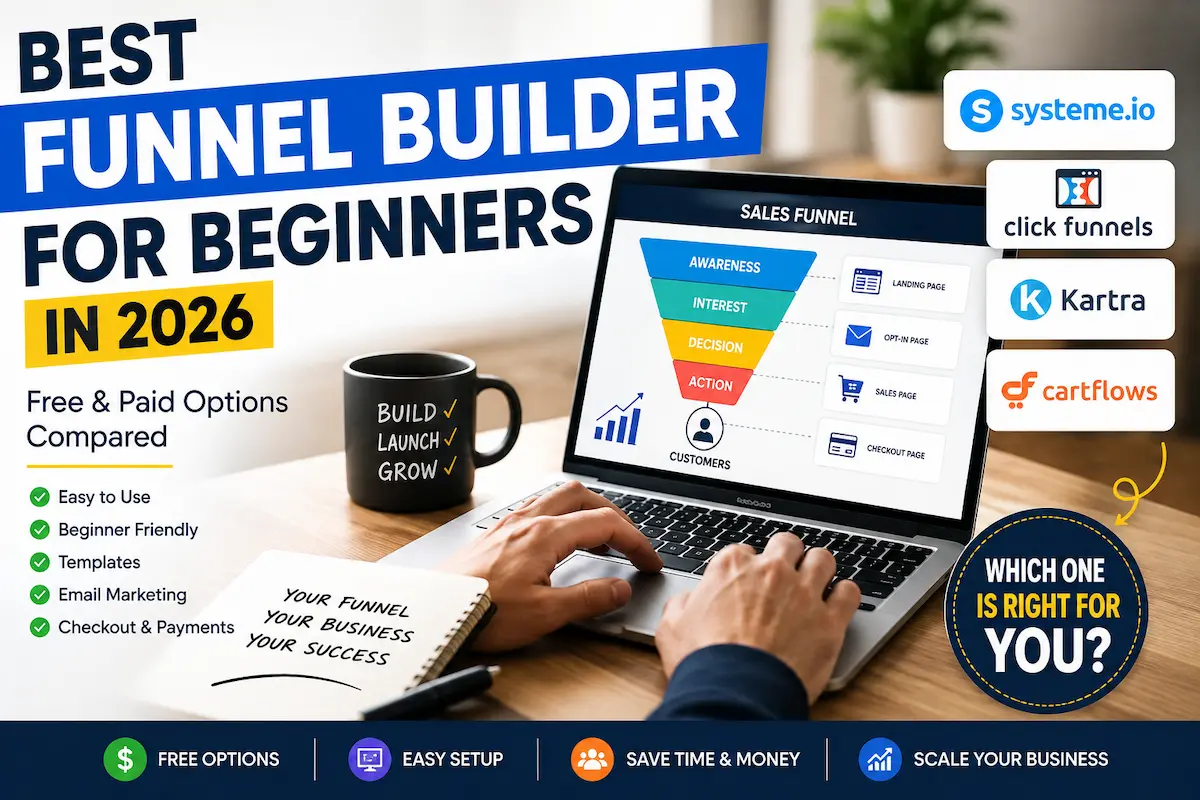
- Best Funnel Builders for Beginners Compared
- Systeme.io: Best Starting Point for Most Beginners
- ClickFunnels: Best for More Advanced Funnel Building
- Other Tools Worth Knowing About
- Pros and Cons
- Who Should Use a Dedicated Funnel Builder?
- Who Should Skip a Funnel Builder for Now?
- Frequently Asked Questions
- Final Verdict
Quick Answer
For most beginners, Systeme.io is the easiest place to start because its Free plan lets you build and test an online business without paying for a subscription upfront.
If you already have an offer, have some marketing budget, and want more advanced funnel-building capabilities, ClickFunnels is the stronger step-up option.
The important point is that you do not need the most expensive funnel builder simply because it has more features. A beginner is usually better served by starting with the platform that solves the immediate problem and upgrading only when a real limitation gets in the way.
Quick Verdict
- Best for beginners on a tight budget: Systeme.io ($0/month Free plan)
- Best free starting point: Systeme.io
- Best for more advanced funnel building: ClickFunnels
- Best for beginners who already have a validated offer: ClickFunnels
- Best overall starting strategy: Start simple and upgrade when your business actually needs more
There is no single funnel builder that is automatically best for every beginner. Your budget, business model, technical experience, and the type of funnel you want to build should determine your choice.
What Makes a Funnel Builder Beginner-Friendly?
A platform can have hundreds of features and still be a poor choice for someone building their first funnel. For a beginner, five factors matter most.
1. Can You Build a Working Funnel Without Technical Skills?
You should be able to create landing pages, connect the steps of your funnel, collect leads, and guide visitors toward an offer without needing to hire a developer.
2. Can You Start Without a Large Financial Commitment?
When you are still testing an idea, paying a large monthly subscription before you know whether the business model works can create unnecessary pressure.
3. Does the Platform Include the Basics?
A useful beginner platform should cover the core parts of a funnel, such as landing pages, lead capture, email follow-up, checkout, and basic automation.
4. Is the Learning Curve Reasonable?
More features are not automatically better. A platform that takes days to understand may slow down a beginner who simply wants to launch a first offer.
5. Can You Grow Into the Platform?
Ideally, you should not have to move immediately when your audience grows. A good starting platform should give you room to learn and expand before you need a more advanced system.
Best Funnel Builders for Beginners Compared
| Tool | Starting Price | Free Option | Core Features Included | Learning Curve |
|---|---|---|---|---|
| Systeme.io | $0 (Free), $17/mo Startup | Yes, free-forever tier | Funnels, email marketing, courses, automation | Low |
| ClickFunnels | $97/mo (Launch plan) | Free trial only | Drag-and-drop funnels, checkout, A/B testing, courses | Moderate |
| Kartra | Trial terms vary by promotion | Trial options may vary | Pages, automation, memberships, marketing tools | Moderate to high |
| CartFlows | Free version available | Yes, free WordPress plugin tier | Checkout optimization for WooCommerce stores | Low if already familiar with WordPress |
Pricing, features, and trial terms can change, so use each provider’s current website before making a purchasing decision. The comparison above focuses on the role each platform can play rather than treating one tool as the right answer for every business.
Systeme.io: Best Starting Point for Most Beginners
Systeme.io is particularly attractive if you are starting from scratch and want to keep your initial costs low.
Its Free plan is designed as a genuine starting tier rather than simply a short demonstration. It gives beginners a way to experiment with funnels, email marketing, courses, and other online-business features before committing to a paid subscription.
Systeme.io pricing (per vendor documentation):
- Free: $0/month
- Startup: $17/month
- Webinar: $47/month
- Unlimited: $97/month
The Free plan includes limits on areas such as contacts, funnels, and courses, while the paid plans increase those limits and add additional capabilities. This tiered structure is useful for beginners because you can start with the tools you actually need instead of paying for an advanced platform before you know what your business requires.
One of the biggest advantages is that funnels, email marketing, course delivery, and other core functions live under one account rather than requiring several separate services and separate monthly bills.
There are trade-offs, though. If you eventually need highly detailed page customization, sophisticated automation, or a more advanced funnel-testing environment, you may find the platform less flexible than higher-end alternatives.
Best fit: beginners, solo entrepreneurs, coaches, course creators, affiliate marketers, and small online businesses that want to validate an idea without a large software bill.
Not ideal for: businesses that already need advanced A/B testing, complex multi-step automation, or highly customized checkout flows.
If you want to understand the platform in more detail before choosing a plan, read our Systeme.io Review 2026.
If pricing is your main concern, our Systeme.io Pricing Guide 2026 breaks down the different plans and when an upgrade makes sense.
Start with Systeme.io’s free plan if you want to test the platform before committing to a paid plan.
ClickFunnels: Best for More Advanced Funnel Building
ClickFunnels is a better fit for beginners who are willing to spend more in exchange for a broader funnel-building environment.
The platform includes a drag-and-drop funnel editor, checkout tools, A/B testing capabilities, courses, email, automation, and analytics — features built specifically around selling online.
ClickFunnels pricing (per vendor documentation):
- Launch: $97/month
- Scale: $197/month
- Optimize: $297/month
Annual billing is offered at lower effective monthly rates, and ClickFunnels currently presents a free-trial option rather than a permanent free tier.
That makes ClickFunnels a very different starting proposition from Systeme.io. At $97/month for the entry-level Launch plan versus Systeme.io’s $0 Free plan, you are paying substantially more from day one. The real question is not whether ClickFunnels has more features — it does — but whether you will actually use those additional capabilities.
For someone who is still trying to figure out what to sell, a more expensive platform may not provide enough additional value to justify the cost. On the other hand, if you already have an offer and want to spend more time improving your funnel, testing pages, optimizing checkout steps, and building a more sophisticated sales process, ClickFunnels becomes more interesting.
Best fit: businesses with a validated offer, marketers who want more advanced funnel capabilities and A/B testing, and users who are comfortable paying $97+/month for a broader platform.
Not ideal for: beginners on a tight budget or anyone who hasn’t yet validated that people want their offer.
For a detailed comparison of the two platforms, see our Systeme.io vs ClickFunnels 2026 comparison.
Check ClickFunnels’ current plans and trial option if you want to explore the more advanced platform.
Other Tools Worth Knowing About
Systeme.io and ClickFunnels are not the only options available. The right choice can change depending on what you are selling and what technology you already use.
Kartra
Kartra takes a broader all-in-one approach, combining pages, automation, memberships, marketing tools, and other business features. It can make sense for someone who wants a larger marketing system, but a first-time funnel builder may not need that level of complexity. If you need a full marketing suite beyond funnels: Kartra is worth evaluating directly on its pricing page, since its trial terms and plan tiers change periodically.
CartFlows
CartFlows is different because it is built specifically around WordPress and WooCommerce, offered as a plugin rather than a standalone platform. If you already operate a WooCommerce store, it can improve checkout and sales-flow functionality without moving your store to a new system. It is not a general-purpose all-in-one platform like Systeme.io or ClickFunnels. If you already run a WooCommerce store: CartFlows is a more targeted fit than switching to a full external funnel builder.
The lesson here is simple: choose based on your existing setup. A WordPress store owner has different needs from a course creator starting an online business from scratch.
Pros and Cons
Systeme.io
Pros:
- Genuine Free-forever plan with no credit card required to start
- Paid plans starting at $17/month, well below most dedicated funnel builders
- Funnels, email marketing, and course/membership tools included in one subscription
- Lower financial risk while you are still testing an idea
Cons:
- Less granular page-design control than dedicated funnel builders
- Automation is built for common use cases, not complex enterprise workflows
- Advanced users may eventually want more specialized split-testing tools
ClickFunnels
Pros:
- Drag-and-drop funnel editor built specifically for high-converting sales sequences
- Built-in A/B testing across funnel pages
- Broader feature set for businesses actively scaling paid traffic
- Free trial available for evaluating the platform before paying
Cons:
- Entry-level plan starts at $97/month, nearly six times Systeme.io’s $17 Startup plan
- No permanent free tier
- Additional features add a steeper learning curve for a first-time user
- Cost may be hard to justify before you have a validated offer
Who Should Use a Dedicated Funnel Builder?
A dedicated funnel platform makes sense when you have a clear offer and want to control the path from visitor to lead to customer. You may benefit from one if you:
- Sell digital products or courses
- Offer coaching or consulting
- Generate leads for a service business
- Run paid advertising to a specific offer
- Want to track where potential customers leave your buying process
- Need landing pages, email follow-up, and checkout in a connected workflow
For these businesses, a funnel builder can reduce the number of separate tools you need to manage.
Who Should Skip a Funnel Builder for Now?
Not every new online business needs funnel software immediately.
If you are still asking whether people actually want your product or service, a simple website, landing page, contact form, and email list may be enough to validate the idea.
Buying a sophisticated funnel platform before you have an offer, audience, or traffic strategy can create unnecessary expense and complexity.
Start with the smallest setup that lets you test the business. Add more software when a real business requirement justifies it.
Frequently Asked Questions
What is the best funnel builder for beginners?
For many beginners, Systeme.io is the most practical starting point because it offers a Free plan and combines several online-business functions in one platform for as little as $17/month at the next tier. ClickFunnels is more appropriate when a user needs a broader funnel-building environment and is comfortable with a $97+/month subscription.
Is there a free funnel builder for beginners?
Yes. Systeme.io offers a Free plan ($0/month) that can be used to build and test an online business. Check the current contact, funnel, and course limits on that plan before deciding whether the free tier covers your specific project.
Is ClickFunnels free?
No. ClickFunnels does not offer a free-forever plan like Systeme.io. Its pricing page lists paid plans starting at $97/month, alongside a free-trial option. Trial terms and pricing can change, so check the official signup page before registering.
Is Systeme.io worth it for beginners?
Yes, particularly if your priority is keeping the setup simple and inexpensive. The platform combines funnels, email, and course tools that would otherwise require separate subscriptions, which makes it easier to learn the basics without managing multiple tools and multiple bills.
Can I use a funnel builder without a website?
Yes. Both Systeme.io and ClickFunnels let you build and host standalone landing pages and funnels without a separate website, since the platform hosts the pages for you.
What’s the practical difference between Systeme.io and ClickFunnels?
The main differences are price and depth of funnel-specific tooling. Systeme.io starts free and bundles email, courses, and funnels for beginners at low cost. ClickFunnels starts at $97/month and focuses more narrowly on advanced funnel building, split testing, and conversion optimization for users who already have an offer.
Can I build a sales funnel without coding?
Yes. Modern funnel builders are generally designed around visual editors and templates, so you can create common funnel types without writing code. You may still need technical knowledge for advanced customizations or third-party integrations.
Can I switch funnel builders later?
Yes, but switching is not always effortless. Depending on your setup, you may need to recreate pages, funnels, automations, integrations, emails, and checkout settings. That is why it is worth choosing a platform that can support your next stage of growth, not just your first week.
Do I need a funnel builder for affiliate marketing?
Not necessarily. Affiliate marketing can be done with a regular website, content strategy, email list, or other traffic sources. A funnel builder becomes more useful when you want to create dedicated lead-generation pages, email sequences, or conversion paths around a particular offer.
Final Verdict
If you are a true beginner and want to test an online business without taking on a large software bill, Systeme.io is the most sensible place to start for many users, given its $0 Free plan and $17/month entry paid tier.
Its biggest advantage is not that it has every advanced feature available. It is that you can get started with a relatively simple setup and expand when your needs become clearer.
ClickFunnels becomes more compelling once your business has moved beyond the testing stage and you want a more feature-rich funnel environment. Its $97+/month cost makes more sense when you are actually using the additional capabilities rather than simply having access to them.
So, for a beginner with no validated offer yet, the lower-risk option is the more defensible starting point. If the business gains traction and the platform becomes the limitation, that is the right time to consider moving up.
Conclusion
There is no universal winner in the beginner funnel-builder market. The best platform is the one that matches your current stage, budget, technical ability, and business model.
For most people starting from zero, the smartest approach is to avoid paying for complexity you do not yet need. Build the first funnel, learn what your audience responds to, and upgrade only when a specific limitation starts costing you time or money.
If you want to compare the two leading options in more detail, read our Systeme.io vs ClickFunnels comparison before making your decision.
Ready to Start?
If you want the lowest-risk way to test funnel building, try Systeme.io’s Free plan and see whether its tools are enough for your first project.
If you already have an offer and want to explore a more advanced funnel-building environment, check ClickFunnels’ current plans and trial option.
Whichever platform you choose, start with the business problem first and the software second. The right funnel builder should make your process easier — not become the business itself.
About the Author
T. Vasireddi is the founder and editor of ToolGrowthHQ, creating practical, research-based guides on web hosting, WordPress, SaaS tools, and digital marketing. His focus is on providing clear, accurate, and useful information to help readers make better technology and software decisions.
Connect with him:
Follow for more AI tool reviews, SaaS comparisons, and digital marketing tips.