Advertising Disclosure: This article contains affiliate links. If you purchase a paid plan through one of our affiliate links, ToolGrowthHQ may earn a commission at no additional cost to you. We only recommend a tool when it appears to fit the use case discussed, and an affiliate relationship does not determine our editorial conclusion.
How we researched this review: This comparison is based on publicly available pricing and feature documentation from Mangools’ official site, vendor specifications for the tools mentioned as alternatives, and general usage patterns reported by SEO practitioners. It was last checked for accuracy in August 2026. We evaluate SEO tools based on core feature coverage, ease of use, pricing structure, and how well a tool fits specific workflows (blogger, freelancer, small business, or agency) — not on which tool has the longest feature list.
Table of Contents
- Quick Answer
- Quick Verdict
- What Is Mangools?
- The Five Core Mangools Tools
- Mangools Pricing in 2026
- Pros and Cons
- Who Should Use Mangools?
- Who Should Avoid Mangools?
- Mangools Alternatives
- Frequently Asked Questions
- Final Verdict
Quick Answer
This Mangools review looks at how the platform handles keyword research, SERP analysis, rank tracking, backlink research, and basic website analysis.
Its biggest strength is not having the largest feature list. It is keeping the workflow relatively simple.
That matters more than it sounds. If you are a blogger, freelancer, small business owner, or a small marketing team, you may not need an enormous SEO platform with dozens of dashboards. You may simply want to find realistic keywords, check the competition, monitor rankings, and understand where competitors are getting links.
That is where Mangools makes sense.
It is less compelling if you need a full technical SEO audit platform, extensive PPC research, advanced content optimization, or the deepest possible backlink database. In those situations, a broader platform such as Semrush, Ahrefs, or SE Ranking may justify its higher cost.
The important question is therefore not “Is Mangools the best SEO tool?”
It is:
“Does Mangools cover the SEO work I actually need to do every week?”
If the answer is yes, its simpler interface can be a genuine advantage rather than a limitation.
Quick Verdict
- Best for: bloggers, freelancers, solo SEOs, and small businesses.
- Best feature: KWFinder for straightforward keyword research — search volume, keyword difficulty, trend data, CPC, and related terms in a single, uncluttered view.
- Best for rank tracking: SERPWatcher when you want a simple view of ranking movement for a defined keyword set, rather than a sprawling agency-style dashboard.
- Best for competitor backlink research: LinkMiner, for spot-checking who links to a competitor rather than mining an entire link graph.
- Toolkit structure: five tools (KWFinder, SERPChecker, SERPWatcher, LinkMiner, SiteProfiler) bundled under one subscription rather than sold separately.
- Refund window: Mangools currently advertises a 48-hour money-back guarantee — short compared with many software companies, so test early.
- Biggest limitation: it is not a complete replacement for a large technical SEO and competitive-intelligence suite.
- Best reason to choose it: you want useful SEO data without spending most of your time learning the software.
- Best reason to skip it: you need advanced site auditing, large-scale competitive research, or a much broader marketing intelligence platform.
For a small website, that distinction can save money. Buying a bigger platform is not automatically better if you only use 20% of it.
What Is Mangools?
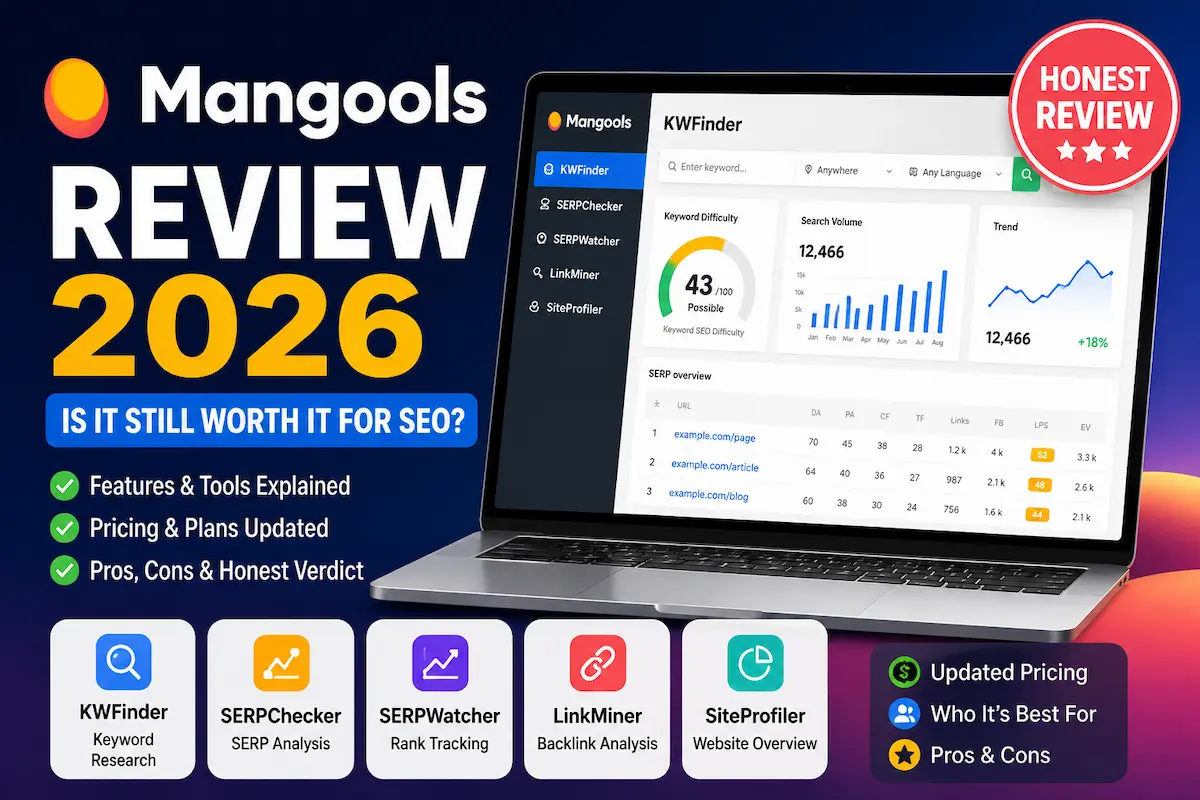
Mangools is an SEO software suite built around five core tools:
- KWFinder – keyword research and keyword discovery.
- SERPChecker – SERP and search-result analysis.
- SERPWatcher – keyword rank tracking.
- LinkMiner – backlink research.
- SiteProfiler – quick website and domain analysis.
Mangools also has additional free SEO resources and newer search-focused features, including tools aimed at AI search visibility.
The important part of its model is that the core tools are bundled together rather than forcing you to buy each one separately.
That makes the platform easier to understand from a budgeting perspective. You are not deciding whether you need one keyword tool, one rank tracker, and another backlink tool as separate subscriptions.
Instead, you get a connected SEO toolkit and then choose the subscription level based mainly on usage limits and account requirements — number of keyword lookups, tracked keywords, tracked domains, and seats.
For someone running a small website in the US or UK, that can be a much more practical setup than paying for an enterprise-level SEO platform before the site has enough traffic or revenue to justify it.
Mangools Pricing in 2026
1. KWFinder — The Main Reason to Consider Mangools
KWFinder is the tool that will probably get the most attention if you are new to Mangools.
You enter a keyword or topic and get keyword ideas along with information such as search volume, keyword difficulty, trends, CPC and related search terms — displayed in a single results screen rather than split across multiple reports.
The interface is one of Mangools’ strongest selling points. Instead of presenting an enormous amount of data immediately, it keeps the workflow relatively focused: one keyword search returns one readable table, not a dashboard of tabs.
For example, imagine you run a small accounting firm in Manchester or a local service business in Texas. You might start with a broad phrase such as “small business accounting” and then look for longer, more specific searches where the competition appears more realistic.
That type of research is where KWFinder is useful.
Another useful workflow is competitor-based keyword research. Instead of starting with a blank keyword list, you can investigate the terms associated with a competing website and look for topics that may be worth covering.
One caution: do not treat a keyword difficulty score as a promise that you will rank.
SEO difficulty metrics are proprietary estimates. Different platforms calculate them differently, and Google’s actual results depend on far more than one numerical score.
A keyword showing a low or moderate difficulty score can still be difficult if the search results are dominated by highly authoritative websites, strong brands, or pages that satisfy the search intent extremely well.
Use the number as a filter, then inspect the actual Google results.
That is a much safer workflow than blindly targeting every keyword with a low score.
Bottom line: KWFinder is particularly attractive when you want keyword research that is quick to understand rather than overloaded with data.
2. SERPChecker — Look at the Actual Search Results
SERPChecker moves the research from “What is the keyword difficulty?” to a more useful question:
“What am I actually competing against?”
You can analyse search results and review the types of pages already ranking for a query — including on-page signals for each ranking result, so you can see why a page ranks, not just that it does.
This is important because a keyword can look attractive inside an SEO tool but become much less attractive once you inspect Google.
For example, if every top result is a major publisher, established software company, government website, or long-standing industry authority, a small site may need a very strong piece of content to compete.
On the other hand, if the results contain outdated articles, thin pages, poorly matched search intent, or smaller sites with relatively weak content, the opportunity may be more interesting.
That is the kind of judgement an SEO tool should help you make rather than replace.
3. SERPWatcher — Simple Rank Tracking
SERPWatcher is Mangools’ rank-tracking tool.
It lets you monitor selected keywords and see how your rankings change over time, with a visual summary of movement (up, down, or unchanged) rather than a raw log of positions.
For a small website, that can be enough.
You do not necessarily need a complicated reporting dashboard just to answer questions such as:
- Are my target keywords moving up?
- Which pages gained visibility?
- Which keywords dropped?
- Is the SEO work I did several months ago producing movement?
SERPWatcher is particularly useful when you have a defined keyword set and want to monitor progress rather than constantly discovering new data.
If you manage a large agency operation with complex reporting requirements, you may eventually want a more advanced rank-tracking system with white-label client reports. For a smaller site, however, simplicity can be a benefit.
4. LinkMiner — Backlink Research
LinkMiner is Mangools’ backlink research tool.
The basic use case is straightforward: investigate backlinks pointing to websites or pages and identify links that may be useful for competitive research, including basic link-quality signals so you can prioritise which links are worth pursuing.
This can help answer questions such as:
- Which websites are linking to competitors?
- Which competitor pages attract the most links?
- Are there relevant industry websites worth approaching?
- What types of content appear to attract links?
The important limitation is that Mangools is not trying to be the largest backlink intelligence platform on the market.
If backlink analysis is the centre of your SEO operation, you should compare the depth and coverage of the backlink databases before choosing a subscription.
For occasional competitor research and link prospecting, however, LinkMiner can be useful without requiring a much larger SEO platform.
5. SiteProfiler — A Quick Domain Overview
SiteProfiler provides a quick overview of a website’s SEO-related information.
This is useful when you want a fast look at a domain rather than building a full competitive research report.
Think of it as a starting point for investigation.
You can use it to get a sense of a competitor’s authority, backlinks, content and other available SEO signals, then move into the more specialised Mangools tools when you need additional detail.
It is not the feature that would make me choose Mangools by itself, but it fits naturally into the rest of the toolkit.
What About Mangools’ Newer AI Search Features?
Search is changing, and Mangools has expanded beyond traditional Google-ranking workflows with AI-search-focused features and free tools.
That is worth watching if your SEO strategy increasingly includes visibility in AI-generated search experiences.
However, I would not buy Mangools solely because of an AI-search feature.
The core buying decision should still be based on the traditional SEO work you need to perform: keyword research, SERP analysis, rank tracking, backlinks and website analysis.
Mangools Pricing in 2026
Mangools currently offers its main paid subscriptions as Basic, Premium and Agency, with the core SEO tools — KWFinder, SERPChecker, SERPWatcher, LinkMiner and SiteProfiler — included across all three paid tiers. Mangools also provides a free account option with limited usage.
The exact price you see can depend on the billing option (monthly vs. annual), current promotional offers, and periodic changes to the pricing structure, so I would not rely on old pricing screenshots or third-party articles when making a purchase decision.
Use the official pricing page as the final source for the amount you will actually be charged.
(Ad) If you are comparing the plans, you can check Mangools’ current pricing and plan details before deciding.
One useful thing about Mangools’ pricing structure is that the main tools are not split into completely different product categories at each tier.
Instead, higher plans are mainly useful when your usage grows and you need higher limits, additional seats or more capacity for client work — for example, more daily keyword lookups, more tracked keywords, or more tracked domains.
That makes the decision fairly simple:
- Basic: sensible starting point for individual users and smaller projects, where keyword and tracking volume is limited by design.
- Premium: more appropriate when your keyword research and tracking workload increases or you need a small team setup.
- Agency: designed for professional SEO and agency workloads with higher usage requirements across multiple client sites.
Mangools also states that its subscriptions are automatically renewed unless you cancel them, so check the billing terms before starting a paid subscription.
The company currently advertises a 48-hour money-back guarantee. That is a short evaluation window compared with some software companies, so do not leave your testing until after the refund period.
If you are considering an annual subscription, spend some time with the free access first. The goal is not simply to see whether the interface looks good. Test whether the keyword limits, rank tracking capacity and backlink research are sufficient for your actual workflow before the 48-hour window closes.
Mangools Pros and Cons
Pros
- Easy to learn: the interface presents one focused view per tool rather than the multi-tab dashboards common in larger SEO suites, so new users are typically productive within a single session.
- Useful keyword research: KWFinder combines search volume, keyword difficulty, trend history, CPC, and related terms in one results screen — the strongest reason for many users to consider Mangools.
- Core tools are bundled: keyword research, SERP analysis, rank tracking, backlinks and site analysis sit within the same subscription and account, rather than being sold as separate add-ons.
- Good fit for smaller websites: you can avoid paying for a large collection of advanced features — deep technical crawling, PPC intelligence, enterprise reporting — that a single-site blogger or small business is unlikely to use.
- Useful free access: a free account tier lets you test the core workflow before committing to a paid plan.
- Good workflow for beginners: the five-tool structure maps directly onto common SEO tasks (find keywords, check the SERP, track rankings, check backlinks, check a domain), which keeps the learning curve manageable.
Cons
- Not a complete technical SEO suite: there is no full site-crawling and technical audit module comparable to dedicated auditing tools, so you may need another platform for deeper site health checks.
- Less suitable for enterprise SEO: large organisations coordinating many stakeholders typically need more advanced, customisable reporting than Mangools currently offers.
- Backlink depth matters: serious link researchers should compare LinkMiner’s index size and refresh rate against specialist backlink competitors before relying on it as a primary link-research tool.
- Keyword difficulty is only an estimate: like every SEO platform’s difficulty score, it is a proprietary calculation, not a guarantee of ranking difficulty.
- Usage limits still matter: high-volume agencies should compare keyword lookup limits, tracked-keyword caps, and tracked-domain limits carefully before choosing a plan.
- 48-hour refund period: the money-back window is short relative to many competitors, so evaluate quickly.
Who Should Use Mangools?
Mangools makes the most sense for people who want useful SEO data without turning SEO software itself into a full-time job.
Solo bloggers
Best for: bloggers whose weekly SEO routine is mostly keyword research, SERP checking and rank tracking.
If you are building a content website and your weekly SEO routine is mostly keyword research, SERP checking and rank tracking, Mangools covers the fundamentals without unnecessary complexity.
That can be particularly useful when your budget is going toward content, hosting, design and other parts of the business rather than an expensive SEO platform.
Freelance SEOs
Best for: freelancers managing a handful of client accounts who need usable data quickly, not a client-reporting suite.
Freelancers can benefit from the balance between usability and research depth.
You can perform keyword research, investigate competitors, monitor rankings and research backlinks without having to build your workflow around a huge enterprise dashboard.
Small businesses
Best for: local or regional businesses focused on a manageable set of search terms rather than large-scale ecommerce SEO.
A local business does not necessarily need the same SEO software stack as a national ecommerce brand.
If your goal is to identify useful search terms, understand local competitors and track a manageable keyword set, Mangools may be enough.
Small marketing teams
Best for: teams of two to five people who need shared access without agency-level reporting overhead.
If several people are involved in content and SEO, the higher Mangools plans can make more sense because usage and account requirements become more important.
Before upgrading, however, calculate how many keywords, domains and searches your team actually needs. Paying for unused capacity is still wasted money.
Who Should Avoid Mangools?
Not ideal for: teams whose SEO work centres on deep technical audits, large-scale PPC research, or enterprise reporting.
Mangools is not designed to replace every SEO and digital-marketing platform.
You should look elsewhere if your workflow depends heavily on:
- deep technical site crawling and auditing;
- large-scale PPC research;
- advanced content optimisation workflows;
- very large competitor databases;
- enterprise-level reporting and SEO operations;
- extensive backlink intelligence across a large portfolio of websites.
That does not mean Mangools is a weak product.
It means you should buy software according to the work you actually need to perform.
A small business paying for a massive SEO suite and using only keyword research may be getting less value than a smaller Mangools subscription used consistently.
Mangools Alternatives
Mangools is easiest to judge when you compare it with alternatives based on specific needs rather than simply asking which brand has the longest feature list.
SE Ranking — broader SEO workflow
If you need a broader all-in-one SEO suite: SE Ranking is worth considering. It goes beyond Mangools’ simpler workflow and includes additional tools such as site auditing and other SEO management capabilities.
(Ad) If you want to compare that option directly, you can explore SE Ranking here.
The trade-off is that broader functionality can also mean more settings, more dashboards and a steeper learning curve.
Ahrefs — deeper backlink and competitive research
If backlink intelligence is your priority: Ahrefs is a stronger candidate when backlink intelligence and large-scale competitor research are central to your SEO strategy.
The downside is that you are moving into a more advanced and typically more expensive SEO environment.
If you are only publishing a small number of articles each month, that additional depth may not justify the cost.
Semrush — broader digital marketing intelligence
If you need SEO plus advertising and content research in one platform: Semrush is better suited to users who want SEO alongside broader competitive, advertising, content and marketing research capabilities.
It is a powerful option, but power comes with complexity. If your primary task is simply finding realistic keywords and monitoring rankings, Mangools may feel more focused.
How Mangools Fits With Your Existing SEO Stack
You do not always have to replace one platform with another.
For example, a business might use Mangools for keyword research and rank tracking while using another specialist tool for technical auditing.
That approach can be perfectly reasonable if the combined cost remains lower than paying for a large all-in-one platform whose advanced features are rarely used.
If you are also comparing broader marketing platforms, our Best Marketing Automation Software in 2026 comparison can help separate SEO tools from CRM and marketing-automation platforms.
Likewise, if your main requirement is broader all-in-one marketing rather than SEO research, see our Best All-in-One Marketing Platform in 2026 comparison.
How I Would Use Mangools for a New Website
If I were building a new content website, I would not start by collecting hundreds of keywords.
I would start with a smaller group of topics that clearly match the audience and business model.
A practical workflow would look like this:
- Start with the business topic. Identify what the website genuinely wants to be known for.
- Use KWFinder for discovery. Look for related searches and longer, more specific phrases.
- Check the SERP manually. Do not rely on keyword difficulty alone.
- Use SERPChecker for deeper comparison. Look at the pages already ranking.
- Create content around search intent. Do not simply repeat the keyword.
- Add the finished pages to SERPWatcher. Track a manageable set of important keywords.
- Use LinkMiner for competitor research. Look for realistic link opportunities rather than chasing every backlink.
- Review the results periodically. Update content when the search results, competitors or user intent change.
The important part is that the SEO tool supports the process. It should not become the process.
Is Mangools Good for US and UK SEO?
Yes, provided you use its location-specific data appropriately.
Search behaviour can differ significantly between the United States and the United Kingdom.
Spelling is an obvious example:
- “optimization” vs. “optimisation”
- “analyze” vs. “analyse”
- “apartment” vs. “flat”
But the differences go beyond spelling. Search intent, local competitors, commercial terminology and regional brands can also change.
If your website targets both markets, do not assume that a keyword performing well in the US will behave identically in the UK.
Use the appropriate location when researching keywords and reviewing SERPs, then create content that sounds natural to the audience rather than forcing American or British wording into every sentence.
For a UK audience, natural UK English matters. For a US audience, natural US English matters. SEO should support that communication rather than making the writing sound robotic.
Frequently Asked Questions
Is Mangools worth it in 2026?
Mangools can be worth it if your main SEO requirements are keyword research, SERP analysis, rank tracking, backlink research and basic website analysis.
If you need a complete enterprise SEO and marketing intelligence platform, you should compare it with broader alternatives before subscribing.
Is Mangools good for beginners?
Yes. Ease of use is one of Mangools’ strongest advantages.
A beginner can generally understand the purpose of the five core tools without first learning an enormous collection of SEO terminology and dashboards.
Is KWFinder included with Mangools?
Yes. KWFinder is part of the Mangools toolkit rather than a completely separate product that has to be purchased independently.
Mangools states that its core tools are included across its subscription plans.
Does Mangools have a free plan?
Yes. Mangools provides a free account option with limited usage. The company also offers higher-access trial/free options depending on the current account and product setup.
Because these limits can change, check the current Mangools site before relying on a specific number of searches or tracked keywords.
Does Mangools have a site audit tool?
Mangools is not positioned as a full technical site-audit platform. Its core toolkit focuses on keyword research, SERP analysis, rank tracking, backlink research and website analysis.
If technical crawling and detailed site auditing are essential to your workflow, consider pairing Mangools with another tool or choosing a broader SEO platform.
Can Mangools replace Ahrefs or Semrush?
For some users, yes. For every use case, no.
Mangools can cover a lot of the everyday work involved in keyword research, SERP analysis, rank tracking and basic backlink research.
Ahrefs and Semrush become more attractive when you need broader competitive research, larger datasets, technical SEO capabilities or additional marketing intelligence.
Is Mangools better than Semrush?
Neither is universally better.
Mangools is more appealing when simplicity and focused SEO workflows are priorities. Semrush is more appealing when you want a broader marketing and competitive-intelligence platform.
The right choice depends on how much of each platform you will actually use.
Is Mangools better than Ahrefs?
Again, it depends on the job.
Mangools is easier to approach and can be a better fit for smaller SEO workflows. Ahrefs is a stronger candidate for users who need extensive backlink and competitive research.
Can I use Mangools without prior SEO experience?
Yes. Because each of the five tools maps to a single, clearly labelled task — find keywords, check a SERP, track rankings, check backlinks, profile a site — new users can generally start getting useful output on their first session, without first learning the terminology larger suites assume you already know.
Does Mangools offer a money-back guarantee?
Yes. Mangools currently states that it offers a 48-hour money-back guarantee for eligible payments, subject to its stated conditions.
Because the refund policy is time-sensitive, check the current terms before purchasing.
Where can I check the current Mangools pricing?
(Ad) You can check the current Mangools pricing and plans directly before subscribing.
Final Verdict
Mangools is not trying to win by having every SEO feature imaginable.
Its appeal is much simpler: give users the core SEO research tools they are likely to use and make those tools relatively easy to understand.
For a blogger researching topics, a freelancer managing client campaigns, or a small business trying to build organic traffic, that can be exactly the right approach.
KWFinder is the standout feature for keyword research, while SERPChecker, SERPWatcher, LinkMiner and SiteProfiler make the overall workflow more complete.
The main reason not to choose Mangools is also straightforward. If you need deep technical auditing, extensive backlink intelligence, large-scale competitive research or a broader digital-marketing platform, you may outgrow it.
So, is Mangools worth it?
For focused SEO work, yes.
For enterprise-level SEO intelligence, probably not.
The smartest approach is to start with your actual workflow rather than the software’s feature list. If you mainly need keyword research, SERP analysis and rank tracking, Mangools has a strong case. If you need ten different marketing disciplines inside one dashboard, a larger platform may be a better long-term investment.
(Ad) If you want to test whether the workflow fits your own website before committing, try KWFinder through Mangools and evaluate it using your own target keywords, locations and competitors.
The best SEO tool is not necessarily the one with the most features. It is the one you can afford, understand and actually use consistently.
About the Author
T. Vasireddi is the founder and editor of ToolGrowthHQ, creating practical, research-based guides on web hosting, WordPress, SaaS tools, and digital marketing.
His focus is on providing clear, accurate, and useful information to help readers make better technology and software decisions.
Connect with him:
Follow for more AI tool reviews, SaaS comparisons, and digital marketing tips.