Affiliate Disclosure: This post contains affiliate links. If you purchase or sign up through one of these links, we may earn a commission at no extra cost to you. Our recommendations are based on the features, pricing, use cases, and limitations discussed in this article. Affiliate relationships do not determine our editorial conclusions.
Methodology note: This comparison is based on publicly available pricing and feature documentation, vendor specification pages, and verified user reviews, updated as of August 2026. We evaluate each platform on its core feature set, published pricing, integration options, and independently reported user feedback to help you make an informed decision. Pricing and features can change, so treat the figures below as current published information rather than permanent prices — always confirm on the provider’s live pricing page before purchasing.
The best competitor analysis tools can help you understand which keywords competitors rank for, where their traffic comes from, how they approach paid search, and how their social channels perform. The challenge is choosing a tool that gives you useful data without paying for features you do not need.
That is why there is no single competitor analysis platform that is automatically right for every business. The better approach is to start with the question you need answered: Which keywords are competitors winning? How much traffic might they receive? What are they doing with paid search? Which technologies are they using? Or how are their social channels performing?
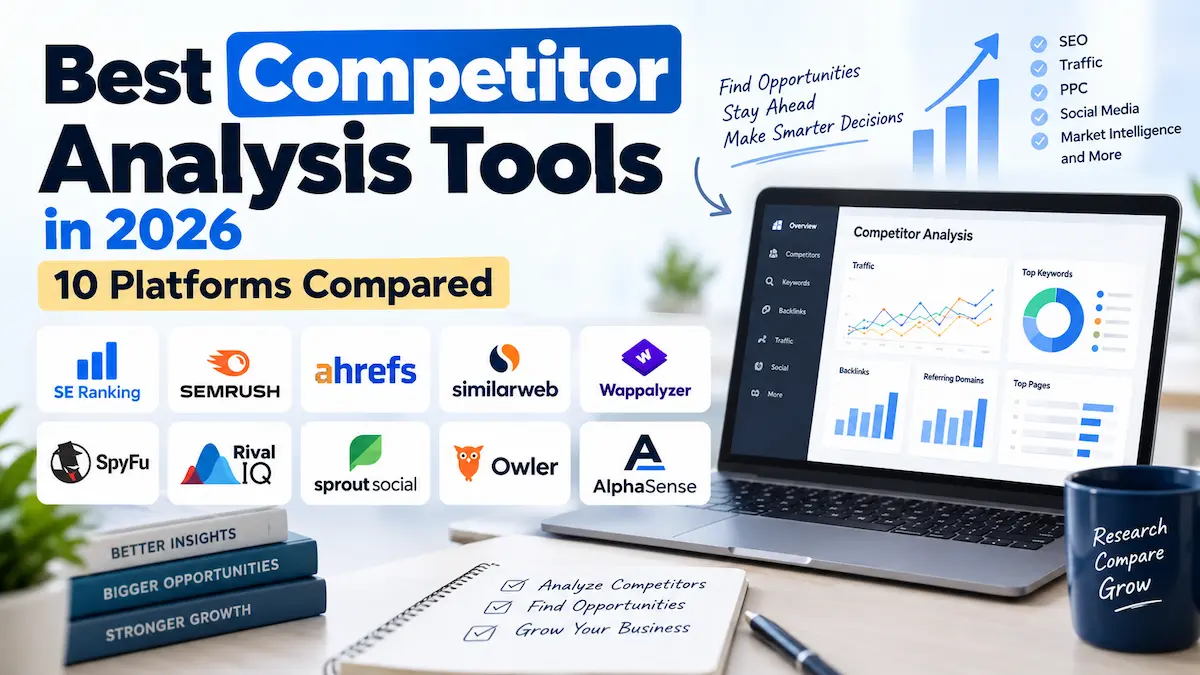
This guide compares 10 established platforms by their primary strengths rather than pretending they all solve exactly the same problem.
Quick Answer
If your main concern is SEO and visibility in AI-powered search, SE Ranking is a strong starting point. Semrush is better suited to businesses that want a broader digital-visibility toolkit. Ahrefs is particularly useful for backlink and organic-search research, while Similarweb is designed around traffic, audience, and market intelligence.
For more specialised research, SpyFu focuses heavily on competitive search advertising data, Rival IQ on social benchmarking, Wappalyzer on website technologies, and AlphaSense on enterprise market intelligence.
Quick Verdict
- Best for SEO + AI search visibility: SE Ranking
- Best broad digital-visibility platform: Semrush
- Best for backlink and organic-search research: Ahrefs
- Best for traffic and market intelligence: Similarweb
- Best for technology-stack research: Wappalyzer
- Best for paid-search competitor research: SpyFu
- Best for social media benchmarking: Rival IQ
- Best for social listening and engagement management: Sprout Social
- Best for company and sales intelligence: Owler
- Best for enterprise market intelligence: AlphaSense
What to Look For in a Competitor Analysis Tool
Before paying for a competitor-analysis platform, decide what kind of information you actually need. A large feature list is not necessarily an advantage if most of those features will never be used.
- Relevant data: Choose a platform that measures the channel where your competitors actually compete.
- Data freshness: Competitor information becomes less useful when it is too old to support a current decision.
- Competitive comparisons: Look for tools that let you compare several competitors rather than researching each one separately.
- Historical information: Historical rankings, advertising data, traffic trends, or social performance can reveal changes that a single snapshot misses.
- Exports and integrations: If you regularly report to clients or your team, CSV exports, APIs, or other integrations can save considerable manual work.
- AI-search coverage: If organic discovery is changing in your market, consider whether the platform can measure visibility in AI-generated search results as well as traditional search.
Comparison Table
| Tool | Best For | Current Pricing Information | Key Strength |
|---|---|---|---|
| SE Ranking | SEO + AI search visibility | Core from $103.20/month billed annually | SEO, competitor research and GEO/AI-search tracking |
| Semrush | Broad digital visibility | AI Visibility from $99/month; SEO Toolkit from $139.95/month | SEO, competitive research, traffic and AI visibility |
| Ahrefs | Backlinks + organic search | Free account; Starter from $29/month | Site Explorer and backlink research |
| Similarweb | Traffic and market intelligence | Starter from $199/month or $1,500/year | Traffic, audience and channel analysis |
| Wappalyzer | Technology-stack research | Free account; paid plans from $250/month | Technology detection and website alerts |
| SpyFu | Paid-search research | From $39/month on the monthly plan | Competitive PPC and historical search data |
| Rival IQ | Social benchmarking | From $239/month on the monthly plan | Competitive social metrics and benchmarking |
| Sprout Social | Social management and listening | From $199/seat/month with annual billing | Social monitoring, competitor insights and engagement tools |
| Owler | Company and sales intelligence | Paid subscription pricing varies | Company news, insights and account intelligence |
| AlphaSense | Enterprise market intelligence | Custom pricing | Research across company documents, transcripts and other intelligence sources |
Prices are based on publicly available information from the providers and may change. Check the provider’s current pricing page before purchasing.
The Best Competitor Analysis Tools, Reviewed
1. SE Ranking — Best for SEO + AI Search Visibility
SE Ranking is one of the more interesting choices in 2026 because it combines traditional SEO competitor research with visibility tracking across newer AI-search environments.
Its current platform covers rank tracking, keyword and competitor research, backlink research, website auditing and other SEO workflows. Its GEO capabilities also extend competitor research into AI-search visibility, with tracking across multiple AI sources.
What you actually get on the Core plan ($103.20/month billed annually):
- 10 projects and 2,000 tracked keywords
- 100 daily AI-search prompts tracked
- API credits and MCP access included
- 14-day free trial, no credit card required
For a website owner, the practical advantage is having conventional SEO research and newer AI-search visibility work in the same platform instead of immediately buying several separate subscriptions.
Best for: SEO teams, agencies, bloggers and businesses that want competitor keyword research together with traditional search and AI-search visibility tracking.
Not ideal for: Businesses whose main competitive question is social performance, financial intelligence or detailed website-technology research.
If you want to examine the platform yourself, you can check SE Ranking’s current plans and start a free trial.
2. Semrush — Best Broad Digital-Visibility Platform
Semrush is useful when competitor research extends beyond one SEO question. Its current competitive-research tools include Organic Rankings, Keyword Gap, Backlink Gap, Traffic Analytics and market-level research.
Semrush also now separates AI visibility into its own toolkit. The current AI Visibility offering starts at $99 per month and includes AI competitor analysis, prompt research and tracking across services including ChatGPT, Google AI, Gemini and Perplexity.
The SEO Toolkit is separately listed from $139.95 per month. That means the old idea that Semrush simply has one universal “starting price” is misleading; the cost depends on the toolkit and combination of capabilities you actually need.
Best for: Agencies, marketing teams and businesses that need SEO, competitive research, traffic intelligence and related digital-marketing capabilities in one ecosystem.
Not ideal for: Small sites that only need occasional keyword or backlink research and do not need a broad subscription.
Semrush also has a useful advantage for competitive research because different reports answer different questions. Keyword Gap can identify search terms competitors rank for that you do not, while Traffic Analytics and Market Explorer address broader traffic and market questions.
3. Ahrefs — Best for Backlink and Organic-Search Research
Ahrefs remains a strong option when your competitor research is centred on organic search and backlinks.
Its Site Explorer can show organic keywords, top pages and backlink information for websites. The platform also includes tools for keyword research, site auditing and rank tracking.
One important correction to older buying guides is Ahrefs’ current free offering. Ahrefs Free is not simply an unrestricted competitor-research account — it provides limited access primarily for verified websites, including Site Explorer and Site Audit. The current Starter plan is listed at $29 per month.
That makes Ahrefs particularly useful if you want to understand why a competitor’s pages attract links, which pages perform well organically, or which search opportunities deserve closer investigation.
Best for: SEO professionals, content teams and link-building specialists who place a high value on organic-search and backlink data.
Not ideal for: Teams primarily interested in social media, company intelligence or technology-stack monitoring.
If you’re comparing SEO platforms, our SE Ranking vs Ahrefs comparison may also be useful.
4. Similarweb — Best for Traffic and Market Intelligence
Similarweb approaches competitor research from a different direction. Instead of concentrating mainly on individual keywords and backlinks, it helps you investigate estimated website traffic, traffic sources, audience characteristics and market-level trends.
This is useful when your question is something like: Where does this competitor appear to get its traffic from? or How important is organic search compared with paid, referral, social or direct traffic?
Similarweb’s published Web Intelligence pricing lists a Starter option from $199 per month or $1,500 per year. Higher tiers provide additional users, historical data and other capabilities.
Remember that competitor traffic figures are estimates rather than the competitor’s private analytics account. They are most useful for directional comparisons and market research, not as a substitute for your own first-party analytics.
Best for: Marketers, researchers and businesses that need traffic and market-level competitive intelligence.
Not ideal for: A small website that only needs basic keyword research and rank tracking.
5. Wappalyzer — Best for Technology-Stack Research
Sometimes the most useful competitor question is not about traffic or rankings at all. It is simply: What technology is this company using?
Wappalyzer identifies technologies that can be detected from public website signals, including technologies associated with content management, analytics and ecommerce. Its website-alert functionality can also notify users when the detected technology stack of a monitored website changes.
Free plan: 50 technology lookups per month and 5 website alerts
Pro plan: From $250/month
For example, a SaaS or hosting company could use technology research to identify businesses using particular platforms. That information can then become part of a broader prospecting or competitive-research workflow.
Best for: SaaS companies, agencies, sales teams and marketers who need technographic information.
Not ideal for: Anyone looking for a complete SEO or social-media analytics platform.
6. SpyFu — Best for Paid-Search Competitor Research
SpyFu is focused heavily on search marketing. Its competitive research capabilities include domain and keyword comparisons, competitor data, advertising history and PPC-related research.
The current monthly Basic plan is listed at $39 per month. SpyFu also advertises annual billing options, but the exact effective annual price can vary across its current pricing presentation, so it is safer to check the live pricing page before making a purchase.
One of the useful aspects of SpyFu is historical advertising information. If you are researching paid-search competitors, historical data can provide more context than looking only at what a competitor appears to be doing today.
Best for: Google Ads users and marketers who want competitive PPC and search-ad research.
Not ideal for: Businesses that have no paid-search strategy and mainly need social or broader market intelligence.
7. Rival IQ — Best for Social Media Benchmarking
Rival IQ is designed specifically for competitive social-media analysis. It supports benchmarking across major social networks and provides comparisons involving engagement, posting activity and audience growth.
Its competitive-analysis tools also include boosted-post detection. The feature uses machine learning to identify Facebook posts that are likely receiving paid promotion, which can help prevent a business from comparing organic performance directly against a competitor’s paid activity.
Current pricing starts at $239 per month for the Drive plan on monthly billing. Annual billing offers a stated 15% saving.
Best for: Social-media managers, agencies and brands that regularly benchmark several competitors.
Not ideal for: Businesses whose competitive research is mainly about SEO, PPC or website traffic.
8. Sprout Social — Best for Social Management and Listening
Sprout Social covers a broader social workflow than a pure benchmarking tool. Its platform combines social publishing, engagement, monitoring and competitive insights, with higher plans adding deeper competitor and paid insights.
Standard: $199/seat/month (annual billing)
Professional: $299/seat/month
Advanced: $399/seat/month
Sprout Social also provides sentiment-related capabilities. This makes it more suitable when the question goes beyond How many interactions did competitors receive? and becomes What are people saying about brands and how is that perception changing?
Best for: Social teams that need both day-to-day social management and deeper monitoring.
Not ideal for: Solo website owners who only need occasional competitor research.
9. Owler — Best for Company and Sales Intelligence
Owler is different from SEO and social platforms because its focus is company intelligence rather than website performance.
Owler’s current product offering includes company news and business intelligence, while Owler Max is aimed more directly at sales teams and account research. The company also offers integrations with platforms such as Salesforce, HubSpot and Slack through Owler Max.
Because current public pricing was not sufficiently clear from the official information reviewed, this article does not state a specific monthly figure — check Owler’s site directly for current subscription pricing.
Best for: Sales and business-development teams that need company-level information and account intelligence.
Not ideal for: SEO specialists who primarily need keyword, backlink or ranking data.
10. AlphaSense — Best for Enterprise Market Intelligence
AlphaSense belongs in a different part of the competitor-intelligence market. It is built for organisations that need to research information across company documents, expert transcripts, news, regulatory information and other professional research sources.
Its current offering includes Market Intelligence and Enterprise Intelligence products, with enterprise customers using the platform for functions such as competitive intelligence, market intelligence, corporate strategy and investment research.
AlphaSense uses custom pricing rather than publishing a simple consumer-style monthly plan, so it is not an obvious choice for a small business or individual blogger.
Best for: Larger organisations with formal competitive-intelligence, strategy, research or investment workflows.
Not ideal for: Bloggers, small businesses and marketing teams that simply want SEO or social competitor data.
Sales Enablement Platforms: A Different Type of Competitor Intelligence
There is another category worth knowing about: sales-enablement and competitive-intelligence platforms such as Crayon and Klue.
These products are not primarily designed to tell you how much traffic a competitor receives or which keywords they rank for. Instead, they are aimed at turning competitive information into material that sales teams can use during deals, such as battlecards, positioning information and competitor talking points.
That distinction matters. If your problem is “Which competitor has the strongest organic visibility?”, an SEO platform makes more sense. If the problem is “What should our sales team say when a prospect compares us with a competitor?”, a sales-enablement platform may be the more relevant category.
How to Choose the Right Tool
Rather than buying the platform with the longest feature list, start with one specific competitive question.
- Need keyword and SEO competitor research? Start with SE Ranking, Semrush or Ahrefs.
- Need AI-search visibility? Look closely at SE Ranking or Semrush’s AI Visibility capabilities.
- Need backlink research? Ahrefs is a natural option.
- Need estimated traffic and market trends? Consider Similarweb.
- Need competitor PPC research? SpyFu is more specialised for that job.
- Need social benchmarking? Rival IQ is built specifically around competitive social analytics.
- Need social management plus listening? Sprout Social covers a wider social workflow.
- Need to identify website technologies? Wappalyzer is the specialist choice.
- Need company-level intelligence? Owler may be more appropriate.
- Need enterprise research across professional information sources? AlphaSense is aimed at that use case.
Who Should Use Competitor Analysis Tools?
These platforms are most useful when you already have a defined competitive set and a decision you need to make.
For example, a content team might compare five competitors to find organic topics they have not covered well. A PPC manager might investigate competitors’ paid-search activity before restructuring campaigns. A social-media team might compare posting frequency and engagement across several brands.
Best for: E-commerce owners, content and SEO teams, marketing agencies, PPC managers, and sales teams that already have a shortlist of competitors and a specific question they need answered.
Not ideal for: Businesses that haven’t yet identified who their real competitors are, or that don’t have a defined research process to act on the data.
The important part is what happens after the research. Competitor data is useful only when it leads to a better decision, such as changing a content plan, identifying a market opportunity, improving positioning or allocating marketing resources differently.
Who Should Avoid Paying for These Tools?
If you are still trying to identify your first competitors, a large subscription may be unnecessary.
The same is true if you do not yet have a specific research process. Paying for a sophisticated dashboard does not automatically create a competitive strategy.
Start with a free account or trial where one is available, define three to five competitors, and write down the questions you want the tool to answer. If the data does not change any decisions after a reasonable trial period, you probably do not need the subscription yet.
Alternatives to Consider
- If you need a budget SEO option: Ahrefs Starter at $29/month is the cheapest paid entry point in this list, alongside its free tier for verified sites.
- If you need AI-search tracking without a full SEO suite: Semrush’s standalone AI Visibility toolkit from $99/month may cost less than bundling it with the full SEO Toolkit.
- If social benchmarking is your main need but budget is tight: Compare Rival IQ against Sprout Social’s Standard tier before committing, since the two price differently per seat versus per account.
- If you only need technology detection occasionally: Wappalyzer’s free plan (50 lookups/month) may be enough before paying $250/month for Pro.
Frequently Asked Questions
What is the best free competitor analysis tool?
There is no single best free option because the free tools cover different types of research. Ahrefs offers a free account with limited access for verified websites, while Wappalyzer offers a free account with limited technology lookups and website alerts. SpyFu also provides a free account with limited search results. The right choice depends on whether you need SEO, technology or paid-search information.
Can I use ChatGPT for competitor analysis?
AI assistants can help organise and analyse information that you provide or that is available through connected tools, but an AI assistant by itself should not be treated as a substitute for dedicated live competitor datasets. For current rankings, traffic estimates, backlink data, advertising information or AI-search visibility, use a platform that actually provides that data and then use AI to help interpret the results.
Do I need separate tools for SEO and social competitor analysis?
Not necessarily, but specialised tools generally go deeper in their own channels. Semrush covers a broad range of digital-visibility research, while platforms such as Rival IQ and Sprout Social are specifically built around social data. If social performance is a major part of your strategy, a dedicated social platform may provide more useful detail than trying to force an SEO tool to do the same job.
Which tools track competitors in AI search?
SE Ranking currently includes GEO capabilities for tracking visibility across AI sources, while Semrush offers an AI Visibility toolkit with competitor analysis and prompt research. The exact platforms, prompts, limits and reporting capabilities can change, so check the current provider documentation before purchasing.
Are competitor traffic numbers exact?
No. Competitor traffic figures supplied by third-party platforms are estimates. They can be useful for directional comparisons and market research, but they should not be presented as a competitor’s private first-party analytics.
Should a small business buy an expensive competitor-analysis platform?
Usually not at the beginning. Start with the smallest tool or free access that answers the question you actually have. Upgrade when the additional data saves enough time or improves enough decisions to justify the cost.
Is SE Ranking or Semrush better for a small business just starting out?
For a small business primarily focused on SEO and AI-search visibility, SE Ranking’s Core plan ($103.20/month annually) bundles more of the needed features into one tier. Semrush can work out cheaper for a narrow need (like just AI Visibility at $99/month) but adds up quickly if you need the full SEO Toolkit on top.
Final Verdict
The best competitor analysis tool depends on what you are trying to learn.
SE Ranking is a particularly interesting choice if SEO and AI-search visibility are both priorities. Semrush makes more sense when you want a broader digital-marketing research platform. Ahrefs is a strong choice for backlink and organic-search analysis, while Similarweb is better suited to traffic and market intelligence.
For specialised work, SpyFu focuses on paid-search research, Rival IQ on social benchmarking, Sprout Social on social management and listening, and Wappalyzer on technology-stack intelligence. Owler and AlphaSense serve more company- and enterprise-oriented research needs.
The most sensible way to choose is simple: define the competitive question first, choose the tool that answers it, and only pay for additional capabilities when you actually need them.
Conclusion
Competitor analysis becomes much more useful when you stop treating it as a search for one “best” platform.
SEO competitors, paid-search competitors, social competitors and market competitors can require very different datasets. Once you know which information matters to your business, the shortlist becomes much easier to build.
Start with one clear question, compare a small group of competitors, and use the resulting information to make a real marketing or business decision. That is where competitor analysis becomes useful rather than just another dashboard to check.
About the Author
T. Vasireddi is the founder and editor of ToolGrowthHQ, creating practical, research-based guides on web hosting, WordPress, SaaS tools, and digital marketing.
His focus is on providing clear, accurate, and useful information to help readers make better technology and software decisions.
Connect with him:
Follow for more AI tool reviews, SaaS comparisons, and digital marketing tips.