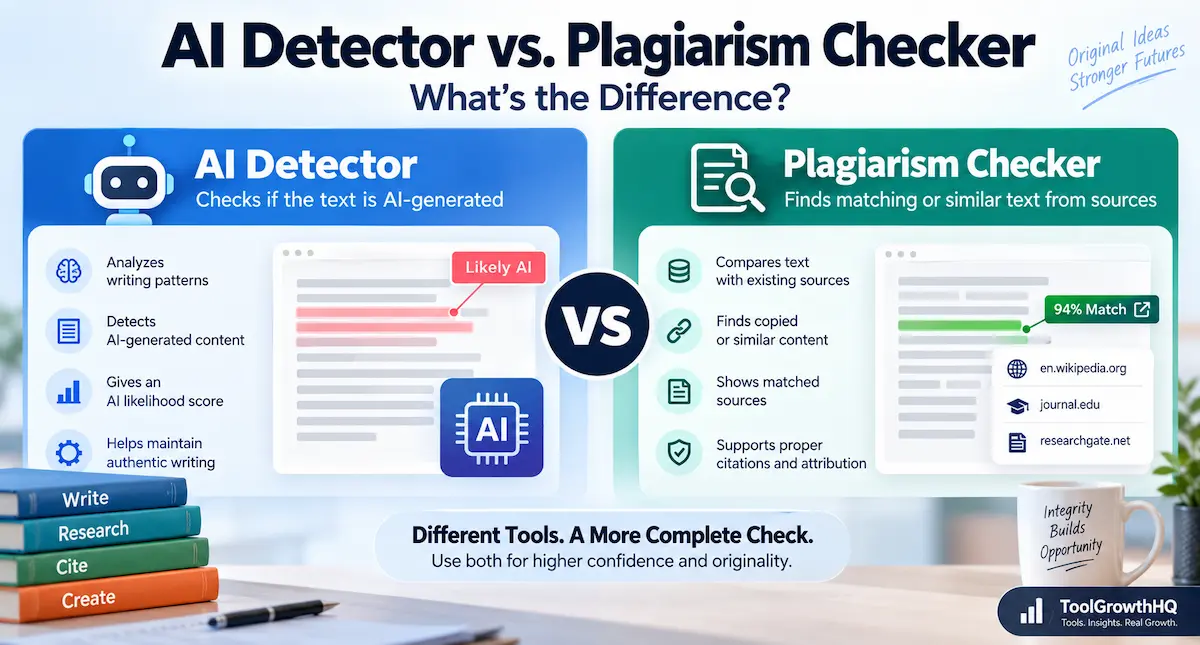
AI detector vs plagiarism checker is an important distinction for anyone reviewing content for originality, AI-generated writing, or source similarity. A plagiarism checker looks for text that matches or closely resembles material in the sources available to it. An AI detector estimates whether writing contains characteristics associated with AI-generated text.
That distinction matters for teachers, students, publishers, researchers, and content teams. A document can show little source overlap and still receive an AI-detection signal. Likewise, human-written work can contain matching material and produce a similarity result.
Some platforms offer both checks in the same product, but that does not make the two technologies interchangeable. The useful question is not simply which score is higher. It is what the report actually measures and what evidence it provides for the decision you need to make.
How we evaluated this comparison: This guide is based on publicly available product documentation, vendor pricing pages, and each platform’s own published guidance on how its detection systems work, cross-checked as of August 2026. Where a vendor’s pricing or feature set is likely to change, we’ve linked to the source page and to our dedicated pricing and review guides so you can confirm current numbers before you buy. We focus on what each tool measures, what it doesn’t, and where its own documentation flags limitations — because that’s the information that actually helps you make a decision, not a generic score.
AI Detector vs Plagiarism Checker: Quick Comparison
| Feature | AI Detector | Plagiarism Checker |
|---|---|---|
| Main purpose | Estimate whether writing resembles AI-generated content | Identify matching or similar text in available sources |
| Primary question | Does this writing resemble AI-generated text? | Does this text match or resemble material found elsewhere? |
| Typical result | AI-writing indicator or probability-style assessment | Similarity score with matched sources |
| Requires a source match? | No | Yes, for a source match to be reported |
| Can new AI-generated text produce a low similarity result? | Potentially | Yes |
| Can human writing receive a similarity result? | Not what the tool is designed to measure | Yes, if matching material is found |
| Main limitation | Detection is probabilistic and can produce incorrect classifications | Results depend on the sources and databases available to the checker |
| Access model | Usually a self-serve subscription with a per-scan or credit-based cost | Sold either as self-serve subscriptions or as institutional licenses to schools and publishers |
| Best use | Investigating possible AI-generated or AI-assisted writing | Investigating source overlap, quotations, paraphrasing, and attribution |
What Is a Plagiarism Checker?
A plagiarism or similarity checker compares submitted text against a collection of existing material and identifies passages that match or closely resemble those sources.
Depending on the service, its comparison sources may include web content, academic publications, previously submitted documents, journals, or other indexed material.
For example, Turnitin’s Similarity Report highlights matching text and provides information about the sources involved. Turnitin explicitly explains that a similarity result does not by itself determine whether plagiarism has occurred. The reviewer still has to examine the matches and their context.
That makes plagiarism checking primarily a source-matching process.
What does a plagiarism checker look for?
- Directly copied passages
- Closely matching wording
- Potentially unattributed quotations
- Similar passages from published sources
- Potentially problematic paraphrasing
- Material matching previously submitted work, where that material is available to the checker
A similarity report should therefore be investigated at the source level rather than treated as a simple pass-or-fail result.
Understanding the difference between an AI detector and a plagiarism checker helps you choose the right type of content check.
What Is an AI Detector?
An AI detector attempts to estimate whether text resembles writing produced by an AI system.
Unlike a plagiarism checker, an AI detector does not have to find the same paragraph in a website or document database. It can evaluate characteristics of the submitted writing and produce an AI-writing assessment.
Different providers use different detection systems, so an AI score from one service should not automatically be treated as equivalent to a score from another.
There is also an important limitation: AI detection is not perfect. Turnitin’s current guidance states that its AI writing detection can misidentify human-written, AI-generated, and AI-paraphrased text. It therefore recommends additional scrutiny and human judgment rather than using the AI report as the sole basis for adverse action against a student.
What does an AI detector look for?
The exact methodology varies between providers. Depending on the system, detection may involve statistical, linguistic, sentence-level, or other model-specific signals.
Because the result is an inference rather than a direct source match, the most responsible way to use an AI detector is as one signal for further review, not as definitive proof of authorship.
AI Detector vs Plagiarism Checker: Key Differences
1. They answer different questions
The easiest way to understand the difference is to separate the questions.
A plagiarism checker asks:
“Where does this wording or similar wording appear?”
An AI detector asks:
“Does this writing resemble text generated by an AI system?”
Those are fundamentally different questions. A tool designed to answer one should not automatically be used as evidence for the other.
2. A plagiarism checker looks for source overlap
If a checker identifies a substantial match, the report can generally show the source or sources involved. That gives the reviewer something concrete to investigate.
However, a checker cannot identify material that is outside the sources or databases available to it. A newly generated passage may therefore have little or no detectable source overlap.
3. An AI detector does not require an identical source
An AI detector can potentially flag writing even when the exact wording has not appeared in the sources checked by a plagiarism system.
That is useful when the question concerns possible AI-generated writing rather than copying. At the same time, the result remains an inference rather than direct evidence of where the text came from.
4. Their limitations are different
Similarity detection can miss relevant material when the source is unavailable, outside the system’s search coverage, or has been substantially changed.
AI detection has a different limitation. Human-written text can sometimes resemble patterns associated with generated writing, while AI-generated or modified text may not always be identified correctly.
That is why a high AI score should not automatically be converted into a conclusion such as “this student cheated.”
Can AI-Generated Content Pass a Plagiarism Checker?
Yes.
AI-generated text can be newly produced and may therefore have little or no direct overlap with material contained in a plagiarism checker’s available sources.
For example, imagine that an AI system produces a new essay on a topic. If the wording does not substantially match material in the sources searched by the plagiarism checker, the similarity report may show relatively little overlap.
That does not establish that the writing was human-written. It only means that the similarity check did not identify significant matching material.
This is why a plagiarism score should not be used as an AI-authorship test.
Can Human-Written Content Be Flagged by an AI Detector?
Yes.
AI detection is probabilistic. Human writing can sometimes contain characteristics that a detection system associates with AI-generated text.
This matters particularly in education. A student who uses formal, structured, or heavily edited language should not automatically be accused of using AI because a detector produces a high result.
Additional evidence and the institution’s academic-integrity policy should be considered before reaching a conclusion.
Why a Similarity Score Is Not a Plagiarism Verdict
A similarity percentage tells you how much text a system has identified as matching or resembling material in its database. It does not automatically tell you why the material matches or whether the use is improper.
For example, a paper may contain legitimate:
- Quoted material
- Bibliographic references
- Common terminology
- Assignment instructions
- Standard academic language
- Properly cited source material
These can contribute to a similarity result without necessarily constituting plagiarism.
The important step is to inspect the actual matches and their sources rather than judging the document from the percentage alone.
Why an AI Score Is Not Proof of AI Use
An AI detector’s result is different from a source match because there may not be a specific source that proves where the writing came from.
A detector may report that some or all of a document resembles AI-generated writing. That result can justify additional review, but it does not automatically establish who wrote the document.
For teachers, useful additional evidence may include:
- Earlier drafts
- Writing or revision history
- Notes and outlines
- Classroom writing samples
- Assignment requirements
- Discussion with the student
- The institution’s academic-integrity policy
The detector result is one part of the review, not the entire case.
AI Detector vs Plagiarism Checker for Teachers
Teachers often need to understand the distinction clearly because automated results can influence academic-integrity decisions.
Use a plagiarism checker when:
- You want to investigate copied or closely matched text.
- You need to review citations and source use.
- A student’s work contains suspiciously similar wording.
- You want to identify possible unattributed passages.
Use an AI detector when:
- Your institution permits AI-detection tools for the relevant assignment.
- You need an additional signal about possible AI-generated writing.
- You are prepared to review the result alongside other evidence.
- The report provides enough information to investigate the flagged content.
Use both when:
The assignment requires checking two separate issues: source overlap and possible AI involvement.
Some academic-integrity platforms combine similarity checking and AI-writing detection in the same workflow. Even when both features appear in one report, they still measure different things.
AI Detector vs Plagiarism Checker for Students
Students can use these tools for different purposes before submitting work.
A plagiarism or similarity check can help identify accidental source overlap, missing quotation marks, or passages that need better attribution.
An AI detector can provide a signal about whether writing resembles AI-generated content, but a “human” result does not prove that a student’s work complies with their institution’s AI-use policy.
The safest approach is to follow the actual academic-integrity and AI-use rules of the school, college, or university.
AI Detector vs Plagiarism Checker for Writers and Publishers
The distinction also matters outside education.
For publishers and content teams, plagiarism or similarity detection is primarily concerned with whether submitted material overlaps with existing sources.
AI detection addresses a different editorial question: whether writing appears to have been generated or substantially assisted by AI.
A publisher may therefore use similarity checking to investigate originality and source attribution while using AI detection as one part of an authorship or editorial review process.
For a broader comparison, see our guide to the best AI content detectors.
Should You Run Both Checks?
It depends on the reason for checking the document.
| Situation | Recommended Check |
|---|---|
| Checking whether a paper copied material | Plagiarism or similarity checker |
| Checking source use and citations | Plagiarism or similarity checker |
| Investigating possible AI-generated writing | AI detector |
| Checking both source overlap and possible AI involvement | Both |
| Evaluating argument quality and reasoning | Human review |
| Checking factual accuracy | Fact-checking and source review |
| Determining whether academic misconduct occurred | Policy-based human investigation |
Running both tools can provide more information, but two automated results do not automatically become proof.
Tools That Combine AI Detection and Plagiarism Checking
Some platforms offer both capabilities, which can make a combined workflow easier. The important point is to understand what each feature is actually checking — and how each tool is actually sold and priced.
Turnitin
Turnitin offers similarity checking and AI-writing detection within its academic-integrity product ecosystem. Its Similarity Report highlights matching text and sources, while its AI Writing Report provides an assessment of text that may have been generated by AI writing tools.
Turnitin’s own guidance emphasizes that AI detection can misidentify different types of writing and should not be used as the sole basis for adverse action against a student. That makes its documentation a useful reminder that an automated AI result still requires human review.
Turnitin is licensed to institutions rather than sold as an individual self-serve subscription: schools, universities, and publishers typically get access through their organization’s contract, and pricing is negotiated per institution rather than listed as a flat monthly fee.
Originality.ai
Originality.ai provides AI detection and plagiarism-related checking capabilities within the same platform, and is built as a self-serve, direct-to-consumer product rather than an institutional license.
Based on its publicly listed pricing, plans generally start around $14.95/month (billed annually) on a credit-based system, where roughly one credit covers 100 words of scanning; a pay-as-you-go option is also available at around $30 one-time for a set block of credits with no monthly commitment. A higher-tier plan aimed at agencies and API users runs closer to $179/month and adds team seats and extended reporting. Originality.ai does not currently offer an ongoing free plan, though its signup flow includes a limited number of free credits to test a scan before you subscribe. Because credit allowances, add-on costs, and promotional terms change, confirm the current numbers on Originality.ai’s own pricing page before purchasing.
If you want to examine the platform in more detail, see our Originality.ai review and Originality.ai pricing guide.
Disclosure: ToolGrowthHQ may earn a commission if you purchase through certain links on this site.
Learn more about Originality.ai
Who should use which type of tool
Best for a plagiarism or similarity checker:
- Students checking a draft for accidental source overlap or missing citations before submission
- Editors and publishers verifying that submitted content isn’t lifted from existing published material
- Academic staff reviewing coursework for proper attribution and quoting
Best for an AI detector:
- Teachers who need an additional signal on possible AI-generated writing, used alongside other evidence
- Publishers and content teams screening freelance submissions for undisclosed AI generation
- Editorial teams that need a fast first-pass check before a human review
Not a good fit for either tool, on its own:
- Making a final disciplinary, grading, or employment decision based solely on one automated score
- Treating a 0% similarity result as proof that content is entirely original
- Treating a high AI-detection score as courtroom-grade proof of AI authorship
Alternatives to consider
If Turnitin or Originality.ai aren’t the right fit for your situation, our broader comparison guides cover more options side by side, including tools built for different budgets and use cases: the best AI content detectors and the best plagiarism checkers.
How to Interpret the Two Reports Correctly
Step 1: Identify what the report measures
Before looking at the percentage, determine whether the report is measuring source similarity or AI-writing signals.
Step 2: Look beyond the headline number
For a similarity report, inspect the actual matched sources.
For an AI report, inspect the available highlighted passages, explanations, or sentence-level information where provided.
Step 3: Investigate the context
A similarity match may be a legitimate quotation or properly cited material. An AI flag may also require additional context.
Step 4: Check the applicable policy
Schools, universities, publishers, and businesses can have different rules about plagiarism, AI use, attribution, and acceptable assistance.
Step 5: Make decisions using evidence
Do not turn an automated score into a conclusion that the report itself does not establish.
Common Mistakes to Avoid
Mistake 1: Treating plagiarism and AI detection as the same thing
They are not. One focuses on source overlap; the other estimates whether writing resembles AI-generated text.
Mistake 2: Assuming 0% similarity means human-written
A clean similarity result does not establish who wrote the document.
Mistake 3: Assuming a high AI score proves cheating
AI detection can produce incorrect classifications. Additional evidence and human review are important.
Mistake 4: Treating the percentage as the entire report
The underlying passages, sources, and context are often more useful than the headline number.
Mistake 5: Using one tool for a problem it was not designed to solve
A plagiarism checker is not automatically an AI detector. An AI detector is not automatically a plagiarism checker.
What About AI-Paraphrased or Rewritten Content?
AI-assisted rewriting creates another layer of complexity.
When existing material is substantially rewritten, a traditional source-matching system may have difficulty identifying the original wording. Some academic-integrity platforms also offer separate capabilities intended to identify AI-modified or AI-paraphrased content.
Those features should still be interpreted according to the specific product’s documentation and limitations.
Most importantly, changing the wording does not automatically remove an attribution obligation. If the underlying material or ideas came from another source, appropriate citation may still be required.
Which Is More Reliable: AI Detection or Plagiarism Detection?
There is no single percentage that can answer this for every situation because the two technologies are designed for different purposes.
When a similarity checker identifies a matching passage and provides the source, the reviewer has concrete material to investigate. The next question is whether that source use is properly quoted, cited, or otherwise permitted.
AI detection is different because its result is an inference about the characteristics of the writing. Even a useful detection signal does not eliminate the need for contextual review.
For high-stakes decisions, both technologies are better treated as decision-support tools rather than automatic judges.
AI Detector vs Plagiarism Checker: Which One Do You Need?
Use a plagiarism or similarity checker if your main concern is copied or closely matching material.
Use an AI detector if your main concern is whether writing appears to have been generated or substantially assisted by AI.
Use both when you legitimately need to investigate source overlap and possible AI involvement separately.
If the result could affect a student’s grade, disciplinary status, employment, publication, or professional reputation, automated reports should be treated as supporting evidence rather than the final decision.
Frequently Asked Questions
Is an AI detector the same as a plagiarism checker?
No. An AI detector estimates whether writing resembles AI-generated text, while a plagiarism or similarity checker looks for matching or similar material in the sources available to it.
Can AI-generated content pass a plagiarism checker?
Yes. If newly generated wording does not substantially match material contained in the checker’s available sources, the similarity result may show little overlap. That does not establish that the content was human-written.
Can plagiarism checkers detect AI-generated content?
A traditional plagiarism checker is designed primarily to identify source overlap. Some platforms also provide a separate AI-detection feature, but the two checks remain different functions.
Can an AI detector detect plagiarism?
Not for the purpose of reliably identifying specific source copying. If you need to find where wording came from, use a plagiarism or similarity checker that can identify matching sources.
Is a 0% similarity score proof that content is original?
No. It means the checker did not identify relevant matching material within the sources it examined. It does not prove that every idea, fact, or expression originated with the writer.
Is a high AI score proof that someone used ChatGPT?
No. An AI-detection result is a probabilistic signal. It should be interpreted with context and, for consequential decisions, additional evidence.
Should teachers use both an AI detector and a plagiarism checker?
They can when both questions are relevant. The similarity check can investigate source overlap, while the AI detector can provide an additional signal about possible AI-generated writing. Neither result should automatically determine whether misconduct occurred.
Which should I run first: plagiarism or AI detection?
If the main concern is source attribution, start with similarity or plagiarism checking. If possible AI use is separately relevant, an AI detector can then be used as an additional signal. The exact workflow should follow the applicable institutional or organizational policy.
What is the biggest difference between AI detection and plagiarism detection?
The biggest difference is the evidence behind the result. Plagiarism or similarity detection generally points to matching or similar source material, while AI detection estimates whether writing resembles patterns associated with AI-generated text.
Can an individual buy Turnitin on their own?
Generally, no. Turnitin is licensed to schools, universities, and publishers rather than sold as a self-serve individual subscription, so most personal users access it through an institution’s existing account.
Does Originality.ai offer a free trial?
Originality.ai does not currently list an ongoing free plan. Its signup process includes a small number of free credits to run an initial scan, after which continued use requires a paid plan — check its pricing page for the current credit allowance before you commit.
Final Verdict
AI detectors and plagiarism checkers are complementary tools, not interchangeable tools.
A plagiarism checker is designed to investigate source overlap. An AI detector is designed to estimate whether writing resembles AI-generated content. A document can therefore show little similarity while still raising an AI-detection signal, or show matching material without that result proving AI use.
For teachers and academic institutions, the distinction is especially important. A similarity result should be investigated through its sources, while an AI result should be treated as a signal that may require further review.
The most responsible workflow is straightforward: use the tool that matches the question, inspect the underlying evidence, follow the relevant policy, and keep human judgment in the decision.
For a broader comparison of detection software, see our guides to the best AI content detectors and best plagiarism checkers.
This post may contain affiliate links. If you purchase through one of these links, we may earn a commission at no extra cost to you.
About the Author
T. Vasireddi is the founder and editor of ToolGrowthHQ, creating practical, research-based guides on web hosting, WordPress, SaaS tools, and digital marketing.
His focus is on providing clear, accurate, and useful information to help readers make better technology and software decisions.
Connect with him:
Follow for more AI tool reviews, SaaS comparisons, and digital marketing tips.