Affiliate Disclosure: This post contains affiliate links. If you purchase or sign up through one of these links, we may earn a commission at no extra cost to you. Our recommendations are based on the information, evidence, and criteria discussed in this article. Affiliate relationships do not determine our editorial conclusions.
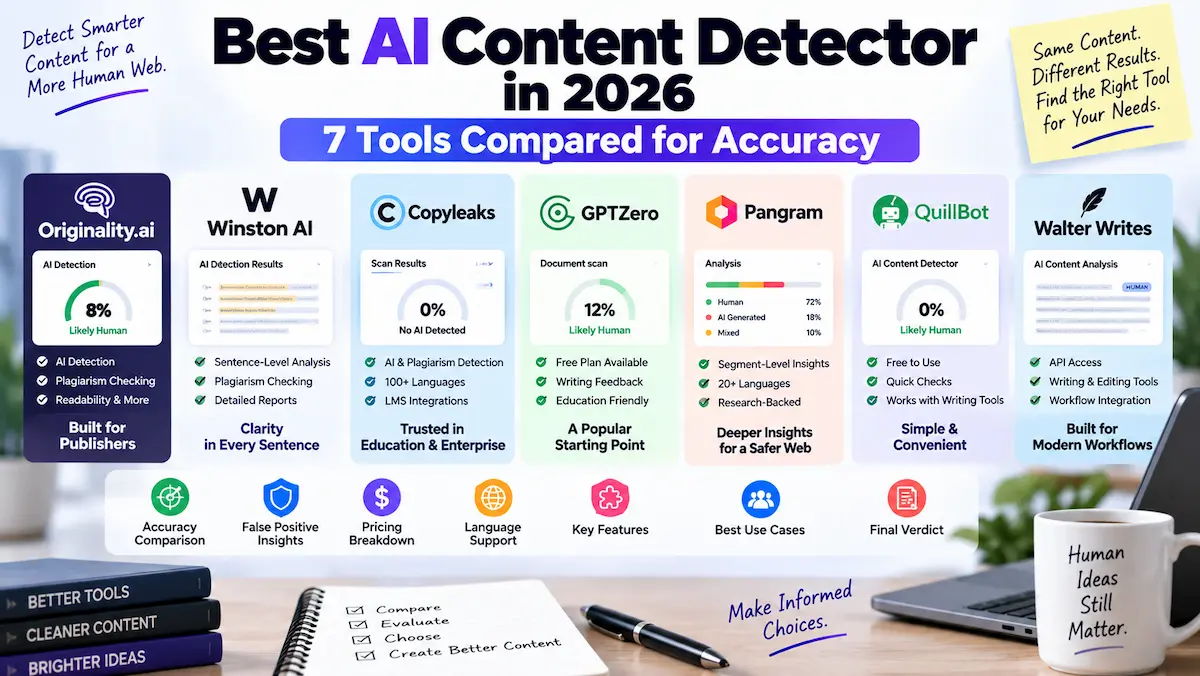
Best AI Content Detector in 2026: 7 Tools Compared for Accuracy
There is no single best AI content detector for every situation. The right choice depends on what you are checking, how much content you process, whether false positives are a major concern, and whether you need features such as plagiarism checking, multilingual detection, education integrations, or website scanning.
How we evaluated these tools: This comparison is based on publicly available pricing pages, vendor feature documentation, product changelogs, and independent detector-accuracy research, checked as of August 2026. We compare tools using five criteria: pricing and credit allowances, supported languages, plagiarism and content-quality features, integration options (LMS, browser, API), and how transparent each vendor is about the limits of AI detection. Pricing and feature details change frequently, so always confirm current terms on the provider’s site before subscribing.
In this guide, we compare seven AI content detection tools: Originality.ai, Winston AI, Copyleaks, GPTZero, Pangram, QuillBot, and Walter Writes. The goal is not to declare one universal winner, but to show where each tool fits and what you should consider before relying on an AI detection score.
Quick Answer
<a href=”https://originality.ai/?via=Aidetector3″ rel=”sponsored”>Originality.ai</a> is a strong option for publishers, editors, agencies, and content teams that want AI detection combined with plagiarism and other content-quality tools. It also supports AI detection in 30 languages.
Winston AI is worth considering if you want sentence-level analysis and a more detailed view of which parts of a document may have triggered the detector.
Copyleaks stands out for multilingual detection, plagiarism checking, education workflows, LMS integrations, and enterprise use.
GPTZero is a useful starting point if you want a free plan and education-oriented features. Pangram is particularly interesting if you want segment-level interpretation and published research around its detection performance. QuillBot is convenient for quick free checks, especially if you already use its writing tools.
The important qualification is that no AI detector should be treated as definitive proof of authorship. Independent research has shown that detector performance can change substantially depending on the model, domain, generation settings, and text manipulation.
Quick Verdict
- Best for publishers and content teams: Originality.ai
- Best for detailed sentence-level review: Winston AI
- Best for multilingual and education workflows: Copyleaks
- Best free starting point for educators: GPTZero
- Best for research-backed detection positioning: Pangram
- Best for quick free checks: QuillBot
- Best for detection inside a writing workflow: Walter Writes
Why the Best AI Content Detector Depends on What You Are Checking
AI content detectors estimate how likely text is to have been generated or substantially produced by an AI system. They do not have direct access to the author’s intentions, and a detection score does not establish authorship by itself.
That distinction matters because different detectors can produce different results on the same document. A tool may be more sensitive to AI-generated passages but also produce more false positives on polished human writing. Another may take a more conservative approach and miss some AI-assisted text.
Independent research reinforces this limitation. The RAID benchmark evaluated more than 6 million generations across 11 models, eight domains, 11 adversarial attacks, and four decoding strategies. The researchers found that detectors could struggle with unseen models and adversarial modifications.
For that reason, the most useful question is not simply, “Which detector has the highest accuracy?” It is, “Which tool gives me useful evidence for the type of decision I need to make?”
The 7 AI Content Detectors Compared
1. Originality.ai
<a href=”https://originality.ai/?via=Aidetector3″ rel=”sponsored”>Originality.ai</a> is particularly well suited to publishers, agencies, editors, writers, and content teams. Its platform combines AI detection with plagiarism checking, readability, grammar, fact checking, content-quality tools, and website scanning.
One important correction to older descriptions of the platform is that Originality.ai is no longer limited to English. Its multilingual AI detection model supports 30 languages, including English, Spanish, French, German, Hindi, Japanese, Korean, Portuguese, Arabic, Chinese, and others.
Originality.ai currently offers several AI detection models, including Lite, Turbo, Academic, and Multilingual. The company publishes high accuracy results for its current models, but it also acknowledges that AI detection is not perfect and that scores should not be used alone for academic disciplinary decisions.
Its current pricing includes a limited free AI checker, Pay As You Go credits, Pro, and Enterprise. Pro is $14.95 per month when billed monthly or $12.95 per month when billed annually, with 2,000 credits per month. Enterprise is $179 monthly or $136.58 monthly when billed annually, with 15,000 credits per month.
Who it fits: Publishers, SEO teams, agencies, editors, and content operations that want AI detection alongside other content-quality checks.
Try it: <a href=”https://originality.ai/?via=Aidetector3″ rel=”sponsored”>Check Originality.ai’s free AI checker</a> before committing to a paid credit plan.
2. Winston AI
Winston AI focuses on giving users more detail than a single overall percentage. Its reports provide sentence-level analysis, making it easier to identify which sections contributed to a detection result.
Winston AI also provides AI image and deepfake detection, plagiarism detection, document scanning, OCR, shareable reports, and team functionality. Its current pricing page lists a free 14-day trial with 2,000 credits, Essential at $18/month, Advanced at $29/month, and Elite at $49/month. Annual billing reduces the effective monthly cost.
Who it fits: Publishers, educators, and reviewers who want more inspectable information around an AI detection result rather than relying on a single score.
3. Copyleaks
Copyleaks combines AI detection and plagiarism checking with a strong education and enterprise focus.
Its AI detector supports 30 languages, while its plagiarism detection supports more than 100 languages. Copyleaks also offers LMS integrations for platforms such as Canvas, Google Classroom, Moodle, Blackboard, Brightspace, Schoology, and Sakai.
Current Personal pricing is $16.99/month monthly or $13.99/month when billed annually, with 100 unified credits. The Pro plan is $99.99/month monthly or $74.99/month annually and includes 12,000 unified credits. One credit covers up to 250 words or one image.
Copyleaks also provides a limited free option for new users to explore its AI and plagiarism detection tools.
Who it fits: Schools, universities, multilingual organizations, and enterprises that need integrations and broader content-integrity capabilities.
4. GPTZero
GPTZero has a strong education-oriented presence and offers AI detection, plagiarism checking, writing feedback, authorship-related tools, and a Chrome extension.
Its free plan provides up to 10,000 words per month, while paid plans increase the available monthly volume and add additional capabilities. GPTZero also supports multilingual detection and education-focused workflows.
One useful characteristic is that GPTZero does not position an AI detection result as an unquestionable verdict. Its own guidance acknowledges that detectors can miss AI text or falsely flag human writing.
Who it fits: Educators, students, and users who want to begin with a free AI detection service.
5. Pangram
Pangram takes a research-oriented approach to AI detection and provides segment-level interpretation rather than relying only on a document-wide number.
Its current free plan allows up to 2,000 words per day and includes AI assistance detection, interpretability features, file upload, OCR, browser extension access, Google Docs integration, and AI detection in more than 20 languages.
The Individual plan is currently $20/month for up to 300,000 words per month, while Professional is $65/month for up to 1.5 million words per month. Team pricing starts at $20 per seat per month.
Who it fits: Users who value segment-level interpretation, research transparency, and flexible usage limits.
6. QuillBot
QuillBot is best known for its writing and paraphrasing tools, but it also offers an AI detector that can be useful for quick checks.
The current free detector supports up to 1,200 words per scan and up to six scans per day. Its reports include AI-generated, human-written and AI-refined, and human-written classifications. QuillBot also provides sentence-level explanations for flagged content.
That makes QuillBot convenient when you want to check a document without immediately committing to a specialist AI-detection subscription.
Who it fits: Writers, students, editors, and anyone looking for a convenient free starting point.
7. Walter Writes
Walter Writes takes a workflow-oriented approach by combining AI detection with writing and revision tools. Its services include AI detection through an API, alongside grammar and writing-related functionality.
For organizations that want programmatic AI detection, Walter Writes currently publishes API pricing based on monthly word volume, with plans ranging from 300,000 words per month upward.
Who it fits: Writers, editors, developers, and teams that want AI detection integrated into an existing workflow.
Comparison Table
| Tool | Starting Option | Free Option | Plagiarism | Best For |
|---|---|---|---|---|
| Originality.ai | $14.95/mo monthly | Limited free AI scans | Yes | Publishers and content teams |
| Winston AI | $18/mo | 14-day trial | Yes | Detailed document review |
| Copyleaks | $16.99/mo monthly | Limited free access | Yes | Education and multilingual teams |
| GPTZero | $8.33/mo annual Essential | 10,000 words/month | Yes | Educators and students |
| Pangram | $20/mo | 2,000 words/day | Yes on paid Individual | Research-focused detection |
| QuillBot | Free / Premium | Yes | Available | Quick checks and writing workflows |
| Walter Writes | Varies | Limited/trial access | Not its primary focus | Integrated writing workflows |
Prices and allowances can change, so check the provider’s current pricing page before subscribing.
Pros and Cons
Originality.ai
- Pros: AI detection paired with plagiarism, readability, grammar, and fact-checking tools in one dashboard; website scanning for auditing existing pages; 30-language AI detection model, including English, Spanish, French, and Hindi.
- Cons: Credits expire at the end of the billing period rather than rolling over; entry-level Pro plan at $14.95/month covers 2,000 credits, which can run out quickly for high-volume publishers.
Winston AI
- Pros: Sentence-level breakdown instead of a single percentage; adds AI image and deepfake detection alongside text scanning; shareable reports for team review.
- Cons: Essential plan starts at $18/month, higher than Originality.ai’s $14.95/month entry tier, for a comparable base credit allowance.
Copyleaks
- Pros: AI detection in 30 languages and plagiarism detection in more than 100 languages; direct LMS integrations with Canvas, Google Classroom, Moodle, Blackboard, Brightspace, Schoology, and Sakai.
- Cons: Pro plan jumps to $99.99/month monthly ($74.99/month annually), a large step up from the $16.99/month Personal tier, which may be hard to justify for solo users who only need basic English detection.
GPTZero
- Pros: Free plan covers up to 10,000 words per month at no cost, the highest free-tier word allowance among the education-focused tools compared here; includes writing feedback tools and a Chrome extension.
- Cons: Like every detector in this comparison, it can still produce false positives on heavily edited or highly structured human writing.
Pangram
- Pros: Free tier allows 2,000 words per day (roughly 60,000/month) with segment-level interpretability, file upload, OCR, and a Google Docs integration; publishes research on its own detection performance rather than only marketing claims.
- Cons: Professional plan at $65/month for 1.5 million words is a meaningful jump from the $20/month Individual plan’s 300,000-word cap for teams that outgrow the entry tier quickly.
QuillBot
- Pros: Free detector allows up to 1,200 words per scan and six scans per day with no subscription required; sentence-level explanations; bundled with QuillBot’s existing paraphrasing and grammar tools.
- Cons: Built as part of a broader writing suite rather than a dedicated content-integrity platform, so it lacks the plagiarism-checking depth of Originality.ai or Copyleaks.
Walter Writes
- Pros: API-first design makes it straightforward to plug AI detection directly into an existing content pipeline; pricing scales by monthly word volume starting at 300,000 words.
- Cons: Less suited to a one-off manual check compared with QuillBot or GPTZero’s free web-based scanners.
Who Should Use This Tool
Different detectors fit different jobs. Here is a quick breakdown by use case:
- Best for: Publishers and agencies running high volumes of contracted content who need AI detection bundled with plagiarism checking — Originality.ai or Copyleaks.
- Best for: Editors who want to see exactly which sentences triggered a flag before making an editorial call — Winston AI or Pangram.
- Best for: Teachers and students who want a genuinely free way to run occasional checks — GPTZero or QuillBot.
- Best for: Development teams that want AI detection triggered automatically inside a CMS or writing tool — Walter Writes.
- Not ideal for: Anyone looking for a single infallible “yes or no” verdict on authorship — no tool on this list, or on the market, provides that with certainty.
Who Should Avoid Relying on One?
You should not use a single AI detection score as the only evidence for a serious decision involving a student’s grade, a freelancer’s payment, an employee’s job, or an author’s reputation.
Human writing can sometimes resemble AI-generated writing, particularly when it is highly structured, formal, repetitive, or heavily edited. At the same time, AI-generated text can sometimes pass as human-written.
The safest workflow is to combine detection results with revision history, drafts, citations, source material, and direct discussion where appropriate.
How to Get Better Results From AI Detection Tools
- Use enough text. Very short samples generally provide less useful evidence than a substantial document.
- Check the whole document when possible. Looking only at isolated sentences can remove important context.
- Review highlighted passages. A detailed report is more useful than a single percentage.
- Compare ambiguous results. If a result could materially affect someone, consider a second detector rather than treating the first score as final.
- Keep the writing process. Drafts, revision history, and source notes can provide evidence that an AI score cannot.
Alternatives Worth Knowing About
If you are researching the best AI content detector, it is worth comparing tools based on your actual workflow rather than choosing solely from a ranking.
- If you need a self-serve tool with plagiarism checking bundled in: Originality.ai is the most publisher-oriented option in this comparison.
- If your organization already runs on an LMS: Copyleaks’ direct Canvas, Moodle, and Google Classroom integrations save setup time.
- If budget is the main constraint: GPTZero’s 10,000-words-per-month free plan or QuillBot’s free daily scans cover occasional checking without a subscription.
- If you want detection built into an API or content pipeline: Walter Writes is designed for that use case rather than manual, one-off checks.
Turnitin is particularly relevant to higher education institutions that already use its academic-integrity infrastructure. It is primarily an institutional product rather than a simple self-serve detector for individual consumers.
If your main requirement is publisher-focused content checking, Originality.ai is worth evaluating alongside the other tools in this list.
For a deeper look at that platform, read our Originality.ai Review 2026.
If you are specifically deciding between the two leading options for AI and plagiarism checking, you can also read our Originality.ai vs Copyleaks comparison.
Frequently Asked Questions
Is any AI content detector 100% accurate?
No. AI detectors estimate the likelihood that text was generated or influenced by AI. Independent research has demonstrated that detector performance can decline when models, domains, generation strategies, or text modifications change.
Which is the best AI content detector for publishers?
Originality.ai is one of the strongest fits for publishers because it combines AI detection with plagiarism checking and other content-quality features. However, your own content type and workflow should determine the final choice.
Which AI detector is best for schools?
Copyleaks and GPTZero are both relevant for education. Copyleaks has extensive LMS integration, while GPTZero offers a free education-oriented starting point.
Does Originality.ai support languages other than English?
Yes. Originality.ai’s multilingual AI detection model supports 30 languages.
How many languages does Copyleaks support for AI detection?
Copyleaks currently supports AI detection in 30 languages. Its plagiarism detection supports more than 100 languages.
Can AI detectors detect AI-written text perfectly?
No. Even strong detectors can produce false positives or false negatives. Their results should be treated as signals that may justify closer review, not as automatic proof of authorship.
Should I use two AI detectors instead of one?
For an important decision, comparing results from more than one detector can provide additional context. If the tools disagree, that disagreement is itself a reason to investigate the underlying content rather than choosing whichever score supports your initial assumption.
Are free AI detectors worth using?
Yes, especially for occasional checks. GPTZero and QuillBot offer free access, while Originality.ai and Pangram also provide free ways to test their detection systems with usage limits. The main difference is usually the amount of content and the additional features available rather than a simple free-versus-paid accuracy rule.
How often should I re-check older content with an AI detector?
There is no fixed schedule, but it can be useful to re-run a check whenever a detector updates its model, when you are preparing to republish or refresh older pages, or when a piece of content is being audited for other quality issues. Because vendors update their models over time, a score from a year ago should not be treated as current.
Final Verdict
The best AI content detector depends on the job you need it to do.
For publishers, agencies, and content teams, <a href=”https://originality.ai/?via=Aidetector3″ rel=”sponsored”>Originality.ai</a> is a strong overall choice because it combines AI detection with plagiarism checking and several publishing-focused tools.
For detailed sentence-level review, Winston AI is worth considering. For education, multilingual detection, LMS integrations, and enterprise workflows, Copyleaks is a particularly strong option. GPTZero provides a useful free starting point, while Pangram offers a research-focused alternative with segment-level interpretation. QuillBot is convenient for quick checks, and Walter Writes is more interesting when AI detection needs to fit into a broader writing workflow.
But there is one rule that matters more than any ranking: do not treat an AI detection percentage as definitive proof that a person did or did not use AI. Research has shown that detection systems can be affected by model changes, sampling strategies, domains, and adversarial modifications.
The most responsible approach is to use AI detection as one signal, review the actual writing, and consider the surrounding evidence before making a consequential decision.
About the Author
T. Vasireddi is the founder and editor of ToolGrowthHQ, creating practical, research-based guides on web hosting, WordPress, SaaS tools, and digital marketing.
His focus is on providing clear, accurate, and useful information to help readers make better technology and software decisions.
Connect with him:
Follow for more AI tool reviews, SaaS comparisons, and digital marketing tips.