Affiliate Disclosure: This post contains affiliate links. If you purchase or sign up through one of these links, we may earn a commission at no extra cost to you. Our recommendations are based on the information, evidence, and criteria discussed in this article. Affiliate relationships do not determine our editorial conclusions.
Originality.ai vs Copyleaks: Which AI Detector Fits Your Workflow in 2026?
Choosing between Originality.ai and Copyleaks is less about finding a detector with the biggest accuracy number and more about matching the tool to your actual workflow.
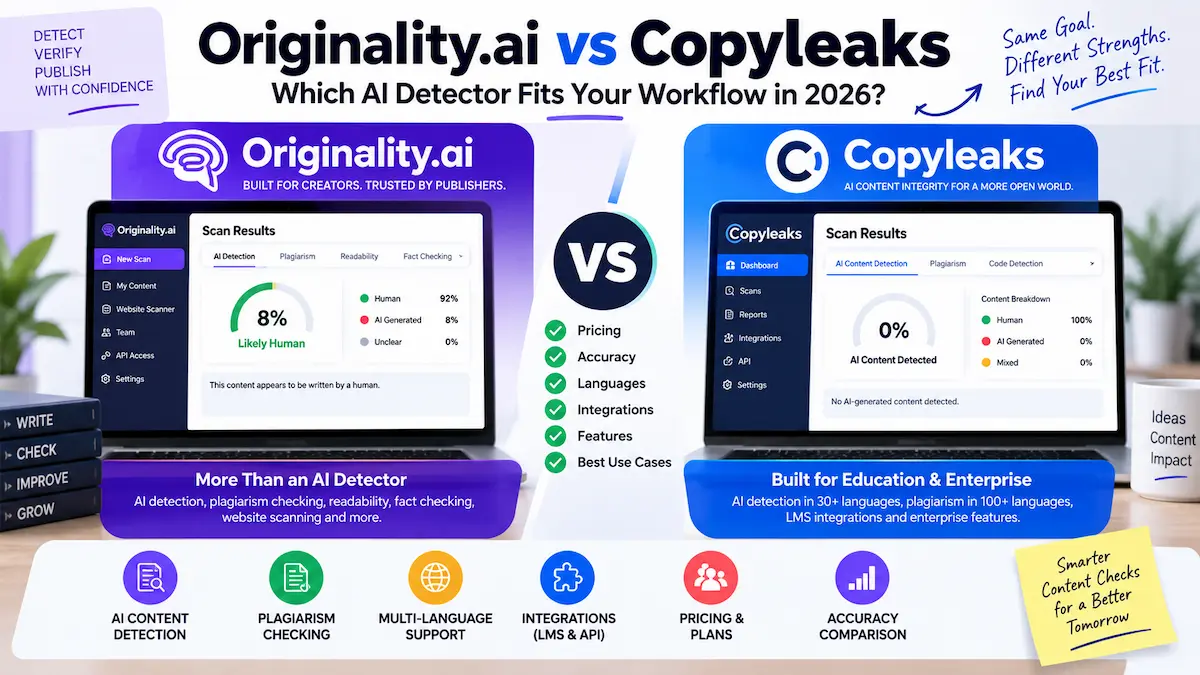
Originality.ai is particularly focused on publishers, writers, editors, agencies, and content teams that want AI detection combined with plagiarism checking, readability, grammar, fact-checking, content-quality tools, and website scanning. Copyleaks takes a broader approach, with AI detection across 30 languages, plagiarism detection across 100+ languages, education workflows, enterprise features, and LMS integrations.
This Originality.ai vs Copyleaks comparison looks at current pricing, AI detection, language support, integrations, credits, practical use cases, and the limitations you should understand before paying for either platform.
Our methodology: This comparison is based on publicly available pricing and feature documentation from both vendors, official product pages, and independently published research on AI-detector performance, updated as of August 2026. We evaluate each tool against a consistent set of criteria — pricing structure, detection scope, language and integration support, and documented limitations — so you can weigh the trade-offs yourself rather than rely on a single accuracy claim.
Quick Answer
If you mainly publish or manage English-language web content, Originality.ai is the more content-publisher-oriented choice. Its subscription combines AI detection with plagiarism, readability, grammar, fact-checking, and other content-quality tools.
Copyleaks is the stronger fit when multilingual detection, academic workflows, LMS integrations, or enterprise requirements are important. Its AI detector supports 30 languages, while its plagiarism system supports more than 100 languages.
Neither platform should be treated as an infallible test of authorship. AI detection produces a probability or prediction, so a score should be considered alongside other evidence when the decision has serious consequences.
Quick Verdict
- Best for publishers and content teams: Originality.ai
- Best for multilingual AI detection: Copyleaks
- Best for schools and LMS-based workflows: Copyleaks
- Best for combining AI detection with publishing-focused checks: Originality.ai
- Best for enterprise integrations and customizable infrastructure: Copyleaks
- Best for occasional Originality.ai checks: Its free AI checker or Pay As You Go option
Who Should Use This Comparison
Best for: website owners, content agencies, freelance editors, academic administrators, and enterprise compliance teams who need to choose between AI-detection platforms based on concrete pricing and feature differences.
Not ideal for: readers looking for a single “most accurate” verdict — as this guide explains below, accuracy claims from either vendor should not be treated as the deciding factor on their own.
What Originality.ai and Copyleaks Actually Do
Originality.ai
Originality.ai is a content-integrity platform built around AI detection and plagiarism checking, with additional tools for readability, grammar, fact checking, content quality, and website scanning.
Its current AI detection system includes different models designed for different use cases. Originality.ai offers models for professional content, academic use, light AI-assisted editing, and multilingual content. Its multilingual model supports 30 languages.
The platform also provides tools such as its Chrome extension, which can be used for AI and plagiarism checks in places such as Google Docs and web pages. For larger publishing operations, full-site scanning and team-management features can make the platform more useful than a standalone AI detector.
Copyleaks
Copyleaks started with plagiarism detection and has expanded into AI detection, education, enterprise compliance, and broader content-integrity workflows.
Its current AI detector supports 30 languages, while its plagiarism detection supports more than 100 languages. Copyleaks also provides integrations with education platforms including Canvas, Moodle, Blackboard, D2L Brightspace, Schoology, Sakai, and others.
That makes Copyleaks particularly relevant for universities, schools, multilingual organizations, and businesses that need detection incorporated into an existing system rather than used only as a standalone browser tool.
Originality.ai vs Copyleaks Pricing
Pricing is one of the clearest differences between the two services. Both use usage-based credits, but the credit systems work differently, so comparing the monthly subscription price alone can be misleading.
Originality.ai Pricing
Originality.ai currently offers a limited free AI detector, Pay As You Go credits, and paid subscriptions.
- Free AI checker: up to 3 AI scans per day, with up to 2,000 words per scan.
- Pay As You Go: $30 one-time payment for 3,000 credits.
- Pro: $14.95/month when billed monthly, or $12.95/month when billed annually.
- Pro credits: 2,000 credits per month.
- Enterprise: $179/month, or $136.58/month when billed annually.
- Enterprise credits: 15,000 credits per month.
- Credit value: 1 credit covers 100 words for an AI check.
Subscription credits expire at the end of the monthly billing period. Pay As You Go credits have a longer validity period, so the two purchasing options suit different usage patterns.
For occasional checking, the free AI checker can make it unnecessary to purchase a subscription immediately. For regular publishing work, the Pro plan provides a much larger recurring credit allowance plus additional content-quality features.
If you want to see the current plans before making a decision, you can check Originality.ai pricing here.
Copyleaks Pricing
Copyleaks currently offers Personal and Pro subscriptions, along with custom Education and Enterprise solutions.
- Personal: $16.99/month monthly or $13.99/month when billed annually.
- Personal allowance: 100 unified credits per month, covering up to 25,000 words or 100 images.
- Pro: $99.99/month monthly or $74.99/month when billed annually.
- Pro allowance: 1,000 unified credits per month, covering up to 250,000 words or 1,000 images.
- Credit value: 1 credit covers up to 250 words or one image.
- Education and Enterprise: custom pricing based on organizational requirements.
Copyleaks therefore makes more sense when you need the additional capabilities bundled into its platform. If you only need large-volume English text checking, its higher-priced Pro plan is harder to justify on scanning volume alone.
Originality.ai vs Copyleaks: Pricing at a Glance
| Plan or Factor | Originality.ai | Copyleaks |
|---|---|---|
| Free option | Limited free AI scans (3/day, up to 2,000 words each) | Free access is available for limited use |
| Entry paid option | $30 Pay As You Go (3,000 credits) | $13.99/month annual Personal |
| Individual subscription | Pro: $12.95/month annual (2,000 credits/mo) | Personal: $13.99/month annual (100 credits/mo) |
| Higher subscription | Enterprise: $136.58/month annual (15,000 credits/mo) | Pro: $74.99/month annual (1,000 credits/mo) |
| Credit value | 1 credit = 100 AI-check words | 1 credit = up to 250 words or 1 image |
| AI detection languages | 30 | 30+ |
| Plagiarism detection | Yes | Yes |
| Website scanning | Yes | Yes on Pro |
| LMS integrations | No major LMS integration | Yes |
| API | Enterprise | Enterprise/custom solutions |
Originality.ai vs Copyleaks Accuracy
Accuracy is the section where comparisons need the most caution.
Both companies publish high accuracy figures based on their own testing. Those figures can be useful for understanding how each company evaluates its models, but they should not be treated as a guarantee that either detector will classify every piece of writing correctly.
Independent research also shows why AI detection needs context. The RAID benchmark evaluated multiple AI detectors across more than 6 million generated texts, 11 models, eight domains, and multiple adversarial attacks. The researchers found that detectors can struggle when confronted with unseen models, different generation strategies, and attempts to manipulate generated text.
That does not mean AI detectors are useless. It means the output should be interpreted as evidence rather than absolute proof.
Originality.ai’s Current Approach
Originality.ai currently offers different detection models depending on the type of content being checked. Its published testing reports very high accuracy figures for its Lite, Turbo, and Academic models, while its multilingual model is designed for content in 30 languages.
The company also explicitly explains that an AI detection score represents a prediction or probability rather than proof that a particular person used AI.
Copyleaks’ Current Approach
Copyleaks also publishes high AI-detection accuracy figures and supports detection across 30+ languages. Its platform is designed to handle different content environments, including academic and enterprise workflows.
The important point in this Originality.ai vs Copyleaks comparison is that a published accuracy percentage does not automatically tell you which detector will perform better on your specific content.
What Should You Do With a High AI Score?
If a freelancer, employee, student, or contributor receives a high AI score, do not treat that score as standalone proof of misconduct.
Consider additional evidence such as:
- Document revision history
- Drafts and previous versions
- Source material and citations
- The person’s explanation of the writing process
- Other relevant editorial or academic evidence
This approach is particularly important when the result could affect payment, employment, grades, publishing decisions, or disciplinary action.
Language Support and Integrations
This is one of the strongest reasons to choose Copyleaks.
Copyleaks
Copyleaks supports AI detection in 30 languages and plagiarism detection in more than 100 languages. Its education offering integrates with major learning-management systems, including Canvas, Moodle, Blackboard, D2L Brightspace, Schoology, Sakai, and other platforms.
For a university or organization working across several languages, these integrations can be more important than the raw price per scan.
Originality.ai
Originality.ai is no longer limited to English-only AI detection. Its multilingual model supports 30 languages, while separate models are available for English-focused use cases such as professional and academic content.
It also provides a Chrome extension, Google Docs-related workflows, writing replay features, full-site scanning, plagiarism checking, and other publishing-oriented tools.
So the difference is not simply “English versus multilingual” anymore. The more useful distinction is publisher-focused workflow versus education and enterprise integration breadth.
Features: Originality.ai vs Copyleaks
| Feature | Originality.ai | Copyleaks |
|---|---|---|
| AI content detection | Yes | Yes |
| Multilingual AI detection | 30 languages | 30+ languages |
| Plagiarism detection | Yes | Yes |
| Readability | Yes | Not positioned as the same publishing-focused bundle |
| Grammar checking | Yes | Available within its broader platform |
| Fact checking | Yes | Not the same core positioning |
| Website scanning | Yes | Yes on Pro |
| Chrome/browser extension | Yes | Yes |
| Google Docs workflow | Yes | Yes |
| LMS integrations | No | Yes |
| Enterprise options | Yes | Yes |
Pros and Cons
Originality.ai Pros
- Strong focus on publishers, agencies, writers, and editors
- AI detection and plagiarism checking in the same platform
- Readability, grammar, fact-checking, and other content-quality tools
- 30-language AI detection
- Full-site scanning for website content
- Chrome extension and writing-workflow features
- Flexible Pay As You Go option ($30 for 3,000 credits) for users who do not want a recurring subscription
Originality.ai Cons
- Subscription credits expire at the end of the billing period, unlike Pay As You Go credits
- API access is reserved for Enterprise ($136.58/month annual)
- Its strongest workflow is centered around content publishing rather than LMS-based education
- No native LMS integrations (Canvas, Moodle, Blackboard, etc.), unlike Copyleaks
- AI scores still require human judgment and should not be treated as definitive proof
Copyleaks Pros
- AI detection across 30 languages
- Plagiarism detection across 100+ languages
- Strong education and LMS integrations, including Canvas, Moodle, Blackboard, D2L Brightspace, Schoology, and Sakai
- Enterprise-focused security, administration, and deployment options
- Website scanning available on the Pro plan
- Browser and Google Docs workflows
- AI and plagiarism detection can be combined in broader content-integrity workflows
Copyleaks Cons
- Pro plan runs $74.99/month annual — substantially more than Originality.ai’s $12.95/month annual Pro plan
- Its broader feature set can be unnecessary for a solo publisher who only wants English content checks
- Personal plan allowance (100 credits/month, up to 25,000 words) is comparatively limited next to Originality.ai’s 2,000 credits/month on Pro
- Education and Enterprise pricing requires contacting sales
- Detection results still represent estimates rather than certainty
Who Should Use Originality.ai?
Originality.ai is a strong choice if you run a website, content agency, publishing operation, or editorial workflow and want several quality checks in one place.
It makes particular sense when your workflow includes checking freelance articles, reviewing large volumes of web content, checking plagiarism, reviewing readability, and maintaining a consistent publishing process.
Best for: solo publishers, content agencies, freelance editors, and small-to-mid-size editorial teams who want AI detection bundled with plagiarism, readability, grammar, and fact-checking tools in one subscription.
Not ideal for: universities needing LMS-integrated workflows, or organizations that require API access without paying for the Enterprise tier.
The Pro plan is especially relevant for individuals and small teams. Larger agencies and publishers that need more credits, team management, longer scan history, and API access can consider Enterprise.
If you want to explore the platform yourself, you can try Originality.ai and compare its current tools with your workflow. The Pro plan is available starting at $12.95/month (billed annually), with no long-term contract required.
Who Should Use Copyleaks?
Copyleaks is the better fit when multilingual detection or institutional integration is central to the job.
Schools and universities can benefit from its LMS integrations, while international organizations can take advantage of its multilingual AI and plagiarism capabilities.
Best for: schools, universities, and multilingual or international organizations that need detection built directly into an existing LMS or enterprise system.
Not ideal for: individual bloggers or small publishers on a tight budget, since Copyleaks’ Pro plan ($74.99/month annual) costs considerably more than comparable individual plans from Originality.ai.
Copyleaks also makes more sense for organizations that need enterprise-level administration, custom deployment, data-hosting options, or API-based workflows.
Who Should Avoid Both?
You should reconsider both tools if you need an AI detector to provide absolute certainty.
No detector can turn a statistical prediction into definitive proof of authorship. If your decision has serious consequences, an AI score should be one piece of evidence rather than the entire case.
You may also not need a paid platform if you only check a few short pieces of content occasionally. In that situation, starting with a limited free option — such as Originality.ai’s free AI checker (3 scans/day, up to 2,000 words each) or Copyleaks’ limited free access — may be more sensible than paying for a subscription immediately.
Which Is Better for Publishers?
For publishers and content agencies, Originality.ai is the more natural fit.
The platform combines AI detection with plagiarism checking, readability, grammar, fact checking, content-quality features, and website scanning. That combination is useful when the objective is not merely detecting AI but improving the overall editorial quality-control process.
If multilingual content and institutional integrations are more important than publishing-focused tools, Copyleaks becomes the stronger alternative.
Which Is Better for Schools and Universities?
Copyleaks has the clearer advantage for education workflows.
Its education offering integrates with major LMS platforms and is designed around institutional requirements. It also supports multilingual AI detection and broad plagiarism detection.
Originality.ai does provide an Academic detection model and education-oriented features, but Copyleaks has a broader established LMS integration strategy.
Which Is Better for Multilingual Content?
Both platforms now support multilingual AI detection, so the old assumption that Originality.ai is English-only is no longer accurate.
Originality.ai supports AI detection in 30 languages through its multilingual model. Copyleaks also supports AI detection in 30 languages and provides plagiarism detection across 100+ languages.
If multilingual plagiarism detection is as important as AI detection, Copyleaks has the broader language offering.
Which Is Better for High-Volume Content?
The answer depends on what you are scanning.
For straightforward text-only AI checking, Originality.ai’s credit structure can be attractive because one AI-check credit covers 100 words and its Pro subscription is relatively inexpensive at $12.95/month (billed annually) for 2,000 credits.
Copyleaks uses unified credits that can cover up to 250 words or one image. Its Pro plan also adds features such as website scanning, analytics, and team seats, but at $74.99/month (billed annually) for 1,000 credits.
Therefore, do not compare only the number of credits. Compare the number of words, images, users, integrations, and additional features your workflow actually requires.
Alternatives Worth Knowing About
Neither Originality.ai nor Copyleaks needs to be your only option.
GPTZero is worth considering if you want another established AI-detection platform and want to compare results across multiple detectors. It’s a reasonable option if your priority is cross-checking a score against a second, independently built model.
Turnitin remains particularly relevant to higher education institutions that already use its academic-integrity infrastructure and plagiarism database, and want AI detection layered onto a system they’re already paying for.
The important point is to compare tools using your actual content. A detector that performs well on one type of writing may produce different results on another.
Frequently Asked Questions
Is Originality.ai or Copyleaks more accurate?
There is no universal winner that can be established from vendor accuracy claims alone. Both publish high accuracy figures, while independent research shows that AI detectors can struggle with unseen models, edited text, and adversarial changes. Test representative samples from your own workflow before making a major decision.
Is Originality.ai cheaper than Copyleaks?
For individual users and English-focused text checking, Originality.ai generally has the lower-cost paid option — its Pro plan runs $12.95/month (annual billing) versus Copyleaks Personal at $13.99/month for a smaller credit allowance. Copyleaks becomes more compelling when you need multilingual detection, LMS integrations, enterprise features, or its broader content-integrity capabilities.
Does Originality.ai support languages other than English?
Yes. Originality.ai currently supports AI detection in 30 languages through its multilingual model.
Does Copyleaks support multilingual AI detection?
Yes. Copyleaks currently supports AI detection in 30 languages and plagiarism detection in more than 100 languages.
Can I use Originality.ai for free?
Yes, but the free AI checker is limited. Originality.ai currently provides up to three free AI scans per day, with up to 2,000 words per scan. Paid plans provide broader access to the platform.
Does Copyleaks have a free option?
Copyleaks provides free access for limited use, while its Personal and Pro plans provide recurring monthly credit allowances and additional features.
Can AI detection prove that someone used AI?
No. An AI detector produces a probability or prediction based on characteristics of the text. It should not be treated as conclusive proof of authorship or AI use.
Which is better for content agencies?
Originality.ai is generally the more natural fit for content agencies that want AI detection, plagiarism checking, readability, fact checking, and website content auditing in one workflow. Copyleaks becomes more attractive when multilingual requirements, enterprise controls, or integrations are central to the agency’s operation.
Which is better for schools?
Copyleaks is generally the stronger fit for schools and universities because of its education offering and LMS integrations. Originality.ai can still be useful where the focus is on academic AI detection and broader content-quality checks.
Is ClickFunnels-style bundled pricing available with either tool?
No — both platforms price around credits rather than flat feature bundles. Originality.ai ties cost to word count per AI-check credit (100 words/credit), while Copyleaks ties cost to a unified credit that covers either words or images (up to 250 words or 1 image/credit). Match the credit math to your actual monthly content volume before comparing sticker prices.
Final Verdict: Originality.ai vs Copyleaks
There is no single winner for every user in this Originality.ai vs Copyleaks comparison.
Choose Originality.ai if you are a publisher, writer, editor, agency, or content team that wants AI detection combined with plagiarism and broader content-quality tools. Its relatively low-cost Pro plan ($12.95/month annual) and publishing-oriented workflow make it particularly appealing for individuals and small teams.
Choose Copyleaks if multilingual detection, academic workflows, LMS integrations, or enterprise requirements are more important. Its broader plagiarism-language coverage and institutional integrations can justify the higher price ($74.99/month annual on Pro) for the right organization.
Most importantly, do not choose either platform solely because of a headline accuracy percentage. AI detection is probabilistic, and independent research has demonstrated that detector performance can change depending on the model, domain, generation method, and text manipulation.
For a publishing workflow, start by comparing Originality.ai against your own real content volume and editorial requirements. If you also need multilingual or education-focused integrations, put Copyleaks through the same test and compare the results before committing to a longer-term plan.
For a more detailed look at Originality.ai’s features, pricing, detection models, and limitations, read our Originality.ai review.
Official Sources
- Originality.ai official pricing
- Originality.ai official website
- Copyleaks official pricing
- Copyleaks official website
- RAID benchmark research — ACL Anthology
About the Author
T. Vasireddi is the founder and editor of ToolGrowthHQ, creating practical, research-based guides on web hosting, WordPress, SaaS tools, and digital marketing.
His focus is on providing clear, accurate, and useful information to help readers make better technology and software decisions.
Connect with him:
Follow for more AI tool reviews, SaaS comparisons, and digital marketing tips.