Affiliate Disclosure: This post contains affiliate links. If you purchase or sign up through one of these links, we may earn a commission at no extra cost to you. Our recommendations are based on the features, pricing, limits, and use cases discussed in this article. Affiliate relationships do not determine our editorial conclusions.
Our Methodology: This comparison is based on publicly available pricing and feature documentation, vendor specifications, and verified user reviews, updated as of August 2026. We evaluate each tool against a consistent set of criteria — update frequency, tracked-keyword capacity, geographic and device targeting, AI-search visibility support, and total cost — so you can compare them on equal footing rather than marketing claims alone.
Quick Answer
The best rank tracking tool depends on what you actually need to monitor.
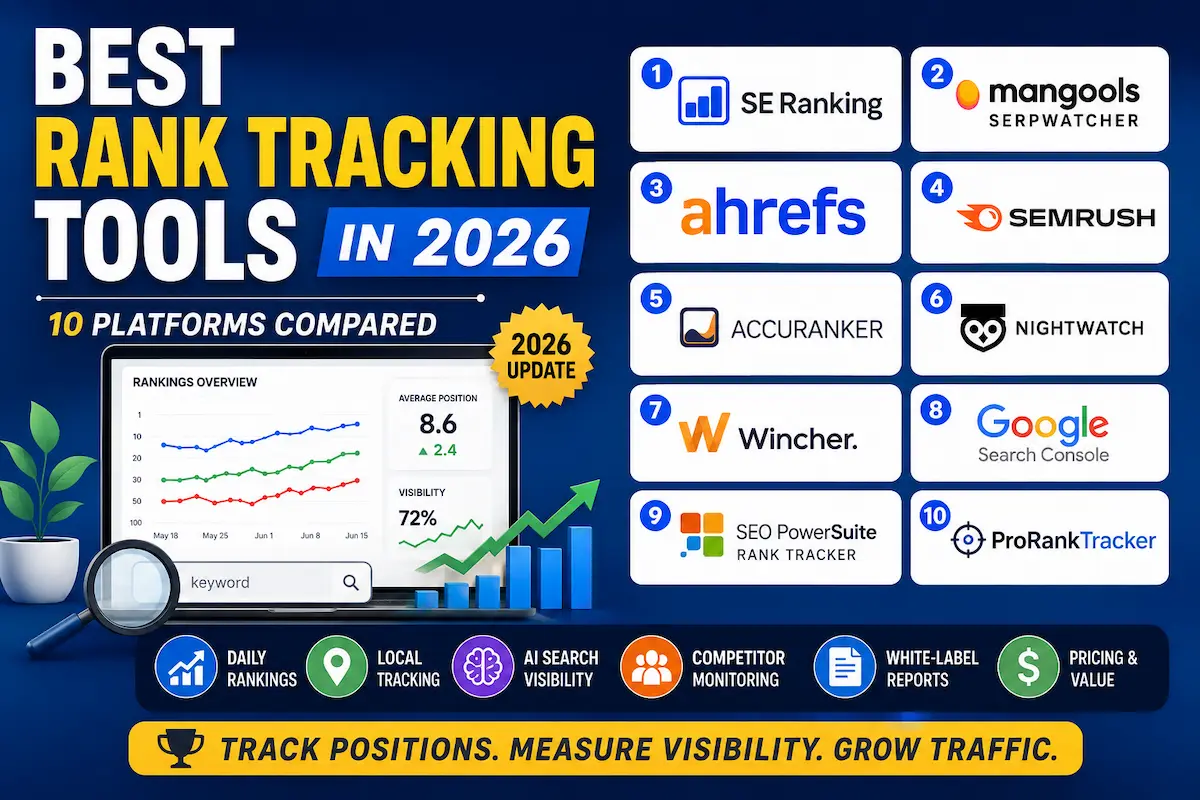
SE Ranking is our pick for the best overall balance of rank tracking, SEO features, daily updates, AI-search visibility, and project capacity. Mangools SERPWatcher is a simpler option if you already use Mangools and mainly want straightforward ranking reports. Ahrefs is particularly useful when rank tracking needs to sit alongside deep backlink and competitor research, while Semrush makes more sense if you want rank tracking inside a broader marketing platform.
For agencies that prioritise rapid or on-demand rank checks, AccuRanker and ProRankTracker deserve a closer look. For local and multi-engine tracking, Nightwatch is another strong option. And if you only need first-party Google performance data, Google Search Console may be enough to start with.
Quick Verdict
- Best overall balance: SE Ranking
- Best for simple rank tracking: Mangools SERPWatcher
- Best for backlink-heavy SEO: Ahrefs
- Best full marketing suite: Semrush
- Best for fast/on-demand tracking: AccuRanker
- Best for local and multi-engine tracking: Nightwatch
- Best for a lean rank-tracking workflow: Wincher
- Best free first-party option: Google Search Console
- Best desktop option with unlimited keyword tracking: SEO PowerSuite Rank Tracker
- Best for granular local and agency reporting: ProRankTracker
If you are comparing the best rank tracking tools in 2026, the first thing to decide is how often you need updates and what type of search visibility you want to measure.
What Makes a Good Rank Tracking Tool in 2026?
A rank tracker should do more than show a number beside a keyword.
The useful question is whether the tool helps you understand where you rank, where you are gaining or losing visibility, which pages are ranking, how competitors are performing, and whether the change is important enough to act on.
For local SEO, location matters too. A business may rank well nationally but perform very differently in individual cities or postcodes. For a website targeting both the USA and UK, country-specific and device-specific tracking can also reveal differences that a single global ranking cannot show.
AI search adds another layer. Traditional rank tracking measures positions in search results, while newer visibility tools can monitor appearances in AI-generated search experiences. These measurements should not be treated as interchangeable: a traditional ranking and an AI citation answer different questions.
Finally, remember that third-party rank trackers estimate or collect search-result positions using their own tracking systems. Google Search Console provides first-party performance data for your own property, including clicks, impressions, CTR, and average position. Those datasets are useful together, but they are not measuring exactly the same thing.
Comparison Table
| Tool | Best For | Update Approach | AI Visibility | Notable Strength |
|---|---|---|---|---|
| SE Ranking | All-around SEO tracking | Daily | Yes | Broad SEO + GEO workflow |
| Mangools SERPWatcher | Simple tracking | Weekly; daily on Agency | No dedicated AI tracking in SERPWatcher | Simple interface |
| Ahrefs | Research-heavy SEO | Weekly on current plans | Yes | Backlink and competitor data |
| Semrush | Full marketing teams | Daily | Yes | Large marketing ecosystem |
| AccuRanker | Fast rank monitoring | Daily + available refresh options | Yes, through AccuLLM | Speed and rank tracking focus |
| Nightwatch | Local and multi-engine tracking | Regular tracking + on-demand checks | Yes | Local and AI visibility coverage |
| Wincher | Small teams | Daily | Not a primary focus | Simple daily monitoring |
| Google Search Console | First-party Google data | Google reporting data | No dedicated AI tracking | Free and first-party |
| SEO PowerSuite Rank Tracker | Desktop SEO workflows | User-configured checks | Google AI Overviews tracking | Unlimited keyword tracking |
| ProRankTracker | Local and agency tracking | Daily + on-demand | Yes | Granular tracking and reporting |
Note: Pricing and limits vary by plan, billing cycle, location, search engine, and usage. Check the provider’s current pricing page before subscribing.
The 10 Best Rank Tracking Tools in 2026
1. SE Ranking
Best for: businesses, bloggers, freelancers, and agencies that want rank tracking as part of a wider SEO platform.
SE Ranking is the strongest all-around choice on this list if you do not want your rank tracker to exist in isolation.
Its current Core plan includes 10 projects, one manager seat, 2,000 tracked keywords per day, and rank tracking across major search engines. It also combines ranking data with keyword research, competitor research, backlink research, website auditing, and AI-search/GEO functionality.
SE Ranking supports Google, Google Mobile, Yahoo, Bing, and YouTube tracking, with geographic targeting that can go down to city or postal-code level. That is useful when your SEO strategy covers different markets or local locations.
Its current platform also tracks AI-search visibility across experiences including Google AI Overviews, Google AI Mode, ChatGPT, Gemini, and Perplexity through its AI-search products and plans.
- Monthly pricing: Core plan starts at $65/month billed annually (higher on month-to-month billing)
- Tracked keywords: 2,000/day on Core, higher on upper tiers
- Free trial: 14 days, no credit card required
- Update frequency: Daily
Explore SE Ranking and start the 14-day trial
Pros:
- Daily rank tracking across 2,000+ keywords on entry plans
- City- and postal-code-level geographic targeting
- Tracks Google, Google Mobile, Yahoo, Bing, and YouTube
- Keyword, competitor, backlink, and audit tools bundled into one platform
- AI-search visibility across ChatGPT, Gemini, Perplexity, and Google AI Overviews/Mode
- 14-day free trial without a credit card
Cons:
- More functionality than needed if you only want a basic rank tracker
- Additional project capacity and AI-search add-ons can increase total cost
Our take: If you want one SEO platform rather than a standalone tracker, SE Ranking is the most balanced option here.
2. Mangools SERPWatcher
Best for: bloggers, freelancers, and marketers who value simplicity.
SERPWatcher takes a different approach. Rather than trying to become an enormous SEO command centre, it focuses on making ranking information easy to understand.
It is part of the Mangools suite alongside KWFinder, SERPChecker, LinkMiner, and SiteProfiler — a meaningful advantage if you already use Mangools for keyword research.
SERPWatcher currently provides weekly rank updates on Basic and Premium plans, while the Agency plan provides daily updates. It supports desktop and mobile tracking and offers location-based tracking, including city-level data.
Its Performance Index combines keyword positions and search volumes into an overall visibility-oriented metric, useful for a quick read on movement without reviewing every keyword individually.
- Rank update frequency: Weekly (Basic/Premium), daily (Agency)
- Tracking scope: Desktop and mobile, with city-level location targeting
- Bundled with: KWFinder, SERPChecker, LinkMiner, SiteProfiler
- AI visibility: No dedicated AI-search tracking module
Explore Mangools and SERPWatcher
Pros:
- Clean, beginner-friendly interface
- Desktop and mobile tracking included
- City-level location-based tracking
- Ranking alerts and visual reports
- Strong integration with KWFinder for keyword research
Cons:
- Weekly rather than daily updates on Basic and Premium
- No dedicated AI-search visibility tracking
- Not positioned as a complete enterprise SEO platform
Our take: If you already use Mangools and want straightforward rank monitoring, SERPWatcher is one of the easiest choices to justify.
3. Ahrefs
Best for: SEO professionals who combine rank tracking with backlink and competitor research.
Ahrefs is much broader than a rank tracker. Its major advantage is the amount of research you can perform around the rankings you are monitoring.
The current Ahrefs Lite plan includes 750 tracked keywords, while Standard increases that to 2,000 and Advanced to 5,000. The current main plans use weekly Rank Tracker updates.
Ahrefs Rank Tracker lets you monitor rankings by location and device, compare competitors, review visibility trends, and examine ranking history. Where Ahrefs becomes particularly useful is the connection between ranking data and other research — if a competitor outranks you, you can move directly into keyword, backlink, content, and competitor analysis to investigate why.
Ahrefs also has Brand Radar for monitoring visibility in AI-generated search experiences.
- Tracked keywords: 750 (Lite), 2,000 (Standard), 5,000 (Advanced)
- Update frequency: Weekly on current main plans
- Backlink index: One of the largest in the industry
- AI visibility: Brand Radar
Pros:
- Deep connection between rankings, backlinks, and competitor research
- Large keyword and web-data ecosystem
- Detailed competitor analysis tools
- AI visibility through Brand Radar
Cons:
- Weekly, not daily, Rank Tracker updates on current main plans
- Higher tiers become expensive quickly
- More than necessary if rank tracking is your only requirement
Our take: Choose Ahrefs when rank tracking is part of a deeper SEO research workflow rather than the main reason you are buying the platform.
4. Semrush
Best for: marketing teams that want SEO, content, competitor research, and visibility tools under one platform.
Semrush’s Position Tracking tool monitors keyword rankings daily and supports location, language, device, and search-engine targeting. Current Position Tracking documentation lists Google, Bing, Baidu, ChatGPT Search, and Google AI Mode among the environments it can monitor.
The current SEO Toolkit starts at $139.95 per month for Pro, which includes 500 tracked keywords across five websites. Guru increases that to 1,500 keywords across 15 websites, while Business increases it to 5,000 across 40 websites.
Semrush is therefore difficult to recommend solely as a rank tracker. Its value comes from the larger ecosystem around Position Tracking, including keyword research, competitor analysis, site auditing, content tools, and AI visibility features.
- Monthly pricing: $139.95 (Pro), higher for Guru and Business tiers
- Tracked keywords: 500 (Pro) up to 5,000 (Business)
- Update frequency: Daily
- AI visibility: ChatGPT Search and Google AI Mode monitoring
Pros:
- Daily Position Tracking
- Strong location and device targeting
- Broad SEO and marketing ecosystem in one login
- Traditional and AI-search monitoring options
- Well suited to larger marketing teams
Cons:
- Expensive if rank tracking is your only need
- Many advanced features require higher plans or separate add-ons
Our take: Semrush is most compelling when you need a marketing platform, not simply a keyword position checker.
5. AccuRanker
Best for: agencies and SEO professionals who place a high value on fast rank data.
AccuRanker is much more focused on rank tracking than broad all-in-one platforms such as Semrush or SE Ranking.
Its current Professional plan starts at $224 per month for 2,000 keywords, with higher keyword volumes available. The platform provides daily updates and is designed around rank-monitoring workflows, reporting, filtering, tagging, and integrations.
AccuRanker also offers AI-focused capabilities through AccuLLM, including AI visibility-related metrics on higher plans.
- Monthly pricing: $224 (Professional, 2,000 keywords)
- Update frequency: Daily, with on-demand refresh options
- AI visibility: AccuLLM (higher plans)
- Notable feature: Advanced filtering and tagging for large keyword sets
Pros:
- Purpose-built rank-tracking focus
- Daily updates with refresh options
- Advanced filtering, tagging, and integrations
- AI-search functionality on relevant plans
Cons:
- More expensive starting point than simpler tools
- Less attractive if you also need a full keyword research and site-audit platform
Our take: AccuRanker makes more sense for professionals who value dedicated rank-tracking infrastructure enough to pay for it.
6. Nightwatch
Best for: local SEO and teams that need several search engines and AI platforms monitored.
Nightwatch has expanded beyond traditional Google rank tracking. Its current Starter plan supports 500 keywords across five websites and includes Google, YouTube, Bing, Yahoo, DuckDuckGo, and Google Maps tracking.
It also supports AI platforms including ChatGPT, Claude, Gemini, and Perplexity, along with AI Mode and AI Overview monitoring.
The platform provides real-time on-demand checks, useful when you do not want to wait for the next scheduled data collection. Its Professional and Agency plans add greater keyword, website, AI, reporting, and agency capacity, including white-label reports at the Professional level.
- Tracked keywords: 500 across 5 websites (Starter)
- Search engines: Google, YouTube, Bing, Yahoo, DuckDuckGo, Google Maps
- AI visibility: ChatGPT, Claude, Gemini, Perplexity, AI Mode/AI Overview monitoring
- White-label reporting: Available from Professional plan
Pros:
- Coverage across six-plus search engines and maps
- Broad AI visibility tracking
- Strong local SEO capabilities
- On-demand, real-time checks
- White-label reporting on higher plans
Cons:
- Current pricing is presented in euros on the public pricing page
- Higher-capacity plans can become expensive
Our take: Nightwatch deserves consideration if local tracking, multiple search engines, and AI visibility are all important to your workflow.
7. Wincher
Best for: small teams that want straightforward daily rank monitoring.
Wincher keeps its focus relatively narrow. Its Rank Tracker provides daily ranking updates, ranking history, competitor comparisons, landing-page insights, SERP features, device tracking, and geographic targeting.
The current pricing structure starts with a plan supporting at least 500 keywords and up to 10 websites, with larger plans increasing keyword and website capacity. The platform also supports local rank tracking through Google Maps.
One useful feature is position-history import, which can help when moving from another rank tracker instead of starting your historical data from scratch.
- Tracked keywords: 500+ on the entry plan, across up to 10 websites
- Update frequency: Daily
- Local tracking: Google Maps supported
- Migration support: Position-history import on applicable plans
Pros:
- Daily ranking updates
- Simple, ranking-focused workflow
- Competitor tracking included
- Local rank tracking via Google Maps
- Position-history import for switching tools
Cons:
- Less broad than full SEO platforms
- AI visibility is not a main differentiator
Our take: Wincher is worth considering if you want a dedicated rank tracker without buying a large all-in-one SEO suite.
8. Google Search Console
Best for: website owners who want free, first-party Google Search performance data.
Google Search Console is not a conventional rank tracker, but it belongs on this list because it answers questions third-party rank trackers cannot answer directly.
Search Console shows clicks, impressions, CTR, queries, pages, countries, devices, and average position for your property’s Google Search performance.
Its average position should not be interpreted as the exact position you will see when manually searching Google. Google explains that the metric is an average of the topmost position for impressions, and individual search results can vary because of factors such as location and search context.
If Search Console says a page has an average position of 5, that does not mean you will personally see it at position 5 every time you search. Search Console is also useful for investigating whether ranking changes are actually affecting clicks and impressions. Google itself recommends looking at changes in clicks and impressions alongside position rather than treating position alone as the complete measure of search performance.
- Cost: Free
- Data type: First-party Google Search performance
- Reporting: Clicks, impressions, CTR, average position, by query/page/country/device
- Competitor tracking: Not available
Pros:
- Completely free
- First-party Google data, not an estimate
- Shows clicks and impressions, not just position
- Useful country and device breakdowns
- Excellent for measuring actual site performance in Google Search
Cons:
- No competitor rank tracking
- Not designed for scheduled keyword-position monitoring
- Does not replace a dedicated rank tracker for controlled keyword sets
Our take: Every site owner should use Search Console, but larger SEO workflows may still need a dedicated rank tracker.
9. SEO PowerSuite Rank Tracker
Best for: SEO professionals who prefer desktop software and want high-volume keyword tracking without a conventional per-keyword SaaS model.
SEO PowerSuite’s Rank Tracker is different from most tools on this list because it is desktop software rather than a purely cloud-based rank tracker.
The current Rank Tracker offering supports unlimited keyword tracking and can check rankings across hundreds of search engines. It also supports local and mobile tracking, competitor research, keyword research, and SERP analysis. The current SEO PowerSuite plans also include Google AI Overviews tracking.
The biggest trade-off is the desktop workflow — you are not getting the same always-online SaaS experience as a cloud platform. Depending on your workflow, that can either be a benefit or an inconvenience.
- Keyword capacity: Unlimited
- Format: Desktop software (not cloud-hosted)
- Search engine coverage: Hundreds of engines supported
- AI visibility: Google AI Overviews tracking included
Pros:
- Unlimited keyword tracking with no per-keyword pricing
- Desktop-based workflow, data stored locally
- Extensive search-engine coverage
- Local and mobile tracking included
- Competitor and keyword research bundled in
Cons:
- Desktop software rather than a simple cloud dashboard
- Setup and data-management requirements can be greater than with SaaS tools
Our take: SEO PowerSuite is worth considering if keyword volume is high and you prefer software installed on your own computer.
10. ProRankTracker
Best for: agencies, local SEO professionals, and users who need detailed reporting and on-demand checks.
ProRankTracker is built specifically around rank tracking and reporting. Its current feature set includes daily ranking updates, on-demand updates, local and mobile tracking, competitor monitoring, reporting, API access on agency plans, and white-label capabilities.
Its subscription plans currently start at $49 per month for 500 tracked terms according to its published pricing information, with larger plans increasing tracked-term capacity.
ProRankTracker also supports detailed local tracking, including granular geographic options and Google Business Profile-related tracking capabilities. For agencies, its reporting and user-management features can be more important than the headline keyword count.
- Monthly pricing: $49 (entry plan, 500 tracked terms)
- Update frequency: Daily plus on-demand
- API access: Available on agency plans
- Local tracking: Google Business Profile-related capabilities included
Pros:
- Daily and on-demand ranking updates
- Strong local tracking capabilities
- Agency reporting and white-label branding options
- Mobile tracking included
- API availability on agency plans
Cons:
- Less of an all-in-one SEO research platform
- Some advanced capabilities are tied to higher plans
Our take: ProRankTracker is a good specialist option when rank tracking and client reporting are the centre of your SEO workflow.
Who Should Use Which Tool
SE Ranking
- Best for: Agencies and bloggers who want rank tracking bundled with keyword research, audits, and AI-search visibility in one login
- Not ideal for: Someone who only wants a bare-bones position checker with no other SEO features
Mangools SERPWatcher
- Best for: Existing Mangools/KWFinder users who want simple, readable ranking reports
- Not ideal for: Teams that need daily updates on a budget plan or dedicated AI-search tracking
Ahrefs
- Best for: SEOs who lean heavily on backlink and competitor research alongside rankings
- Not ideal for: Users who only need rank tracking and nothing else
Semrush
- Best for: Marketing teams that already run content, PPC, and social from the same platform
- Not ideal for: Solo bloggers tracking a small number of keywords on a budget
AccuRanker
- Best for: Agencies that need fast, dedicated, high-accuracy rank data at scale
- Not ideal for: Small sites with a modest keyword list
Nightwatch
- Best for: Local businesses and agencies tracking multiple search engines and AI platforms at once
- Not ideal for: Users who want US-dollar-only pricing without conversion
Wincher
- Best for: Small teams that want a lean, no-frills daily tracker
- Not ideal for: Agencies needing a full SEO research suite in the same tool
Google Search Console
- Best for: Any website owner, as a free baseline alongside a paid tracker
- Not ideal for: Agencies needing competitor tracking or scheduled keyword monitoring
SEO PowerSuite Rank Tracker
- Best for: High-volume keyword tracking on a fixed software cost rather than per-keyword SaaS pricing
- Not ideal for: Teams that want a purely cloud-based, always-synced dashboard
ProRankTracker
- Best for: Agencies needing granular local tracking and white-label client reports
- Not ideal for: Users wanting a complete SEO suite beyond rank tracking
Alternatives to Consider by Budget and Need
- If you need a completely free starting point: Google Search Console
- If you need a budget-friendly paid option with keyword research included: Mangools SERPWatcher
- If you need advanced automation and reporting for agencies: ProRankTracker or Nightwatch
- If you need the deepest backlink and competitor data alongside rankings: Ahrefs
- If you need everything under one marketing roof: Semrush
- If you need unlimited keywords without recurring per-keyword costs: SEO PowerSuite Rank Tracker
Which Rank Tracker Is Best for Different Users?
Best Rank Tracking Tool for Bloggers
For a blogger, the choice usually comes down to how much SEO work you are doing beyond ranking checks.
If you want keyword research, rank tracking, audits, backlink research, and AI-search visibility together, SE Ranking is the more complete option.
If you already use Mangools and prefer a simpler interface, SERPWatcher is easier to keep alongside your keyword research workflow.
If you are still building your first website and only have a small number of keywords, Google Search Console may be enough initially.
You can also compare these options with our guide to the best SEO tools for bloggers.
Best Rank Tracking Tool for Small Businesses
Small businesses should pay particular attention to location tracking.
A business serving customers in Chicago, Manchester, Birmingham, or another specific area needs ranking information that reflects its target market. A national ranking can hide major differences between locations.
SE Ranking, Nightwatch, Wincher, and ProRankTracker all have useful local-tracking capabilities.
For a small business that also needs keyword research and website auditing, SE Ranking is the more complete choice. For a business mainly interested in local ranking monitoring, a specialist platform may be more appropriate.
Best Rank Tracking Tool for Agencies
Agencies should look beyond keyword limits.
Client seats, reporting, white-label functionality, location tracking, competitor monitoring, API access, and data exports can have a bigger effect on your workflow than another few hundred tracked keywords.
SE Ranking offers an Agency Pack with white-label platform and reporting functionality. Nightwatch provides white-label reports on its Professional plan, while ProRankTracker has agency-oriented reporting, branding, users, and API capabilities.
For agencies, calculate the full monthly cost of the plan plus the capabilities you actually require before comparing providers.
Best Rank Tracking Tool for Local SEO
Local SEO requires more than checking a national keyword position.
Look for the ability to track specific cities, regions, postcodes, devices, and local search features. Google Maps or Google Business Profile monitoring can also be valuable depending on your campaign.
Nightwatch, ProRankTracker, SE Ranking, and Wincher are worth comparing for this use case.
Best Rank Tracking Tool for AI Search Visibility
If your goal includes monitoring how your brand appears in AI-generated search experiences, traditional rank tracking alone is no longer enough.
SE Ranking, Ahrefs, Semrush, Nightwatch, and ProRankTracker now offer AI-search visibility features, although the platforms monitor different AI systems and use different metrics and limits.
Do not compare these features solely by the words “AI tracking.” Check exactly which platforms, prompts, locations, update frequencies, and reporting capabilities are included in the plan you are considering.
How to Choose a Rank Tracking Tool
If you are still unsure, use this checklist before paying for anything.
- Count your keywords. Decide how many terms you genuinely need to monitor.
- Count your websites. Agencies should calculate this across all clients.
- Decide how often you need updates. Weekly may be enough for stable projects; daily monitoring is more useful for active SEO work.
- Check location requirements. Local businesses may need city or postcode tracking.
- Check devices. Desktop and mobile results can differ.
- Check search engines. Google may be enough for some sites, while others need Bing, YouTube, Yahoo, or other engines.
- Check competitor tracking. This can be valuable when ranking changes need context.
- Check AI visibility. If AI search matters to your strategy, verify the exact platforms supported.
- Check reporting. Agencies may need white-label reports, scheduled reports, exports, or API access.
- Compare the total cost. Include add-ons, extra seats, additional keywords, and other capacity you actually need.
Rank Tracking vs Google Search Console: Do You Need Both?
For many serious SEO workflows, yes.
A rank tracker answers questions such as:
- Where does my site rank for this specific keyword?
- How did that position change over time?
- Where are my competitors ranking?
- Which location or device performs better?
- Which keywords are gaining or losing visibility?
Search Console answers a different set of questions:
- How many impressions did my pages receive?
- How many clicks came from Google Search?
- Which queries generated those impressions and clicks?
- Which countries and devices generated the traffic?
- What is my actual average position in Google’s first-party reporting?
Using both gives you a more complete picture.
For example, if your rank tracker shows a keyword moving from position 4 to position 5, but Search Console shows that impressions and clicks are increasing, the change may not require immediate action. Likewise, a stable ranking combined with a significant CTR decline deserves investigation rather than assuming the ranking itself is the problem.
How Often Should You Track Keyword Rankings?
There is no universal requirement to check rankings every day.
Weekly tracking can be perfectly reasonable for a stable website where you are interested in long-term trends.
Daily tracking becomes more useful when you are actively publishing content, changing important pages, launching a new campaign, investigating ranking volatility, or managing SEO for clients.
On-demand tracking can be valuable when you have just made a significant change and want another data point without waiting for the next scheduled update.
The important thing is consistency. A useful rank tracker should help you identify meaningful trends rather than encourage you to react to every small daily movement.
Why Rankings Should Not Be Your Only SEO Metric
A ranking is an important diagnostic signal, but it is not the final business outcome.
A page can rank well for a keyword with very little commercial value. Another page might rank slightly lower but generate significantly more qualified visitors.
That is why ranking data should be considered alongside:
- Impressions
- Organic clicks
- CTR
- Conversions
- Revenue or leads
- Search intent
- Relevant SERP features
This is particularly important in 2026 because search results increasingly contain elements beyond traditional organic blue links.
Pros and Cons at a Glance
SE Ranking
- Pros: Daily tracking, broad SEO toolkit, local tracking, AI-search capabilities, strong project capacity
- Cons: More complex than a dedicated basic tracker; additional capacity can cost extra
Mangools SERPWatcher
- Pros: Simple interface, useful reports, strong fit with KWFinder
- Cons: Weekly updates on Basic and Premium; limited AI-search functionality
Ahrefs
- Pros: Excellent research ecosystem, backlinks, competitor analysis
- Cons: Weekly Rank Tracker updates on current main plans; expensive for tracking alone
Semrush
- Pros: Daily tracking and extensive marketing tools
- Cons: Expensive if you only need rankings
AccuRanker
- Pros: Dedicated rank tracking, daily updates, advanced filtering
- Cons: High starting cost for smaller sites
Nightwatch
- Pros: Local, multi-engine, and AI visibility tracking
- Cons: Higher plans can become expensive
Wincher
- Pros: Simple daily tracking, local tracking, competitor monitoring
- Cons: Less comprehensive than an all-in-one SEO platform
Google Search Console
- Pros: Free, first-party Google data
- Cons: No competitor tracking or dedicated keyword-monitoring workflow
SEO PowerSuite Rank Tracker
- Pros: Unlimited keyword tracking, desktop workflow, broad search-engine coverage
- Cons: Requires desktop software and a different workflow from cloud tools
ProRankTracker
- Pros: Daily and on-demand tracking, local SEO, agency reporting
- Cons: More specialised than a complete SEO suite
Frequently Asked Questions
What is the best rank tracking tool in 2026?
There is no universal winner. For a broad SEO workflow, SE Ranking offers one of the strongest combinations of daily rank tracking, keyword research, audits, backlinks, project management, and AI-search visibility. For specialist requirements, tools such as Ahrefs, AccuRanker, Nightwatch, or ProRankTracker may be a better fit.
Is Google Search Console a rank tracker?
Not in the same sense as a dedicated rank-tracking platform. Search Console reports first-party Google Search performance for your own property, including clicks, impressions, CTR, and average position. It does not provide the same controlled keyword, competitor, location, and historical tracking workflow offered by dedicated rank trackers.
How accurate are rank tracking tools?
Rank tracking data should be treated as a measurement of search visibility under specified tracking conditions, not as a universal ranking that every searcher will see. Location, device, language, search context, search features, update frequency, and the provider’s methodology can all affect the reported result.
Should I track rankings every day?
Not necessarily. Weekly monitoring can be sufficient for stable websites. Daily tracking becomes more useful when you are actively optimising content, managing clients, monitoring competitive keywords, or investigating changes soon after they happen.
What is AI visibility tracking?
AI visibility tracking measures how a brand, website, product, or other entity appears in supported AI-generated search experiences. Depending on the platform, this can include mentions, citations, sources, prompts, or visibility metrics. It is different from traditional Google keyword ranking.
Which rank tracker is best for local SEO?
Look for a tool that supports precise geographic tracking, mobile results, local SERP features, and Google Maps or Business Profile monitoring where relevant. SE Ranking, Nightwatch, Wincher, and ProRankTracker are all worth comparing for local workflows.
Which rank tracker is best for agencies?
Agencies should compare project capacity, keyword limits, client seats, white-label reporting, scheduled reports, API access, location tracking, and total cost. SE Ranking, Nightwatch, and ProRankTracker each offer agency-oriented capabilities, but the best choice depends on the agency’s workflow and scale.
Do I need an expensive rank tracker for one website?
No. If you operate one small website with a limited number of important queries, Google Search Console may provide enough information to get started. A paid rank tracker becomes more useful as your keyword list, publishing schedule, competitive research, or reporting requirements grow.
Is it worth paying for a rank tracker if I already use Google Search Console?
It depends on your needs. Search Console cannot show you competitor positions, track keywords you don’t yet rank for, or offer scheduled historical tracking of a fixed keyword list. If any of those matter to your workflow, a dedicated rank tracker adds capability that Search Console does not provide.
Final Verdict
The best rank tracking tool is not necessarily the one with the largest database or the longest feature list. It is the one that gives you the right data at a frequency and level of detail that matches your SEO workflow.
SE Ranking is our best overall choice for users who want daily rank tracking combined with keyword research, competitor analysis, website audits, backlink tools, and AI-search visibility.
Mangools SERPWatcher is a better fit when simplicity matters and you already use the Mangools ecosystem.
Ahrefs is particularly attractive when backlink and competitor research are central to your SEO process. Semrush is a strong choice when rank tracking needs to sit inside a larger marketing and SEO platform.
AccuRanker is worth considering for specialist rank-tracking workflows where speed and dedicated functionality justify the cost. Nightwatch is particularly interesting for local, multi-engine, and AI visibility tracking. Wincher keeps things straightforward for smaller teams.
For users who want first-party Google data without paying for another platform, Google Search Console remains essential. And for high-volume desktop SEO work, SEO PowerSuite Rank Tracker offers a fundamentally different approach.
Finally, ProRankTracker is worth considering when local tracking, daily updates, on-demand checks, and agency reporting are more important than having a complete SEO research suite.
If you are already comparing SE Ranking with other major SEO platforms, you can also read our SE Ranking review and our SE Ranking vs Semrush comparison before making a decision.
And if keyword research is the main reason you are looking for an SEO platform, our guide to the best keyword research tools is a better place to compare those capabilities directly.
The main takeaway is simple: track rankings, but do not optimise for the rank number alone. Combine ranking trends with Search Console impressions, clicks, CTR, conversions, and the actual search results your audience sees. That gives you a much more useful picture of whether your SEO work is producing meaningful progress.
About the Author
T. Vasireddi is the founder and editor of ToolGrowthHQ, creating practical, research-based guides on web hosting, WordPress, SaaS tools, and digital marketing.
His focus is on providing clear, accurate, and useful information to help readers make better technology and software decisions.
Connect with him:
Follow for more AI tool reviews, SaaS comparisons, and digital marketing tips.