Affiliate Disclosure: Some links in this article are affiliate links. If you sign up or purchase through those links, ToolGrowthHQ may earn a commission at no extra cost to you. This applies to our links for Systeme.io, ClickFunnels, and GoHighLevel. The commission does not determine which platform we mention or how we compare it. Other platforms mentioned in this article are included for comparison and are not affiliate-linked here.
If you’re searching for ClickFunnels alternatives, you’re probably not looking for another tool just because it has a different logo.
You may be trying to lower your monthly software bill, simplify your funnel setup, add a proper CRM, improve email marketing, or get more control over your landing pages.
And that’s where choosing an alternative gets interesting.
ClickFunnels is still a serious funnel-building platform, but it isn’t automatically the right choice for every business. A solo creator with one simple funnel has very different needs from an agency managing dozens of client accounts.
So instead of treating every competitor as if it solves the same problem, this comparison looks at what each platform is actually good at, where it falls short, and who should realistically consider using it.
How this comparison was put together: This guide is based on publicly available pricing and feature documentation, vendor specifications, and verified user reviews from established review platforms, updated as of August 2026. We evaluate each tool against a fixed set of criteria — funnel building, email marketing, automation, CRM depth, ease of use, cost, scalability, and use-case fit — so you can compare platforms on the same terms rather than on marketing copy alone. Pricing and feature limits change often, so treat every figure below as a starting point for your own verification, not a locked-in quote.
Short version: Systeme.io is the most compelling place to start if keeping costs low is important. GoHighLevel makes more sense when CRM, automation, and multiple client or business accounts matter. ClickFunnels remains attractive when funnel-focused workflows and its established ecosystem are your priority. The other five options are better suited to specific use cases rather than being universal replacements.
Table of Contents
- Quick Answer
- Quick Verdict
- Why People Look for a ClickFunnels Alternative
- How We Compared These Platforms
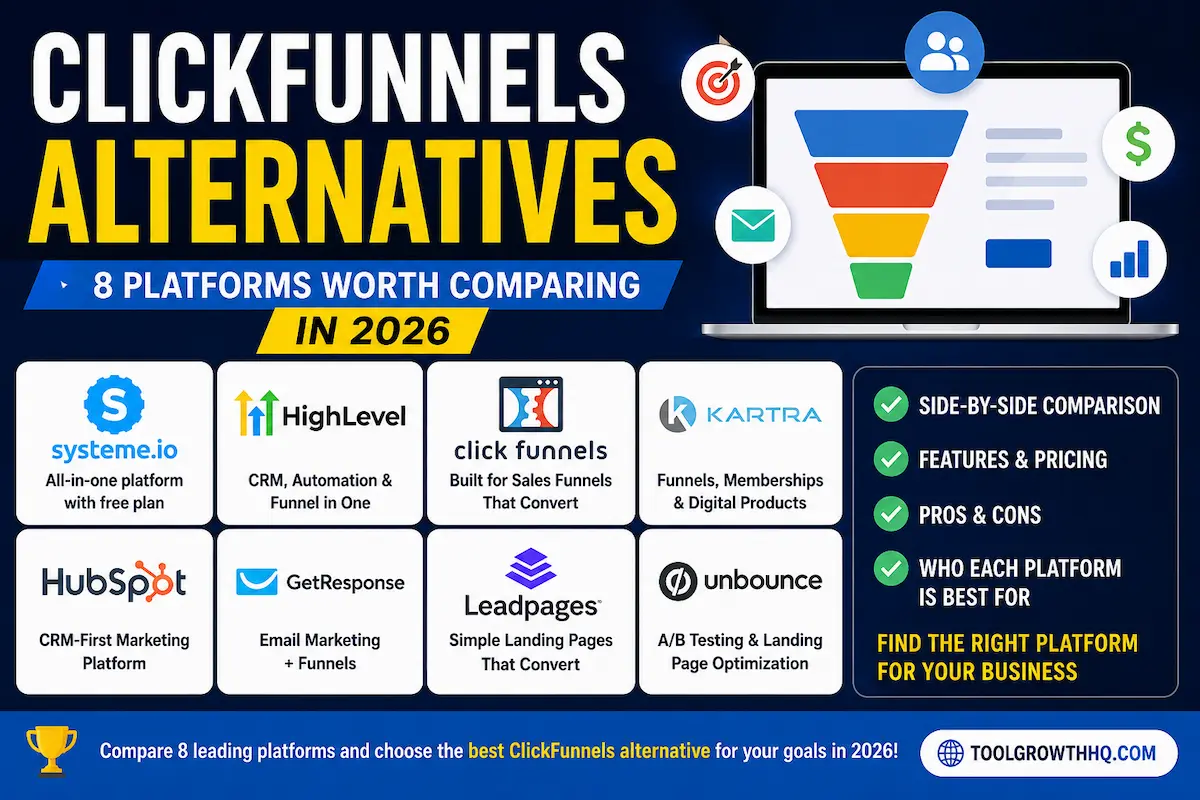
- 8 ClickFunnels Alternatives Compared
- Comparison Table
- Pros and Cons of Switching
- Who Should Consider Switching
- Who Should Stick With ClickFunnels
- A Simple Decision Guide
- Frequently Asked Questions
- Alternatives to Consider Based on Your Priority
- Final Verdict
Quick Answer
There isn’t one ClickFunnels alternative that is best for everyone.
Systeme.io is our strongest starting point for solo marketers, creators, coaches, and small businesses that want funnels and email marketing without committing to a large monthly software bill from day one.
GoHighLevel is the stronger choice when your funnel is only one part of a larger lead-management system and you also need CRM, automation, booking, communication, or multiple accounts.
ClickFunnels itself can still be the better choice if your business is heavily focused on sales funnels and you already value its ecosystem, templates, and funnel-specific workflow.
For more specialized requirements, GetResponse, Leadpages, Unbounce, HubSpot, Kartra, and Webflow can make sense — but they solve somewhat different problems.
Quick Verdict
| What you need | Our pick | Why |
|---|---|---|
| Lowest-cost starting point | Systeme.io | Free entry-level plan plus funnels, email, and courses in one place |
| CRM + funnels + automation | GoHighLevel | Built around CRM, workflows, communication, and multiple accounts |
| Funnel-focused workflow | ClickFunnels | Purpose-built around sales funnels and related conversion workflows |
| Email-first marketing | GetResponse | Email marketing and automation are central to the platform |
| Landing pages only | Leadpages | Simpler if you don’t need a complete funnel ecosystem |
| Landing-page testing | Unbounce | Built for marketers focused on landing-page experimentation |
| CRM-first marketing | HubSpot | Strong choice when CRM is the center of the business stack |
| Maximum design control | Webflow | Full CMS and design flexibility beyond a typical funnel builder |
Why People Look for a ClickFunnels Alternative
Usually, the reason isn’t that ClickFunnels suddenly became unusable.
More often, the business has changed.
A beginner might discover that they only need one landing page and an email sequence. An agency might realize that managing leads and client accounts is more important than having another collection of funnel templates. A growing business may want more design control over its website.
There is also the simple question of cost.
At the time of writing, ClickFunnels’ published 2026 pricing starts at $97/month for the Launch plan, while Systeme.io has a $0 entry-level plan and HighLevel’s Starter plan is listed at $97/month. Pricing, features, limits, and trial terms can change, so you should verify the current offer before subscribing.
If you’re specifically comparing ClickFunnels’ current plans, our ClickFunnels pricing explained article goes into the plan structure in more detail.
The important point is that price alone shouldn’t decide the move. Switching platforms also has a cost in time, migration work, integrations, tracking, email sequences, and learning.
How We Compared These Platforms
Rather than comparing every available feature, we focused on the things that can actually change your decision:
- Funnel building: How suitable is the platform for landing pages and multi-step funnels?
- Email marketing: Can you capture, segment, and follow up with leads?
- Automation: How much of the follow-up process can be automated?
- CRM capabilities: Does the platform help you manage leads beyond the funnel?
- Ease of use: How difficult is it for a small team or solo operator to learn?
- Cost: Does the pricing model make sense for the size of your operation?
- Scalability: Will the platform still make sense when your campaigns become more complex?
- Use-case fit: Is the platform genuinely suitable for the type of business you’re running?
One important limitation: we have not tested all eight platforms in identical real-world campaigns, so this is not a claim that one platform will produce a specific conversion rate or revenue result for every business.
The goal is simpler: help you narrow the shortlist before you spend money or take on a migration.
8 ClickFunnels Alternatives Compared
1. Systeme.io
Systeme.io is probably the first alternative we’d investigate if you’re starting from scratch and don’t want to build your marketing stack from several different subscriptions.
It combines funnels, email marketing, courses, automation, and other marketing features in one platform. That matters because the real cost of a funnel isn’t always the funnel builder itself. Once you add email software, landing pages, automation, and other services, a cheap-looking setup can become surprisingly expensive.
- Entry-level plan: Free (published limits apply on contacts, funnels, and emails)
- Paid tier starting point: Startup plan under $50/month, based on current published pricing
- Built-in features: Funnel builder, email marketing/automation, course hosting, blogging, and affiliate management in a single dashboard
- Learning curve: Marketed as beginner-friendly, with fewer configuration screens than CRM-first platforms
The trade-off is flexibility. If you want highly customized page designs or complicated automation logic, you may eventually find the platform less flexible than more advanced systems.
Best for: Beginners, solo founders, creators, coaches, and small businesses that want an all-in-one starting point without a large starting bill.
Not ideal for: Businesses that need highly complex automation logic or maximum page-design freedom.
If you want to see how it compares specifically with ClickFunnels, read our Systeme.io vs ClickFunnels comparison. We also have a detailed Systeme.io review and a separate Systeme.io pricing guide.
Affiliate link: Check Systeme.io’s current plans. If you sign up through this link, we may earn a commission at no additional cost to you.
2. GoHighLevel
GoHighLevel takes a different approach from a traditional funnel builder. Funnels are important, but the platform is built around a much broader CRM and marketing system.
That distinction matters.
If your business needs landing pages plus lead pipelines, automated follow-up, appointment booking, email and SMS communication, reporting, and multiple accounts, a funnel-only platform may eventually feel limiting.
- Starter plan: Listed at $97/month, based on currently published pricing
- Higher tiers: Designed for agencies needing multiple sub-accounts and white-label options
- Included capabilities: CRM, pipeline management, appointment booking, SMS/email communication, and workflow automation bundled into one system
- Trial availability: A free trial is currently advertised, though trial length and terms can change
The downside is complexity. More features mean more settings, more concepts to learn, and more opportunities to build a system that is unnecessarily complicated.
Best for: Agencies, consultants, businesses with multiple campaigns, and teams that need CRM and automation alongside funnels.
Not ideal for: Someone who only needs one simple landing page and a basic email sequence.
Our ClickFunnels vs GoHighLevel comparison is useful if you’re deciding specifically between these two platforms.
Affiliate link: Explore GoHighLevel. If you sign up through this link, we may earn a commission at no additional cost to you.
3. Kartra
Kartra is aimed at businesses that want more than a basic landing-page-and-email setup. Its ecosystem covers areas such as funnels, memberships, digital products, checkout, and customer communication.
That makes it interesting for creators and businesses selling digital products where the customer journey continues after the initial opt-in or purchase.
- Core modules: Funnels, membership sites, help desk, checkout/cart, and email automation in one platform
- Best fit for volume: Businesses managing an active catalog of digital products or courses rather than a single offer
The downside is that an all-in-one platform can become expensive and unnecessarily complex when you only use a small percentage of its features.
Best for: Established digital-product businesses, course creators, and membership-based businesses.
Not ideal for: Beginners who simply need a low-cost landing page and email sequence.
4. HubSpot
HubSpot is arguably the biggest departure from the traditional ClickFunnels model on this list.
Instead of starting with the funnel and adding customer management later, HubSpot puts the CRM at the center. Marketing, sales, customer management, reporting, and automation can then be built around that core.
That can be a major advantage for a growing business that needs a proper view of its leads and customers.
But if your only goal is to create a high-converting sales funnel quickly, HubSpot may feel like far more software than you actually need.
- Free CRM tier: Available, with paid Marketing Hub tiers layered on top for funnel and campaign features
- Core strength: Contact-level tracking across marketing, sales, and service in a single record
Best for: Businesses where CRM and customer management are central to the operation.
Not ideal for: Someone looking primarily for a dedicated funnel-building experience.
5. GetResponse
GetResponse started with email marketing, and that background still influences how the platform feels.
If your business relies heavily on newsletters, email sequences, webinars, lead nurturing, and campaign automation, having those capabilities closely connected can be useful.
The question is whether you need a complete funnel-building ecosystem or primarily want a strong email marketing platform with additional funnel features.
- Core strength: Email automation, newsletter tools, and built-in webinar hosting
- Funnel features: Available as an add-on layer rather than the platform’s original focus
Best for: Email-first marketers, webinar businesses, and businesses that treat email as a primary acquisition and conversion channel.
Not ideal for: Businesses looking specifically for a funnel-first platform with extensive funnel-specific workflows.
If email marketing is actually your main requirement, compare this type of platform with the options in our best email marketing platforms for small businesses guide.
6. Leadpages
Leadpages makes sense when you don’t actually need to replace your entire marketing stack.
If you already have an email provider and CRM but want a straightforward way to create landing pages and capture leads, a specialist tool can be easier to manage than an all-in-one platform.
- Core strength: Landing page templates with conversion-focused layouts and built-in A/B testing
- Integration model: Designed to connect to your existing email/CRM tools rather than replace them
The trade-off is obvious: once your requirements expand into complex funnels, CRM, automation, or advanced customer journeys, you’ll need additional tools.
Best for: Businesses that mainly need landing pages and lead capture.
Not ideal for: Businesses looking for a complete funnel, CRM, and automation platform in one place.
For a broader comparison of this category, see our best landing page builders guide.
7. Unbounce
Unbounce is another specialist option, particularly interesting for marketers who care deeply about landing-page performance and testing.
That narrower focus can actually be an advantage. You don’t necessarily need an all-in-one platform just because one exists.
If your existing email and CRM systems already work well, putting your budget into better landing pages and experimentation may be a more sensible decision.
- Core strength: AI-assisted copy and layout testing built specifically around landing-page conversion rate
- Best fit: Paid-traffic campaigns where small page changes materially affect cost per acquisition
Best for: Paid-traffic marketers and teams focused heavily on landing-page optimization and testing.
Not ideal for: Businesses looking to replace their CRM, email platform, and entire funnel stack at the same time.
8. Webflow
Webflow is the option we’d consider when design control matters more than having a traditional funnel-builder experience.
It is fundamentally a website and CMS platform, not a direct ClickFunnels clone. That means you can build much more customized website experiences, but you may need additional tools and integrations for forms, payments, automation, and other funnel functions.
- Core strength: Full visual control over layout, typography, and interactions with a native CMS
- Trade-off: No native funnel, email, or CRM features — these require third-party integrations
For a design-focused brand, that trade-off can be worth it. For a beginner who wants a funnel running this afternoon, it probably isn’t.
Best for: Design-conscious businesses, agencies, and teams comfortable with a more flexible website-building workflow.
Not ideal for: Beginners who want an all-in-one funnel system with minimal setup.
ClickFunnels Alternatives Comparison Table
| Platform | Best For | Primary Strength | Main Trade-Off |
|---|---|---|---|
| Systeme.io | Beginners and small businesses | All-in-one value, free entry plan | Less design and automation depth |
| GoHighLevel | Agencies and CRM-driven businesses | CRM + automation + multi-account | Steeper learning curve |
| Kartra | Digital products and memberships | Broad all-in-one ecosystem | Can be more platform than you need |
| HubSpot | CRM-first businesses | Customer and sales management | Less funnel-focused |
| GetResponse | Email-first marketers | Email, automation, webinars | Not primarily funnel-first |
| Leadpages | Landing pages | Focused page creation with A/B testing | Requires other tools for a complete stack |
| Unbounce | Paid-traffic teams | Landing-page optimization | Not a complete CRM/funnel replacement |
| Webflow | Design-focused businesses | Full design and CMS flexibility | More setup and integrations required |
Important: Pricing, feature limits, trials, and plan names can change. Treat the table as a decision guide rather than a permanent pricing sheet — always confirm current terms on each vendor’s site before subscribing.
Pros and Cons of Switching Away From ClickFunnels
Potential advantages
- Lower starting cost: Some alternatives let you start with a free or lower-cost plan.
- Better fit: A specialist platform can be easier when you only need landing pages or email.
- Stronger CRM: Platforms such as GoHighLevel can put customer management much closer to the funnel.
- More design freedom: Website-focused platforms can provide substantially more control over the final experience.
- Different pricing models: You may find another platform’s limits fit your traffic and contact volume better.
Potential disadvantages
- Migration takes time: Pages, domains, forms, tracking, integrations, and email sequences may all need attention.
- You’ll need to learn another platform: Moving does not automatically make the system simpler.
- Some features may disappear: A cheaper platform can have fewer capabilities in areas you currently rely on.
- Your existing integrations may need rebuilding: This is easy to underestimate.
- Multiple tools can recreate the original problem: Saving money on the funnel builder doesn’t help if you then need three extra subscriptions.
Before switching, make a list of everything your current funnel actually uses. Don’t compare platforms based only on their homepage feature lists.
Who Should Consider a ClickFunnels Alternative?
You should seriously investigate alternatives if one or more of these situations sounds familiar:
- You are paying for ClickFunnels features that you rarely use.
- You mainly need a landing page and email sequence rather than a complete funnel ecosystem.
- Your business has grown and CRM or pipeline management is now a bigger priority.
- You are an agency and need multiple client accounts.
- You want more control over website design.
- You are starting a new project and don’t want a large recurring software commitment immediately.
- Your current stack requires too many disconnected tools.
If you’re completely new to funnels, you may also want to start with our best funnel builder for beginners comparison before deciding whether you even need a ClickFunnels-level platform.
Who Should Stick With ClickFunnels?
Switching isn’t automatically an upgrade.
ClickFunnels can still be the sensible choice if your existing business is already built around it and the system is working.
For example, staying may make sense if:
- Your existing funnels are performing well.
- Your team already knows the platform.
- Your integrations are working reliably.
- You rely heavily on ClickFunnels-specific workflows.
- The cost of migrating is greater than the savings you would realistically achieve.
- You value its funnel-focused ecosystem more than having a broader CRM platform.
In other words, don’t switch software simply because another platform has a longer feature list.
A working funnel is often more valuable than a theoretically better platform that takes months to rebuild.
Our ClickFunnels review covers the platform itself, while our ClickFunnels vs GoHighLevel comparison is better if CRM and automation are your main concerns.
A Simple Decision Guide
If you’re still unsure, use this shortcut.
Choose Systeme.io if…
- You are starting from scratch.
- You want to keep your initial software costs low.
- You want funnels and email in the same platform.
- You don’t need extremely advanced automation.
Affiliate link: See Systeme.io’s current plans. We may earn a commission if you sign up through this link.
Choose GoHighLevel if…
- You need a CRM as much as you need funnels.
- You manage multiple campaigns or client accounts.
- You want deeper workflow automation.
- You need lead management, appointments, and communication in the same ecosystem.
Affiliate link: Explore GoHighLevel. We may earn a commission if you sign up through this link.
Choose ClickFunnels if…
- Your business is strongly centered around sales funnels.
- You already use ClickFunnels and migration would create unnecessary work.
- You value its funnel-focused ecosystem and templates.
- The platform’s workflow matches the way your team already operates.
Affiliate link: Start the ClickFunnels free trial. We may earn a commission if you sign up through this link.
Choose a specialist platform if…
You already have most of your marketing stack in place and only need to improve one part of it.
For example, an email-first business may prefer an email marketing platform. A paid-traffic team may want a specialist landing-page testing tool. A design-led brand may prefer Webflow.
Sometimes the best ClickFunnels alternative is not another all-in-one platform at all.
Frequently Asked Questions
What is the best free ClickFunnels alternative?
For someone who wants to start without paying for a subscription immediately, Systeme.io is one of the strongest options to investigate because it currently offers a free entry-level plan.
That doesn’t automatically make it the best choice for every business. If you need advanced CRM functionality, for example, you may quickly find that a different platform fits better.
Is GoHighLevel better than ClickFunnels?
Not universally.
GoHighLevel is generally the more natural fit when CRM, lead management, automation, communication, and multiple accounts are central to your operation. ClickFunnels makes more sense when the funnel itself is the center of the workflow.
For a detailed comparison, see our ClickFunnels vs GoHighLevel guide.
Is Systeme.io better than ClickFunnels?
It can be, especially for a beginner or small business that wants a lower-cost all-in-one setup.
ClickFunnels can still be the better fit if you need its specific funnel ecosystem and are comfortable with its pricing.
Our Systeme.io vs ClickFunnels comparison looks at the decision more closely.
Is there a free ClickFunnels plan?
ClickFunnels currently offers a free trial rather than a permanently free plan. Trial terms and plan details can change, so check the current offer before signing up.
What is the cheapest ClickFunnels alternative?
There isn’t a single answer because “cheapest” depends on what you need included.
If you only need a landing page, a specialist page builder may cost less. If you need funnels plus email marketing, an all-in-one platform such as Systeme.io may provide better overall value than combining several separate services.
Should I move from ClickFunnels if I’m already using it?
Not automatically.
If your funnels work, your integrations are stable, and your team is comfortable with the platform, switching purely to save a little money may not be worthwhile.
Calculate the actual migration cost first: rebuilding pages, reconnecting domains, moving forms, checking tracking, recreating automations, and testing the entire customer journey.
Is Webflow a direct ClickFunnels replacement?
No. Webflow is primarily a website and CMS platform. It gives you much more design control, but you may need additional tools and integrations to recreate the funnel-specific functionality you would normally expect from ClickFunnels.
Do I need an all-in-one funnel platform?
No.
If you already have an email provider, CRM, analytics setup, and other marketing tools that work well, adding another all-in-one platform may create unnecessary overlap.
On the other hand, if your current stack is held together by several disconnected subscriptions, consolidating those tools can make sense.
Can I switch platforms without losing my existing leads and email list?
In most cases, yes. Email contacts, tags, and basic subscriber data can typically be exported from ClickFunnels and imported into the new platform. What’s harder to migrate cleanly is automation logic (if/then sequences, tagging rules) and page-level tracking — those usually need to be rebuilt manually rather than imported.
How long does a typical migration away from ClickFunnels take?
There’s no fixed number, since it depends on how many funnels, automations, and integrations you’re running. A single simple funnel with one email sequence can often be rebuilt in a few days. An agency account with dozens of funnels, multiple integrations, and complex automation logic across several clients is a multi-week project. Budget more time than you expect for testing before you cancel your existing subscription.
Alternatives to Consider Based on Your Priority
If none of the “choose X if” sections above gave you a clear answer, use this as a quick cross-reference:
- If you need a budget-first option: Start with Systeme.io’s free plan before paying for anything.
- If you need advanced CRM and multi-account management: Compare GoHighLevel against HubSpot’s paid Marketing Hub tiers.
- If email is your primary channel: Compare GetResponse against Systeme.io’s built-in email tools rather than adding a third platform.
- If you only need better-converting landing pages: Compare Leadpages and Unbounce directly rather than migrating your whole stack.
- If brand and design control matter most: Webflow is worth the extra setup time; funnel-specific features can be added via integrations.
Final Verdict
ClickFunnels still has a legitimate place in the funnel-builder market, but there is no reason to assume it is automatically the right platform for every business.
For most beginners and budget-conscious users, start by looking at Systeme.io. It gives you a relatively low-risk way to build funnels and email marketing without immediately committing to a large monthly software stack.
For agencies and businesses that need CRM and automation alongside funnels, GoHighLevel deserves a closer look. Its broader feature set is useful when the real problem is managing leads and follow-up rather than simply creating another landing page.
For businesses already invested in ClickFunnels, staying may be the smarter decision. Software migration has a real cost, and changing platforms doesn’t guarantee better conversions.
And for specialized requirements, don’t be afraid to choose a specialist. GetResponse can make more sense for an email-first operation. Leadpages or Unbounce may be better if landing pages are the main requirement. Webflow can be the better route when design control matters most. HubSpot can make sense when the CRM is the center of the business.
The best ClickFunnels alternative is therefore not the platform with the longest feature list.
It’s the one that solves your actual bottleneck without adding a new one.
Before You Switch: A 5-Minute Checklist
Before cancelling ClickFunnels or signing up for an alternative, answer these five questions:
- What do I actually use in ClickFunnels today?
- Which features do I need every week?
- What will I have to rebuild after switching?
- Will the new platform reduce my total software cost or simply move the cost somewhere else?
- Will my team find the new platform easier to operate?
If you cannot answer those questions yet, don’t rush the migration.
Compare the actual workflow first, then choose the software.
Related Guides From ToolGrowthHQ
- ClickFunnels Review 2026
- ClickFunnels Pricing Explained
- Systeme.io vs ClickFunnels
- ClickFunnels vs GoHighLevel
- Best Sales Funnel Software
- Best Free Funnel Builders
- Best Landing Page Builders
- Best All-in-One Marketing Platforms
Final Note on Affiliate Links
Some links in this article are affiliate links, which means ToolGrowthHQ may earn a commission if you sign up or purchase through them. This does not increase your price.
We have intentionally not added affiliate links for every platform mentioned. The purpose of this comparison is to help you choose a suitable tool, not to make every recommendation monetized.
Compliance note: This article is provided for informational purposes and is not legal advice. Advertising, affiliate disclosure, privacy, email marketing, and consumer-protection requirements can vary by country, platform, and affiliate program. Always check the current rules that apply to your business and traffic sources.
About the Author
T. Vasireddi is the founder and editor of ToolGrowthHQ, creating practical, research-based guides on web hosting, WordPress, SaaS tools, and digital marketing.
His focus is on providing clear, accurate, and useful information to help readers make better technology and software decisions.
Connect with him:
Follow for more AI tool reviews, SaaS comparisons, and digital marketing tips.