Advertisement & Affiliate Disclosure: This review contains affiliate links. If you sign up through one of our ClickFunnels links, ToolGrowthHQ may earn a commission at no additional cost to you. This does not affect what you pay or how we evaluate ClickFunnels. Our recommendations are based on the platform’s published features, pricing, limitations, and suitability for different types of businesses.
How we researched this review: This comparison is based on publicly available pricing and feature documentation, vendor specifications, and verified user reviews, updated as of August 2026. We evaluate tools based on feature depth, pricing transparency, plan limits, ease of use, and suitability for different business types to help you make informed decisions. We do not accept payment for favorable coverage.
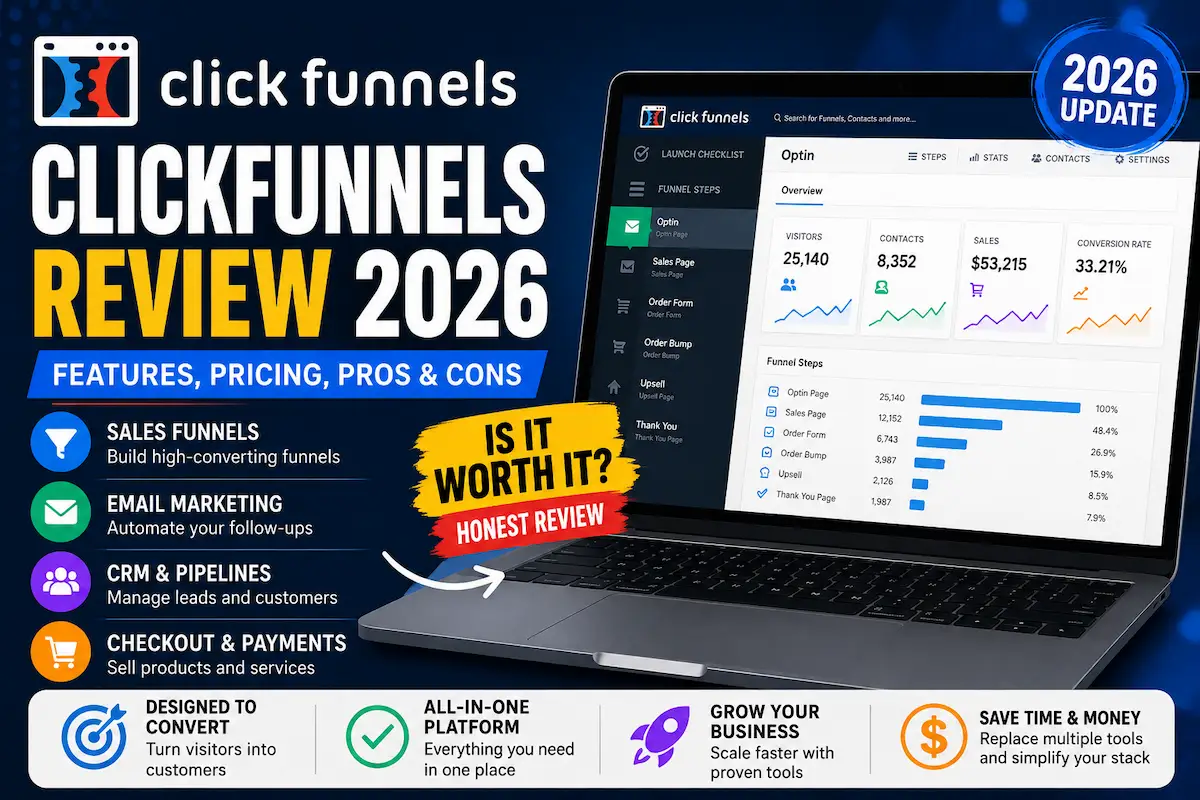
This ClickFunnels review looks at the platform from a practical business perspective. If you’re considering ClickFunnels, the important question isn’t simply whether the software has enough features. It does. The more useful question is whether your business actually needs a dedicated funnel platform badly enough to justify the cost.
That’s what this review is about. Rather than repeating a feature list, we’ll look at what ClickFunnels is good at, where it can be overkill, how the current pricing works, and which types of businesses are most likely to get their money’s worth.
Table of Contents
- Quick Answer
- Quick Verdict
- What Is ClickFunnels?
- Key Features
- ClickFunnels Pricing
- Pros
- Cons
- Who Should Use ClickFunnels?
- Who Should Avoid ClickFunnels?
- Alternatives to ClickFunnels
- Frequently Asked Questions
- Final Verdict
Quick Answer
ClickFunnels is worth considering if your business depends on sales funnels rather than simply needing a website or a few landing pages.
The platform brings funnel building, landing pages, checkout, email marketing, CRM functionality, courses, and other marketing tools into one system. That can be genuinely convenient when your sales process involves several steps, such as a lead capture page followed by an offer, checkout, upsell, and follow-up sequence.
The trade-off is price. ClickFunnels starts at $97 per month on monthly billing, so it is not the tool I’d recommend simply because you’re curious about funnel marketing. If you’re still validating your first offer, a cheaper platform can make more sense.
On the other hand, if you’ve already proved that your funnel works and you’re looking for a more complete funnel-focused platform, ClickFunnels deserves a serious look.
Quick Verdict
- Best for: Course creators, coaches, consultants, and businesses that rely heavily on multi-step sales funnels
- Best reason to choose it: You want funnels, checkout, marketing tools, and customer journeys managed in one platform
- Best reason to avoid it: You only need a simple website or landing page
- For beginners: Usable, but expect to spend some time learning the platform
- For budget-conscious users: Compare it with lower-cost alternatives before committing
- Overall take: A capable funnel platform, but its value depends heavily on whether you will actually use the funnel ecosystem
What Is ClickFunnels?
ClickFunnels is a SaaS platform built around a relatively simple idea: instead of sending every visitor to a general-purpose website and hoping they figure out what to do next, you create a deliberate path that moves them toward a specific action.
For example, a funnel might begin with a lead-magnet landing page, continue to a sales page, move to checkout, and then offer an upsell. Another business might use a webinar registration page followed by an email sequence and a product offer.
That funnel-first approach is what separates ClickFunnels from a conventional website builder.
Over time, ClickFunnels has expanded beyond funnel pages. The current platform also includes tools for websites, landing pages, email marketing, CRM and opportunity management, courses and communities, checkout, and other marketing workflows.
That breadth is useful, but it also creates the main question you should ask before buying: will you actually use enough of the platform to justify paying for it?
Key Features
Sales Funnel Builder
This is the centre of the ClickFunnels experience.
You can create multi-step funnels and connect pages together without building the entire customer journey from scratch. Depending on your campaign, that can include opt-in pages, sales pages, checkout pages, upsells, downsells, and other steps.
Concrete specifics worth knowing: the funnel builder uses a drag-and-drop visual editor with no coding required, includes pre-built funnel templates organized by use case (webinar, product launch, lead generation), and supports A/B split testing on funnel steps. For a business that already understands its offer and wants a structured sales journey, this can save a considerable amount of setup work.
Landing Page and Website Builder
ClickFunnels isn’t limited to traditional funnel pages. You can also create landing pages and website pages using a visual editor.
That’s useful if you want your marketing pages and funnels to live inside the same platform. However, I wouldn’t choose ClickFunnels solely because you need a basic business website. There are simpler website-focused options for that job.
If landing pages are your main requirement, our guide to the best landing page builders is a better place to compare dedicated alternatives.
Email Marketing and Automation
ClickFunnels includes email functionality so businesses can build follow-up campaigns without automatically needing a separate email marketing platform.
This becomes particularly useful when email actions are connected to what happens inside the funnel. Someone who opts in, purchases, or moves through a particular stage can be handled differently from someone who never takes the next step.
For businesses with highly specialised email-marketing requirements, a dedicated email platform may still offer more depth. But for users who value consolidation, having email tools alongside the funnel can be convenient.
CRM and Opportunity Management
ClickFunnels also includes CRM functionality designed around the sales process.
That can help businesses keep track of leads, customers, opportunities, meetings, and activity without immediately adding another CRM product to the stack.
I’d still compare the CRM against a specialist platform if CRM is the heart of your operation. ClickFunnels’ main strength remains the funnel and marketing journey rather than being a general-purpose enterprise CRM.
Courses and Communities
ClickFunnels can also be used to sell and deliver online courses and community-based products.
That’s particularly relevant for coaches, educators, and digital-product businesses that want the marketing funnel and the product-delivery experience connected in one system.
If the learning experience itself is the main product and you need a highly specialised course platform, however, you should compare ClickFunnels with platforms built specifically around education and memberships.
Checkout, Upsells and Order Flow
One of the strongest reasons to consider ClickFunnels is the connection between the funnel and the transaction itself.
Instead of treating the landing page, checkout, and post-purchase offer as completely separate systems, you can build them into a connected customer journey.
That matters for businesses where average order value is important. For example, a customer might purchase an initial product and then be presented with a relevant additional offer as part of the same buying journey.
Affiliate Management
ClickFunnels also provides affiliate-management functionality, but you shouldn’t assume it is included on every plan.
Because ClickFunnels changes features and limits between plans, businesses intending to run their own affiliate programme should check the current plan details before subscribing.
ClickFunnels Pricing
ClickFunnels pricing is much easier to understand when you separate monthly billing from the discounted annual rates.
As of 2026, the current ClickFunnels 2.0 pricing structure lists:
- Launch: $97/month, or $81/month when billed annually
- Scale: $197/month, or $164/month when billed annually
- Optimize: $297/month, or $248/month when billed annually
- Dominate: $5,997/year, available as an annual-only plan
| Plan | Monthly Price | Annual (per mo.) | Workspaces | Team Members | Contacts | Monthly Emails | Courses | Custom Domains |
|---|---|---|---|---|---|---|---|---|
| Launch | $97 | $81 | 1 | 2 | 10,000 | 50,000 | 3 | 5 |
| Scale | $197 | $164 | Higher | Higher | Higher | Higher | Higher | Higher |
| Optimize | $297 | $248 | Higher still | Higher still | Higher still | Higher still | Higher still | Higher still |
| Dominate | $5,997/yr | — | Highest | Highest | Highest | Highest | Highest | Highest |
The Launch plan is designed for a smaller operation and currently includes one workspace, two team members, up to 10,000 contacts, 50,000 emails per month, three courses, five custom domains, and unlimited visitors.
Higher plans increase limits such as workspaces, team members, contacts, email volume, courses, and custom domains. ClickFunnels also lists unlimited funnels and unlimited visitors across the current plans, although other resources remain plan-dependent.
Pricing and included limits can change, so don’t treat an old screenshot or an older review as the final word on what you’ll receive.
Check ClickFunnels’ current pricing and plan limits.
Is ClickFunnels Expensive?
Compared with free or low-cost funnel builders, yes. For context, Systeme.io’s paid plans start well under $50/month and it offers a permanent free tier, which is a meaningfully different price point for someone still testing an offer.
But price alone doesn’t tell you whether it’s expensive for your business.
If a funnel generates enough additional revenue to justify the subscription, the monthly fee can become a relatively small operating expense. If you’re still trying to get your first few customers, however, paying nearly $100 per month for funnel software may be difficult to justify.
That’s why I wouldn’t recommend choosing ClickFunnels simply because it has more features. Choose it when those features solve a problem you actually have.
ClickFunnels Free Trial
ClickFunnels currently offers a 14-day free trial (no credit card charge until the trial ends, provided you cancel in time). Be aware that the trial is not the same thing as a permanently free plan. According to ClickFunnels’ current support documentation, the card on file can be charged when the 14-day trial ends if the account hasn’t been canceled.
If you’re testing the platform, put the trial end date somewhere you’ll actually see it. That’s a small step, but it avoids an unnecessary subscription charge.
Start the ClickFunnels 14-day free trial.
Pros
- Funnel-first architecture: Built around complete multi-step sales journeys (opt-in → offer → checkout → upsell), not just standalone pages.
- Drag-and-drop visual editor: No coding required, with pre-built funnel templates by use case.
- All-in-one approach: Funnels, landing pages, checkout, email, CRM functionality, and courses are managed from the same platform, reducing the number of separate subscriptions.
- Good fit for digital offers: Coaches, course creators, consultants, and information-product businesses can build several parts of their sales process in one place.
- Built-in upsell and order-flow tools: Businesses can build post-purchase offers directly into the checkout journey instead of stopping at a single checkout page.
- Room to scale: Higher-tier plans provide substantially larger limits for teams, contacts, workspaces, emails, and courses (see pricing table above).
Cons
- Higher starting cost: $97/month on monthly billing is significantly above budget-focused alternatives like Systeme.io (paid plans well under $50/month, with a free tier available).
- Learning curve: A platform with this many moving parts — funnels, CRM, email, courses, checkout — takes longer to learn than a basic landing-page builder.
- Plan-dependent limits: Contacts, emails, workspaces, courses, and team members are capped differently on each tier (see the pricing table).
- Can be overkill: If you only need a simple website or one landing page, most of ClickFunnels’ ecosystem may go unused.
- Not necessarily the best specialist tool: Businesses that already have excellent dedicated CRM, email, website, or course software may not benefit from replacing everything with one platform.
Who Should Use ClickFunnels?
ClickFunnels makes the most sense when the funnel is an important part of how you sell.
Best for:
- Course creators selling programmes online
- Coaches selling consultations or coaching packages
- Consultants using lead-generation funnels
- Digital-product businesses
- Businesses using webinars to generate sales
- Marketers who rely on upsells and order flows
- Small teams that want several marketing functions under one roof
The common factor isn’t the industry. It’s the sales process.
If your customer journey naturally looks like traffic → lead → offer → checkout → follow-up, ClickFunnels is much easier to justify than it is for someone who simply wants a five-page company website.
Who Should Avoid ClickFunnels?
Not ideal for:
- A local service business that just needs a homepage, services page, contact form, and phone number
- Solopreneurs who only need a single landing page
- Beginners on a tight budget who haven’t validated an offer yet
- Businesses with an existing CRM, email platform, checkout system, course platform, and website builder they’re already happy with
For example, a local service business that needs a homepage, services page, contact form, and phone number probably doesn’t need a full funnel platform. The same applies if you’re only looking for a landing page — paying for a complete funnel ecosystem may create more complexity rather than less. Adding ClickFunnels on top of a stack you’re already happy with may create overlap instead of simplifying your workflow.
Alternatives to ClickFunnels
ClickFunnels isn’t automatically the right answer just because you want to build funnels.
- If you need a budget option: Try Systeme.io — paid plans well under $50/month, with a permanent free tier.
- If you need agency/multi-client tools: Try GoHighLevel — built around CRM, sub-accounts, and managing several client businesses at once.
- If you only need landing pages: See our Best Landing Page Builders guide.
- If budget is your first filter: See our Best Free Funnel Builders comparison.
Systeme.io
Systeme.io vs ClickFunnels is one of the more useful comparisons to make if you’re deciding between a lower-cost all-in-one platform and ClickFunnels.
Systeme.io is particularly attractive to creators and smaller businesses because it offers a permanent free plan and combines funnels, email, and other marketing functions at a much lower entry cost.
That doesn’t make it universally better. ClickFunnels offers a different level of funnel-focused functionality and may make more sense once the business has validated its sales process and needs more room to grow.
If you’re considering the broader market rather than only these two platforms, our guide to Systeme.io alternatives compares several other options.
GoHighLevel
GoHighLevel is worth considering when your requirements go beyond building funnels for one business.
Its agency-oriented approach, CRM functionality, client management, conversations, automation, and sub-account structure make it a very different proposition from ClickFunnels.
For a marketing agency managing several client businesses, GoHighLevel can be a more natural fit. For a course creator selling one product, that additional agency infrastructure may be unnecessary.
Dedicated Landing Page Builders
If you don’t need email automation, checkout flows, course delivery, or a complete funnel system, a dedicated landing-page platform may be the smarter choice.
Our Best Landing Page Builders guide covers the category in more detail.
Free Funnel Builders
If your main concern is keeping monthly costs low while you’re testing an idea, start with the free and lower-cost options before committing to a $97/month platform.
Our Best Free Funnel Builders comparison is useful if budget is your first filter.
How ClickFunnels Fits Into the Bigger Picture
If you’re completely new to funnel software and aren’t sure what type of platform you need, our Best Funnel Builder for Beginners guide is a better starting point than jumping straight into a paid subscription.
Frequently Asked Questions
Is ClickFunnels worth it?
ClickFunnels can be worth it if your business genuinely depends on multi-step sales funnels and you will use enough of the platform to justify the subscription.
If you only need a basic website or landing page, I wouldn’t pay for ClickFunnels simply for the sake of having more features.
Is ClickFunnels worth it for beginners?
It can be, but only once you already know what you’re selling. A beginner who is still figuring out their offer will likely get more value from a lower-cost tool like Systeme.io first, then move to ClickFunnels once the funnel is validated and needs to scale.
How much does ClickFunnels cost?
As of 2026, ClickFunnels lists Launch at $97/month, Scale at $197/month, and Optimize at $297/month on monthly billing. Annual billing reduces the effective monthly price to $81, $164, and $248 respectively. The Dominate plan is listed at $5,997 per year.
Because SaaS pricing can change, check the current plan page before making a purchase.
Can I use ClickFunnels without a website?
Yes. ClickFunnels includes its own website and page-building tools, so you can run funnels and pages entirely inside the platform without a separate site. That said, if you need a large, content-heavy website, a dedicated CMS may still serve you better.
What’s the difference between ClickFunnels 2.0 and the older version?
The current version (referred to as ClickFunnels 2.0 in vendor materials) expanded beyond funnel pages to add a broader website builder, CRM and opportunity management, and workspace-based team structure. Plan names and limits referenced in this review reflect the current 2.0 pricing structure as of 2026.
Does ClickFunnels offer a free trial?
Yes. ClickFunnels currently offers a 14-day free trial. The trial is not a permanent free plan, and you should check the cancellation terms before the trial ends.
Does ClickFunnels have CRM functionality?
Yes. ClickFunnels includes CRM and opportunity-management functionality. It can be useful for businesses that want customer and lead information connected closely to their funnel activity.
If advanced CRM capabilities are the central requirement of your business, compare it with dedicated CRM platforms before making the decision.
Can I use ClickFunnels for online courses?
Yes. ClickFunnels includes course and community functionality, allowing creators to connect the marketing funnel with product delivery.
Whether it is the best course platform for you depends on how much importance you place on the learning environment itself compared with the marketing and sales funnel.
What are the best ClickFunnels alternatives?
There isn’t one universal alternative. Systeme.io is attractive if keeping costs low is important. GoHighLevel is particularly interesting for agencies and businesses managing multiple client accounts. Dedicated landing-page builders make more sense when you don’t need a complete funnel ecosystem.
The best alternative depends on the specific part of ClickFunnels you actually need.
Is ClickFunnels better than Systeme.io?
Not across the board. ClickFunnels is the stronger consideration if your priority is a dedicated funnel ecosystem and you’re comfortable paying more. Systeme.io is more attractive when low cost, simplicity, and a generous free entry point matter more.
For the detailed comparison, read our Systeme.io vs ClickFunnels review.
Final Verdict
ClickFunnels is a capable funnel platform, but it isn’t automatically a good purchase for every business.
The strongest case for ClickFunnels is a business that already has an offer and wants a structured system for turning traffic into leads, customers, and additional sales. In that situation, having the funnel, landing pages, checkout, email, CRM functionality, and other pieces connected can be genuinely useful.
The weakest case is someone who simply needs a website or a single landing page.
At $97 per month on monthly billing, ClickFunnels is too expensive to recommend as a casual experiment when cheaper options can validate the same basic idea. But once the funnel itself becomes an important part of your revenue process, the calculation changes.
So my answer to “Is ClickFunnels worth it?” is: yes, for the right business — but don’t buy it just because the feature list is impressive.
Start with your sales process. If you genuinely need the funnel ecosystem, ClickFunnels is worth testing. If you don’t, save the money and use a simpler tool.
If ClickFunnels fits the way you sell, you can test the platform before committing to a long-term plan:
Start the ClickFunnels 14-day free trial
Affiliate disclosure reminder: This is an affiliate link, and ToolGrowthHQ may earn a commission if you sign up through it, at no additional cost to you.
About the Author
T. Vasireddi is the founder and editor of ToolGrowthHQ, creating practical, research-based guides on web hosting, WordPress, SaaS tools, and digital marketing.
His focus is on providing clear, accurate, and useful information to help readers make better technology and software decisions.
Connect with him:
Follow for more AI tool reviews, SaaS comparisons, and digital marketing tips.