Advertising / Affiliate Disclosure: Some links in this article are affiliate links. If you click an affiliate link and purchase or sign up for a qualifying service, ToolGrowthHQ may receive a commission at no additional cost to you. Affiliate relationships do not determine our editorial conclusions. We compare tools based on their use cases, features, usability, pricing considerations, and the trade-offs discussed in this article.
This comparison is based on publicly available pricing and feature documentation, vendor specification pages, and verified third-party user reviews (G2, Capterra), current as of August 2026. We evaluate tools based on pricing transparency, core feature set, ease of setup, and documented user feedback to help you make an informed decision. Pricing and features change frequently — always confirm current details on the vendor’s official pricing page before purchasing. [METHODOLOGY ADDED]
Quick Answer
If you’re wondering how to increase funnel conversion rates, don’t start by redesigning the entire funnel. Start by finding the exact stage where people are leaving, work out why they’re leaving, and fix that specific problem first.
That sounds obvious, but it is surprisingly easy to optimize the wrong thing. A beautiful landing page will not fix a broken checkout. A better sales page will not compensate for poorly targeted traffic. And changing a button from one color to another will not solve an offer that visitors simply do not understand.
The practical approach is to measure the funnel stage by stage, identify the most meaningful drop-off, investigate the reason behind it, and then test one change at a time.
If you’re building a funnel from scratch, our guides to best sales funnel software and the best funnel builders for beginners can help you compare the underlying platforms before you start optimizing.
How to Increase Funnel Conversion Rates: Start With the Right Benchmark
There isn’t one conversion-rate number that automatically makes a funnel “good.”
A funnel selling a $20 product to consumers should not be judged by exactly the same benchmark as a B2B funnel trying to generate sales calls for a $20,000 annual contract. Traffic source, audience quality, offer price, buying cycle, industry, device mix, and the number of steps in the funnel can all change the result.
That is why blindly copying an industry benchmark can sometimes lead you in the wrong direction.
A better starting point is your own historical data.
For example, imagine a funnel that receives:
- 10,000 landing-page visitors
- 2,000 people who move to the next step
- 500 people who reach the offer page
- 150 completed purchases
The important question isn’t simply whether 150 purchases is “good.”
The more useful question is: where is the funnel losing more people than expected, and why?
Once you identify the largest meaningful drop-off, you have a much clearer place to begin testing.
Step 1: Find Exactly Where People Are Dropping Off
Before changing a headline, redesigning a page, or rewriting your sales copy, identify the stage where the largest percentage of visitors leaves.
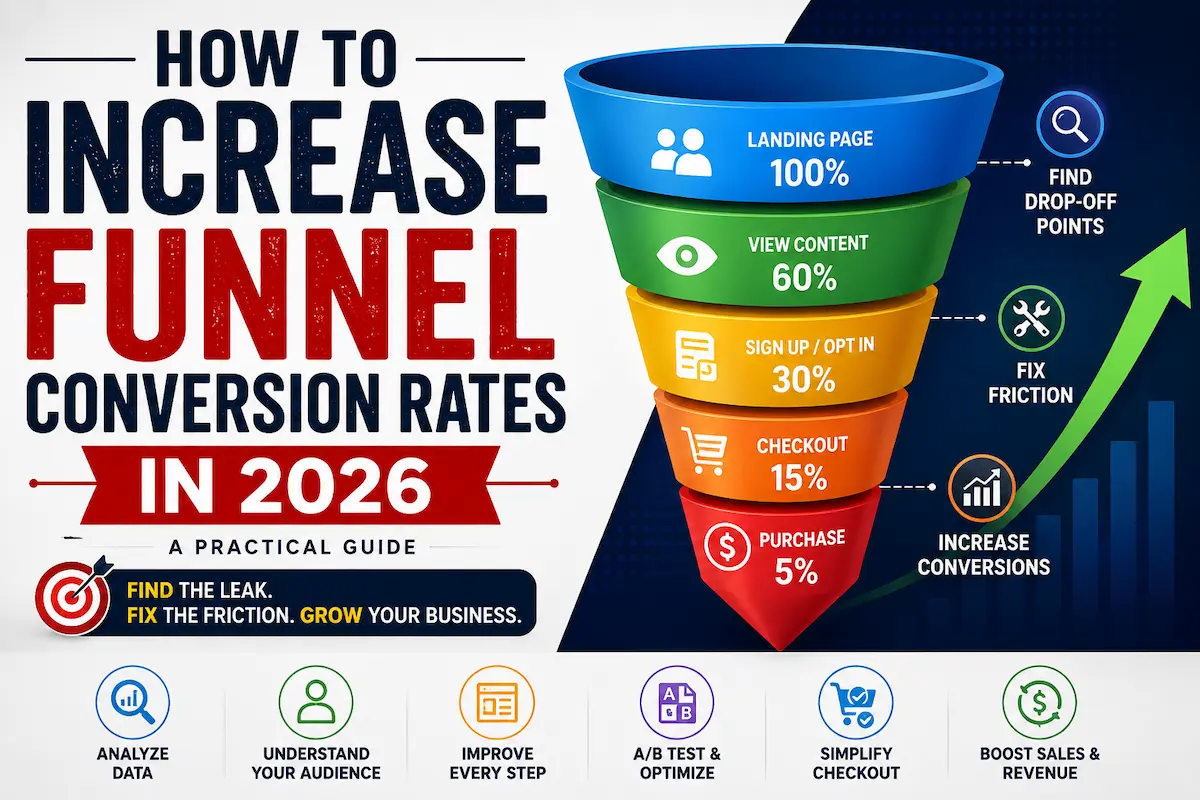
A typical funnel might look something like this:
- Landing page
- Opt-in or lead form
- Sales or offer page
- Checkout or booking page
- Purchase or completed action
Each stage should be measured separately. Looking only at the final conversion rate can hide the actual problem.
Once you know which step is leaking the most visitors, investigate that step specifically.
Use Funnel Reports
Step-by-step funnel reports can show how many people enter each stage and how many continue to the next one. This gives you a starting point based on actual visitor behavior rather than assumptions.
For example, if 60% of visitors move from your landing page to your offer page but only 8% move from the offer page to checkout, the offer page deserves more attention than the landing page.
Use Heatmaps and Session Recordings Carefully
Heatmaps and anonymized session recordings can help you understand what visitors actually do on a page.
You may discover that visitors:
- Ignore an important call-to-action
- Click an element that looks interactive but is not
- Stop reading before reaching the main offer
- Struggle with a form
- Repeatedly return to the pricing or FAQ section
These observations can give you useful hypotheses to test. They should not automatically be treated as proof that one specific design change will increase conversions.
Track Micro-Conversions
Not every useful action is a purchase.
Depending on the funnel, you might track video plays, form starts, scroll depth, product-page visits, demo requests, pricing-page visits, or clicks on important information.
These smaller actions can help you understand where visitors are becoming interested and where they start losing confidence.
Fix the highest-leverage problem first. A small improvement at the biggest leak can be more valuable than making several unrelated changes throughout the funnel.
Step 2: Rule Out a Traffic Problem Before You Touch the Funnel
A well-designed funnel can still convert poorly if it receives the wrong visitors.
Before rebuilding a page, check whether conversion rates differ significantly between traffic sources.
For example, visitors coming from a highly specific search query may behave very differently from visitors who clicked a broad social-media advertisement.
Use campaign tracking and UTM parameters where appropriate so you can compare traffic sources more accurately.
If one source converts substantially worse than the others, investigate the audience targeting and the promise made before the visitor reached your funnel.
The problem may be the traffic rather than the page.
Likewise, if one source consistently produces qualified visitors who move deeper into the funnel, that information can help you decide where future marketing effort deserves more attention.
Fixing the Top of the Funnel
The top of the funnel is where people first decide whether your offer is relevant to them.
The objective should not simply be collecting as many clicks or email addresses as possible. You want to attract and qualify the right attention.
Match the Message to the Traffic Source
If a visitor clicked an advertisement about a specific problem, the landing page should address that problem clearly.
For example, someone searching for a solution to slow WordPress hosting should not arrive on a generic page that talks about digital marketing in general.
The closer the message matches the visitor’s original intent, the easier it is for that visitor to understand why they are on the page.
Reduce Unnecessary Form Fields
Ask for information you genuinely need at that stage.
If an initial lead form asks for a phone number, company size, job title, budget, industry, and several other details before explaining the value of the offer, you may be creating unnecessary friction.
In many situations, a shorter initial form is easier to complete. Additional information can potentially be collected later when there is a stronger reason for the visitor to provide it.
Add Relevant Trust Signals
Trust signals should support the decision rather than overwhelm the page.
Depending on the business, useful examples may include customer numbers, relevant testimonials, recognizable publications, transparent policies, security information, case studies, or clear contact details.
Only use claims that you can substantiate. Avoid creating impressive-looking numbers or testimonials simply because they make a landing page appear more persuasive.
Fixing the Middle of the Funnel
The middle of the funnel is where visitors evaluate whether the solution is genuinely relevant to their situation.
Make the Offer Easy to Understand
A first-time visitor should be able to understand what you offer, who it is for, and what problem it solves without having to decode complicated marketing language.
Replace vague phrases with specific explanations wherever possible.
Instead of simply saying that a product is “powerful,” explain what the customer can actually use it to accomplish.
Give Visitors a Way to Learn Before They Commit
Not every visitor is ready to book a sales call or purchase immediately.
Depending on your business model, useful intermediate steps can include:
- Product demonstrations
- Free trials
- Detailed documentation
- Case studies
- Comparison pages
- Frequently asked questions
- Educational guides
These resources give cautious visitors a way to build confidence before making a decision.
Help Multiple Decision-Makers Evaluate the Offer
This is especially important for B2B products.
The person who discovers your website may not be the person who approves the purchase.
Clear documentation, case studies, pricing information, security details, implementation information, and ROI explanations can make it easier for that visitor to explain the product internally.
Fixing the Bottom of the Funnel: Checkout and Decision Pages
Near the final decision, visitors are often thinking more carefully about risk, price, trust, and whether the purchase is worth it.
Remove Unnecessary Distractions
Checkout and final decision pages should make the intended action obvious.
Remove unnecessary navigation, irrelevant links, excessive pop-ups, and unrelated offers that can distract visitors at the point of decision.
Make Pricing Easy to Compare
If your business has multiple plans, make the differences between them clear.
Visitors should not have to open several pages to understand what is included in each option.
If you highlight a recommended plan, explain why it may be suitable rather than using exaggerated claims.
Address Common Objections
A short FAQ can answer practical questions about billing, refunds, implementation, integrations, support, or cancellation.
These questions are often more useful than adding another paragraph of generic promotional copy.
Make Guarantees and Policies Specific
If you offer a refund policy or guarantee, explain its actual terms clearly.
Do not use vague language that could give visitors a misleading impression about what is guaranteed.
Don’t Stop at the Sale: Post-Purchase Conversion
A funnel does not necessarily end when someone completes the purchase.
For businesses that depend on repeat purchases, subscriptions, referrals, or long-term customer relationships, the post-purchase experience can be just as important as the initial conversion.
Use the Confirmation Page Properly
A confirmation page can explain what happens next, provide useful instructions, answer immediate questions, or present a genuinely relevant next step.
Avoid turning every confirmation page into a wall of additional offers.
Help Customers Reach Their First Meaningful Outcome
For software businesses, this could mean completing setup, importing data, creating the first campaign, or reaching another meaningful activation milestone.
For ecommerce businesses, it could mean providing delivery information, setup instructions, or guidance on getting the most value from the product.
The easier it is for a new customer to understand what to do next, the better the overall customer experience can be.
Ask for Reviews at the Right Time
A review request is generally more useful after the customer has had enough time to experience the product or service.
Keep the request straightforward and never pressure customers to leave a positive review.
Do You Need Dedicated Funnel Software?
You can build a funnel using a general website platform combined with separate analytics, forms, email marketing, and testing tools.
That approach can work well, particularly when you already have a website infrastructure that meets your needs.
The trade-off is that managing several systems can make funnel reporting and experimentation more complicated.
Dedicated funnel platforms can simplify the process by bringing page building, funnel steps, marketing automation, and related tools into one environment.
Ad — Affiliate link: If you want to explore a dedicated funnel platform, you can check the current ClickFunnels trial or offer. This is an affiliate link, so ToolGrowthHQ may receive a commission if you make a qualifying purchase or sign-up through it.
For businesses that want a broader all-in-one marketing environment, another option worth comparing is Systeme.io.
Ad — Affiliate link: You can explore Systeme.io’s current plans and features. This is an affiliate link, meaning ToolGrowthHQ may receive a commission from a qualifying action.
If your business also needs CRM, pipelines, automation, and customer-management features, a platform such as GoHighLevel may be worth evaluating.
Ad — Affiliate link: You can explore GoHighLevel to review its current platform and features. This is an affiliate link and ToolGrowthHQ may receive a commission from a qualifying action.
Comparison: Funnel Tracking and Optimization Tools
The table below reflects each vendor’s published entry-level pricing and core funnel-building capability. Verify current numbers on each vendor’s pricing page, since plans and limits change. [COMPARISON ENHANCED]
| Platform | Entry Price | Funnel Building | Free Trial | Best Fit |
|---|---|---|---|---|
| ClickFunnels | Starts at $97/month (higher tiers run up to roughly $297/month for more contacts and features) | Yes — drag-and-drop funnel and page builder | 14-day free trial | Creators, marketers, and businesses building dedicated, offer-focused funnels |
| Systeme.io | Free plan available (2,000 contacts, 3 funnels); paid plans start around $27/month | Yes — funnels combined with email, courses, and blog tools | Free plan doubles as a no-cost trial | Beginners and small businesses wanting an all-in-one platform on a tight budget |
| GoHighLevel | Starts at $97/month (Starter, 3 sub-accounts); $297/month Unlimited plan removes the sub-account cap | Yes — funnels combined with CRM, pipelines, and automation | 14-day free trial on every plan | Agencies and businesses that need funnels plus CRM and client-management workflows |
Features, limits, pricing, and plan availability can change. Always review the provider’s current information before making a purchase decision.
Pros and Cons of Using a Dedicated Funnel Platform
Pros
- Funnel steps, pages, and automation can be managed from one environment instead of stitching together separate tools
- Drag-and-drop editors with pre-built templates reduce the need for coding or a developer
- Built-in analytics and split-testing tools make it easier to see where a funnel is leaking visitors
- Native integrations (payment processors, email, calendars, Zapier) cut down on manual setup
- Faster page creation and editing for teams that regularly launch new funnels
Cons
- Entry-level plans often cap contacts, funnels, or sub-accounts — upgrading to remove those caps can meaningfully raise the monthly cost (for example, GoHighLevel’s jump from $97/month Starter to $297/month Unlimited)
- Some platforms have a real learning curve for automation and workflow features
- You may end up paying for CRM, automation, or agency features you don’t use if you only need simple landing pages
- Migrating funnels, contacts, and automations to a different platform later can take real time
- A dedicated funnel platform may be unnecessary for a very simple website with a single landing page
Who Should Use Each Type of Platform
- Best for ClickFunnels: Course creators, coaches, and ecommerce sellers who want a purpose-built, offer-focused funnel builder and are comfortable with a $97+/month starting price.
- Best for Systeme.io: Beginners, solopreneurs, and budget-conscious businesses that want funnels, email, and course hosting in one place without committing to a paid plan right away.
- Best for GoHighLevel: Agencies and businesses managing multiple clients or pipelines that need funnels bundled with CRM, SMS, and automation — not ideal if you only need a single simple funnel.
- Not ideal for any of the three: A single-page site with minimal traffic, where basic analytics and a simple page builder may be enough until volume justifies dedicated software.
Alternatives to Consider
- If you need a free or near-free starting point: Systeme.io’s free plan supports up to 3 funnels and 2,000 contacts with no credit card required.
- If you need advanced CRM and client automation: GoHighLevel’s Unlimited plan ($297/month) removes the sub-account cap that limits the $97/month Starter tier.
- If your priority is a dedicated, high-converting sales funnel rather than a full marketing suite: ClickFunnels focuses specifically on funnel and offer building rather than broader CRM functionality.
Common Mistakes That Quietly Kill Conversion Rates
1. Redesigning Everything at Once
If you change the headline, offer, page layout, pricing, form, CTA, and traffic source simultaneously, you may not know which change caused the result.
Whenever practical, isolate important changes so you can learn from the outcome.
2. Assuming the Offer Is the Problem
A low conversion rate does not automatically mean the product is bad.
The real issue could be poor traffic quality, unclear messaging, slow page performance, lack of trust, a confusing checkout, or a technical error.
3. Adding Too Many Form Fields
Every additional field creates another potential point of friction.
Only request information that has a clear purpose at that stage of the customer journey.
4. Ignoring Mobile Visitors
A funnel that looks good on a desktop monitor can still be frustrating on a smartphone.
Check mobile layouts, button sizes, forms, checkout steps, images, page speed, and text readability.
5. Testing Without Enough Data
An apparent improvement from a small number of visitors may simply be random variation.
Use a testing approach appropriate to your traffic volume and avoid declaring a winner too early.
6. Optimizing Only for the First Conversion
A higher opt-in rate is not necessarily an improvement if the additional leads are poorly qualified.
Look at the complete customer journey rather than optimizing one metric in isolation.
Frequently Asked Questions
How to Increase Funnel Conversion Rates Fastest?
If you’re learning how to increase funnel conversion rates, start with the largest measurable drop-off point rather than changing the entire funnel. Use funnel reports, analytics, or session recordings to identify where visitors leave, then test one specific improvement at a time.
What Is a Good Conversion Rate for a Funnel?
There is no universal conversion rate that applies to every funnel. The appropriate result depends on factors such as industry, offer price, traffic source, audience quality, buying cycle, and funnel structure.
For that reason, your own historical performance is often a more useful benchmark than copying a generic number from another business.
What Are the Main Stages of a Sales Funnel?
Most sales-funnel models include some variation of awareness, consideration, decision or purchase, and post-purchase retention.
Different businesses may use different names or add additional stages, but the underlying concept is the same: fewer people normally progress through each stage as they move closer to becoming customers.
Why Is My Funnel Conversion Rate Dropping?
Common causes include a change in traffic quality, a new audience, a change in search intent, a technical problem, slower page performance, unclear messaging, pricing changes, or stronger competition.
Start by comparing conversion rates by traffic source and funnel stage. That can help you determine whether the problem is primarily related to traffic or the funnel itself.
How Do I Calculate a Funnel Conversion Rate?
Divide the number of people who complete the target action by the number of people who entered that stage, then multiply by 100.
For example, if 1,000 people reach a page and 50 complete the target action:
50 ÷ 1,000 × 100 = 5%
For a multi-step funnel, calculate the conversion rate at each important stage rather than looking only at the final number.
Should I Use a Funnel Builder or a Normal Website?
It depends on your business model.
A traditional website can be a better fit for businesses that need content, navigation, multiple product categories, and broader information architecture.
A dedicated funnel builder can make more sense when the primary goal is guiding visitors through a defined sequence toward an action such as purchasing, booking a call, registering, or submitting a form.
Can A/B Testing Increase Funnel Conversions?
A/B testing can help you compare different versions of a page or element, but testing itself does not guarantee an improvement.
The important part is forming a sensible hypothesis, changing an element that could reasonably affect user behavior, collecting enough data, and interpreting the result carefully.
Is a Free Plan Like Systeme.io’s Enough for a Beginner’s First Funnel?
For a first funnel with modest traffic, a free plan that supports a handful of funnels and a few thousand contacts is usually enough to test an offer before committing to a paid plan. Beginners typically only need to upgrade once they exceed those contact, funnel, or automation limits.
Is It Worth Paying for GoHighLevel Instead of ClickFunnels If I Only Need One Funnel?
Not usually. GoHighLevel’s value comes from bundling CRM, SMS, and multi-client management alongside funnels, which mainly benefits agencies or businesses managing several accounts. A single-funnel business focused purely on page and offer building is generally better matched to a funnel-first tool.
Do These Platforms Charge Extra Fees Beyond the Listed Monthly Price?
It depends on usage. Beyond the base subscription, some platforms bill separately for things like email sending volume, SMS/voice usage, additional sub-accounts, or dedicated sending domains. Check each vendor’s current pricing page for usage-based charges before budgeting for a plan.
Final Verdict
How to increase funnel conversion rates is ultimately a diagnosis problem before it is a design problem.
Find the exact stage where visitors are leaving. Determine whether the issue comes from traffic quality, messaging, friction, trust, pricing, usability, or a technical problem. Then make one meaningful improvement and measure the result.
Businesses running funnels at meaningful volume can benefit from dedicated funnel software because centralized funnel management and related marketing tools can make experimentation easier.
ClickFunnels can be worth evaluating for offer-focused funnels. Systeme.io can be useful for businesses looking for a broader all-in-one marketing platform on a tighter budget. GoHighLevel is particularly worth comparing when CRM, automation, and customer-management workflows are important.
None of these platforms is automatically the right choice for every business. The right decision depends on your funnel structure, traffic volume, budget, technical requirements, and the amount of marketing automation you actually need.
Conclusion
A leaking funnel rarely needs a complete rebuild.
More often, it needs a closer look at the numbers.
Find the step where people are actually leaving, understand what is causing the drop-off, and fix that specific piece of friction. Then measure the result before moving on to another part of the funnel.
Over time, this process can turn conversion optimization from guesswork into a repeatable system.
Call To Action
If you’re currently piecing together several tools to build and analyze your funnel, it may be worth comparing a dedicated funnel platform with your existing setup.
Ad — Affiliate link: If ClickFunnels fits your use case, you can check the current ClickFunnels trial or offer. ToolGrowthHQ may receive a commission if you complete a qualifying action through this affiliate link, at no additional cost to you.
If ClickFunnels is not the right fit, compare the alternatives before committing to a long-term platform.
Related Guides
- Best Sales Funnel Software in 2026
- Best Funnel Builder for Beginners in 2026
- ClickFunnels Review 2026: Features, Pricing, Pros & Cons
- Systeme.io Review 2026: Is the Free All-in-One Platform Worth It?
- Systeme.io vs ClickFunnels (2026): Which Funnel Builder Is Worth It?
- ClickFunnels vs GoHighLevel (2026): Which One Actually Fits Your Business?
- Best All-in-One Marketing Platform in 2026
- Best Landing Page Builders in 2026
Frequently Related Topics
If you’re comparing funnel platforms, you may also want to read our guides on best free funnel builders, ClickFunnels alternatives, funnel builders for coaches, funnel builders for affiliate marketing, and funnel builders for ecommerce.
About the Author
T. Vasireddi is the founder and editor of ToolGrowthHQ, creating practical, research-based guides on web hosting, WordPress, SaaS tools, and digital marketing.
His focus is on providing clear, accurate, and useful information to help readers make better technology and software decisions.
Connect with him:
Follow for more AI tool reviews, SaaS comparisons, and digital marketing tips.