Advertising / Affiliate Disclosure: Some links in this article are affiliate links. The links marked as “Ad” are affiliate links, which means ToolGrowthHQ receives a commission when a qualifying sign-up or purchase is attributed to one of those links. This does not increase your price, and it does not determine how we compare the platforms. Our recommendations are based on the use case, features, pricing, and trade-offs discussed below.
This comparison is based on publicly available pricing pages, vendor feature documentation, and verified third-party reviews for ClickFunnels, Systeme.io, and GoHighLevel, current as of August 2026. We evaluate each platform on checkout experience, upsell and order-bump capability, email/automation depth, product-delivery support, and pricing structure, so you can match the tool to how you actually sell rather than to a generic feature list. Pricing and plan limits change over time, so always confirm current numbers on the provider’s own pricing page before subscribing.
Quick Answer
The best funnel builder for ecommerce depends on how you sell, what you sell, and how much control you need over checkout, upsells, and customer follow-up.
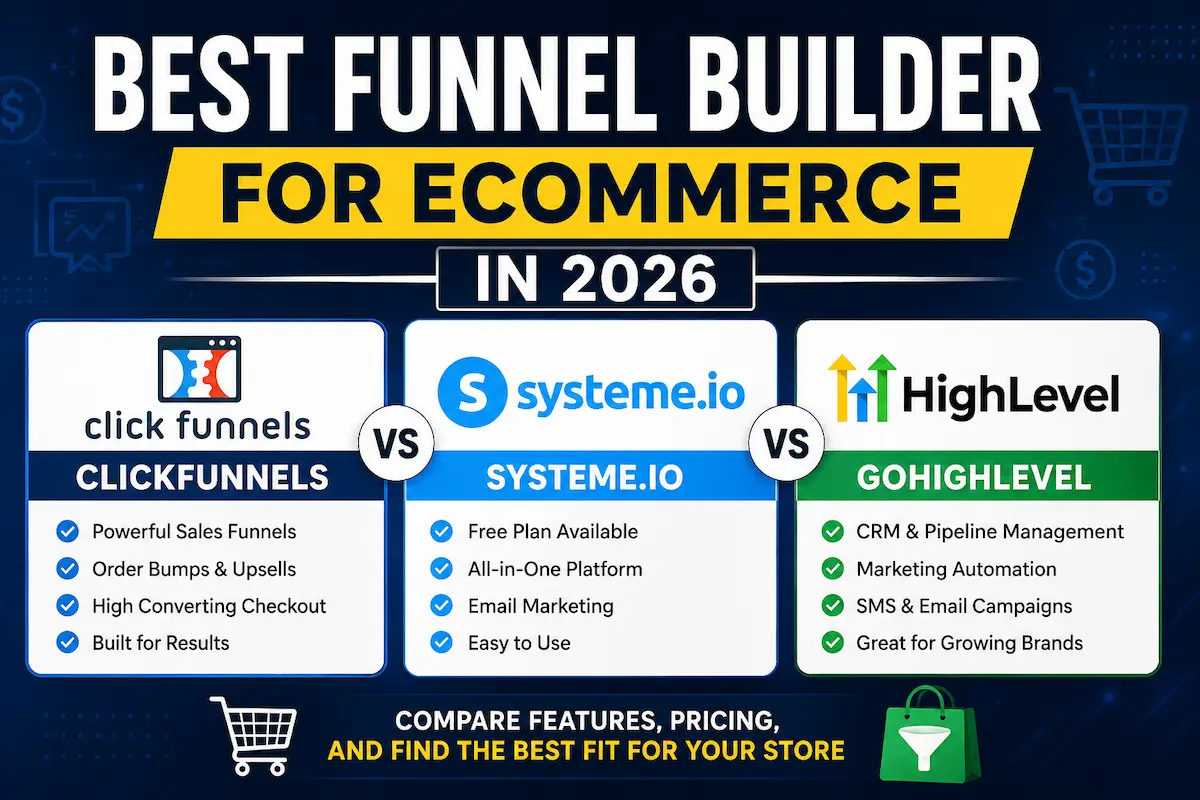
If you’re selling a single product or a small number of offers and want strong upsells and order bumps, ClickFunnels is the strongest fit of the three platforms compared here. If you’re testing an ecommerce idea on a tight budget, Systeme.io is the easier place to start because it has a free plan and combines funnels, email marketing, and other business tools in one platform. If your ecommerce operation also needs CRM, pipelines, automation, and broader customer management, GoHighLevel becomes more interesting.
But there’s an important exception: if you already run a large WooCommerce store with many products, a WooCommerce-native funnel or checkout solution may make more sense than moving your selling process into a general-purpose funnel platform.
Quick Verdict
- Best for single-product and offer-focused ecommerce: ClickFunnels
- Best for starting on a limited budget: Systeme.io
- Best for ecommerce plus CRM and automation: GoHighLevel
- Best for an established WooCommerce catalogue: A WooCommerce-native solution
The important part is not simply choosing the platform with the longest feature list. Your ecommerce model should determine the tool.
What Makes a Good Ecommerce Funnel Builder?
Ecommerce funnels are different from a simple lead-generation funnel.
When someone is buying a product, you have fewer opportunities to recover from unnecessary friction. A visitor might arrive from an ad, land on a product or offer page, go through checkout, and then see an upsell or complementary offer. Every step needs to make sense.
For that reason, I would look at five areas before choosing an ecommerce funnel builder:
- Checkout experience: Can customers move from the offer to payment without unnecessary steps?
- Order bumps and upsells: Can you increase the value of an order without making the buying process confusing?
- Email and automation: Can you follow up with leads and customers based on what they actually did?
- Product delivery: Does the platform support the type of product you’re selling, or will you need another system?
- Business fit: Are you selling one main offer, or are you operating a full product catalogue?
That last question is often overlooked. A funnel builder can be excellent at selling one carefully designed offer while being a poor replacement for a traditional ecommerce storefront.
ClickFunnels for Ecommerce
ClickFunnels is the most natural choice of the three if your ecommerce strategy revolves around a focused offer rather than a huge product catalogue.
Think about a business selling one main product with a complementary product, bundle, upgrade, or post-purchase offer. Instead of asking the customer to browse through dozens of unrelated products, you can guide them through a deliberate buying journey.
That’s where ClickFunnels makes the most sense.
Its funnel-first approach is particularly useful when your goal is to move a visitor from an offer page into checkout and then present relevant additional offers. This makes it a strong candidate for direct-response ecommerce campaigns, product launches, and businesses built around one or a few hero products.
It is less attractive if what you really need is a conventional online shop with hundreds of products, complex categories, inventory management, and catalogue-style browsing.
As of August 2026, ClickFunnels is sold on three core monthly tiers: Launch at $97/month, Scale at $197/month, and Optimize at $297/month, with a fourth Dominate tier billed at $5,997/year for larger operations. Annual billing brings the three main tiers down to roughly $81, $164, and $248 per month. Every tier includes unlimited funnels, landing pages, and visitor traffic, with the higher tiers mainly raising contact and email-volume limits rather than unlocking core funnel features. All plans come with a 14-day free trial and a 30-day money-back guarantee, giving you up to 44 days to test the platform before committing.
Ad: If your ecommerce business is built around a focused offer and you want to explore ClickFunnels’ funnel-building capabilities, you can start with ClickFunnels here.
If you want a broader look before signing up, see our ClickFunnels Review 2026 and ClickFunnels Pricing Explained.
Where ClickFunnels Fits Best
- Single-product ecommerce offers
- Hero-product campaigns
- Product launches
- Funnels using order bumps and upsells
- Businesses focused heavily on conversion paths
Where ClickFunnels May Not Be the Best Fit
- Large product catalogues
- Businesses that primarily need traditional storefront browsing
- Stores where inventory management is the central requirement
- Businesses that don’t need a dedicated funnel-building system
Systeme.io for Ecommerce
Systeme.io takes a different approach.
Instead of positioning itself purely as a funnel builder, it combines funnels with email marketing, automation, online courses, and other business tools. That can be useful for a small ecommerce business that doesn’t want to assemble several different services before validating an offer.
The biggest attraction for a new seller is the entry point. Systeme.io has a free plan, while paid plans increase the available limits and capabilities.
That makes it particularly interesting if you’re still testing whether a product or offer can generate enough demand to justify a larger software budget.
There is a trade-off, though. If your business depends heavily on sophisticated ecommerce merchandising, a large product catalogue, or highly specialised storefront functionality, a dedicated ecommerce platform can still be the better foundation.
Systeme.io’s Free plan costs $0/month and includes roughly 2,000 contacts, a handful of sales funnels, one custom domain, and unlimited email sending — enough for many people to validate a first offer without a card on file. Paid tiers move to Startup at $17/month, Webinar at $47/month (which adds evergreen webinar functionality and a larger contact allowance), and Unlimited at $97/month, which removes most contact and funnel caps. That puts its entry-level paid plan well below ClickFunnels’ $97/month starting price and GoHighLevel’s $97/month starting price, which is the main reason it gets recommended to sellers who are still validating demand.
Ad: If keeping your initial software costs low is important, you can start with Systeme.io and evaluate whether its funnel and marketing tools fit your business.
For more detail, our Systeme.io Review 2026 looks at the platform more broadly, while our Systeme.io Pricing Guide explains the plan structure.
Where Systeme.io Fits Best
- New ecommerce businesses
- Entrepreneurs validating a product idea
- Businesses with a limited software budget
- Creators selling products alongside courses or digital offers
- Businesses that prefer an all-in-one platform
Where Systeme.io May Not Be the Best Fit
- Large ecommerce catalogues
- Highly specialised inventory requirements
- Businesses that need a mature storefront ecosystem first
- Teams looking for highly specialised ecommerce functionality
GoHighLevel for Ecommerce
GoHighLevel is a different proposition again.
Its strength is the combination of funnels, CRM, pipelines, workflows, communication tools, and broader marketing automation. That makes it more interesting when ecommerce is only one part of the business.
For example, imagine a business that sells products but also provides consultations, memberships, coaching, or other services. In that situation, customer management becomes just as important as the checkout page.
GoHighLevel can make sense in that type of environment because the funnel can sit alongside CRM and automation rather than operating as an isolated tool.
The downside is complexity. If all you want is a simple ecommerce funnel for one product, you may not need everything that comes with a broader CRM and marketing platform.
GoHighLevel is priced on three tiers: Starter at $97/month, Unlimited at $297/month, and SaaS Pro at $497/month, with annual billing lowering each to roughly $81, $248, and $414 per month. All plans include a 14-day free trial (a card is required to start), and the core CRM, funnel builder, calendars, and unified inbox are available from the Starter tier. Email, SMS, and phone usage are billed separately on top of the subscription based on volume, which is worth budgeting for if follow-up automation is central to your ecommerce strategy.
Ad: If CRM, automation, and customer follow-up are important parts of your ecommerce strategy, you can check GoHighLevel’s current plans here.
You can also compare the platform directly with ClickFunnels in our ClickFunnels vs GoHighLevel comparison.
Where GoHighLevel Fits Best
- Ecommerce combined with services or consulting
- Businesses that need CRM and pipelines
- Businesses using extensive follow-up automation
- Agencies managing multiple client businesses
- Businesses that want marketing and customer management in one system
Where GoHighLevel May Not Be the Best Fit
- A simple one-product store
- Businesses that don’t need CRM functionality
- Small sellers who want the simplest possible setup
- Traditional ecommerce businesses primarily focused on catalogue management
ClickFunnels vs Systeme.io vs GoHighLevel
| Platform | Entry Price (Monthly) | Free Trial / Free Plan | Best Use Case | Main Strength | Main Trade-Off |
|---|---|---|---|---|---|
| ClickFunnels | $97/month (Launch) | 14-day free trial, no free plan | Focused ecommerce offers | Funnel and upsell strategy | Can be more than a simple store needs |
| Systeme.io | $0/month (Free plan); $17/month (Startup) | Permanent free plan, no card required | Budget-conscious sellers | All-in-one value | Less specialised for large ecommerce operations |
| GoHighLevel | $97/month (Starter) | 14-day free trial, card required | Ecommerce + CRM | Automation and customer management | More complexity than some small sellers need; usage-based SMS/email/phone fees |
Pricing and plan limits can change, so check the provider’s current pricing before making a purchase decision.
What About WooCommerce?
This is where the comparison becomes more interesting for WordPress users.
If you already have a WooCommerce store with a product catalogue, you may not need to replace your existing ecommerce system with a general-purpose funnel builder.
A WooCommerce-native funnel or checkout solution can work directly with the store environment you’re already using. That can be important when your business depends on existing products, checkout settings, customer accounts, shipping, taxes, inventory, and other store functionality.
In other words, don’t choose a funnel builder simply because it has a good-looking funnel editor.
Choose it because it solves the problem your ecommerce business actually has.
If you’re still building the technical foundation of a WooCommerce store, you may also want to read our guide to Best WordPress Hosting for WooCommerce Stores.
Single Product vs Full Ecommerce Store
This is probably the simplest way to decide whether you need a funnel builder in the first place.
If You Sell One Main Product
A funnel builder can be extremely useful.
You can build a focused journey around one offer, explain the product, handle objections, present the checkout, and offer relevant additional products or upgrades.
In this situation, ClickFunnels deserves serious consideration.
If You Sell a Small Number of Products
You still have a good reason to consider a funnel-based approach, especially if some products are naturally bought together.
Systeme.io may be attractive if you want to keep the overall software stack simple and inexpensive.
If You Sell Hundreds of Products
A traditional ecommerce platform is usually more important than a funnel builder.
Customers often want to browse categories, filter products, compare options, check availability, and return to products later. A linear funnel isn’t always the right experience for that type of shopping.
When Should You Use a Funnel Builder Instead of a Storefront?
Use a funnel builder when the buying journey itself is a major part of your sales strategy.
For example:
- You have one main product.
- You run paid traffic to a specific offer.
- You want an upsell after checkout.
- You sell a bundle or limited offer.
- You need a dedicated launch funnel.
Use a conventional ecommerce storefront when customers need to browse a large selection of products.
And there’s no rule saying you have to choose only one approach. Some businesses use a normal storefront for their catalogue while creating dedicated funnels for selected products, campaigns, or launches.
How Much Does an Ecommerce Funnel Builder Cost?
The cost difference between these platforms can be significant, but the monthly subscription isn’t the only cost you should consider.
You should also think about:
- Payment processing fees
- Email or SMS usage
- Additional integrations
- Domain and hosting requirements
- Third-party ecommerce software
- Time required to learn and maintain the platform
Systeme.io has a free entry-level plan and paid plans beginning at $17/month. ClickFunnels starts at $97/month and GoHighLevel also starts at $97/month, both with higher entry prices than Systeme.io, but each targets a somewhat different business need: ClickFunnels for funnel-first ecommerce, and GoHighLevel for ecommerce paired with CRM and client management. On GoHighLevel specifically, factor in usage-based email, SMS, and phone charges on top of the base subscription, since those can add a meaningful amount to your monthly total depending on send volume.
Instead of asking, “Which platform is cheapest?” ask:
“Which platform gives me the features I actually need without paying for capabilities I won’t use?”
Pros and Cons
ClickFunnels
Pros:
- Unlimited funnels, pages, and visitor traffic on every plan, including the entry-level Launch tier
- Native upsell, order-bump, and checkout flow built specifically for offer-driven selling
- 14-day free trial plus a 30-day money-back guarantee (44 days total to evaluate)
- Strong choice for direct-response campaigns and product launches
Cons:
- No free plan; entry pricing starts at $97/month ($81/month billed annually)
- Higher-tier pricing ($197–$297/month) is driven mainly by contact and email volume, not extra funnel features
- Not the natural choice for a huge, browsable product catalogue
Systeme.io
Pros:
- Free plan available permanently, with no credit card required to start
- Combines funnels, email marketing, and course hosting in one subscription
- Lowest paid entry point of the three at $17/month
- Good for testing a new offer before committing to a larger budget
Cons:
- Not designed primarily as a large ecommerce catalogue system
- Funnel design templates are generally considered less extensive than ClickFunnels’
- Some businesses may eventually need more specialised ecommerce functionality as they scale
GoHighLevel
Pros:
- Combines CRM, pipelines, funnels, calendars, and a unified inbox from the Starter tier ($97/month)
- Useful for businesses combining ecommerce with services, consulting, or memberships
- SaaS Pro tier allows agencies to white-label and resell the platform
- Broad marketing and automation toolkit beyond just the funnel builder
Cons:
- Same $97/month starting price as ClickFunnels, but with usage-based SMS, email, and phone fees on top
- More complexity than a simple, single-product ecommerce funnel typically requires
- Higher starting cost than Systeme.io, and a card is required for the trial
Who Should Choose ClickFunnels?
Choose ClickFunnels if your ecommerce strategy is built around a focused offer and the sales journey matters more than traditional catalogue browsing.
It is particularly worth considering if you expect to use upsells, order bumps, product launches, or dedicated sales funnels as an important part of your acquisition strategy.
Best for: single-offer ecommerce sellers, course creators bundling a product with a digital offer, and direct-response advertisers running paid traffic to one hero product.
Not ideal for: sellers on a very tight starting budget, since there’s no free plan, or anyone whose main need is a large, browsable catalogue rather than a guided funnel.
If you’re still unsure, our ClickFunnels Alternatives article can help you compare other options.
Who Should Choose Systeme.io?
Choose Systeme.io if you’re starting small, want to keep costs under control, and prefer having funnels, email marketing, and related tools under one roof.
It is especially attractive when you’re validating an offer rather than running a mature ecommerce operation with complex catalogue requirements.
Best for: first-time ecommerce sellers, solopreneurs validating a single offer, and creators who want funnels and email marketing bundled with course hosting.
Not ideal for: businesses that already need advanced automation, a large product catalogue, or highly polished funnel templates out of the box.
If you want to see where it fits among other beginner-friendly tools, take a look at our Best Funnel Builder for Beginners comparison.
Who Should Choose GoHighLevel?
Choose GoHighLevel if ecommerce is part of a larger customer-acquisition and relationship-management system.
For example, if you need funnels, CRM, pipelines, automation, communication, and customer follow-up in the same environment, its broader feature set can be useful.
Best for: businesses that pair product sales with services, coaching, or consulting, and agencies that need to manage multiple client accounts from one dashboard.
Not ideal for: a solo seller with one simple product who doesn’t need CRM, pipelines, or agency-style sub-accounts.
If you are choosing between GoHighLevel and ClickFunnels specifically, our ClickFunnels vs GoHighLevel comparison covers that decision in more detail.
Who Should Avoid General-Purpose Funnel Builders?
You probably don’t need a general-purpose funnel builder if your main requirement is a traditional ecommerce store with a large catalogue.
For example, if customers regularly browse hundreds of products, compare categories, use filters, manage shopping carts, and return to the store later, your ecommerce platform should remain the centre of the experience.
A funnel builder can still be useful for individual campaigns, but it doesn’t necessarily need to replace the store itself.
Alternatives Worth Considering
- If you need a lower-cost starting point: Systeme.io’s free plan lets you build funnels and collect emails before you commit to a paid subscription.
- If your priority is a mature WooCommerce catalogue: a WooCommerce-native checkout or funnel plugin will typically integrate more cleanly than a general-purpose builder.
- If CRM and client management matter as much as the funnel itself: GoHighLevel’s Starter plan bundles both from $97/month.
How This Compares With Other Funnel Builder Choices
If you’re not sure whether ecommerce is actually the right use case for a funnel builder, our Best Sales Funnel Software in 2026 guide gives you a broader comparison.
You can also see our Best Funnel Builder for Affiliate Marketing article if your business model is based more on affiliate offers than physical products.
And if you’re comparing Systeme.io and ClickFunnels specifically, our Systeme.io vs ClickFunnels comparison is the most relevant next read.
Frequently Asked Questions
What is the best funnel builder for ecommerce?
For a focused ecommerce offer, ClickFunnels is the strongest option among the three compared here. Systeme.io is more attractive for budget-conscious sellers, while GoHighLevel makes more sense when CRM and automation are major requirements.
Is ClickFunnels good for ecommerce?
Yes, particularly when your ecommerce strategy centres on a single product, a small number of offers, upsells, order bumps, or campaign-specific sales funnels. It is less suitable as a replacement for a large traditional product catalogue. Plans start at $97/month with a 14-day free trial.
Is Systeme.io good for ecommerce?
Systeme.io can be a practical starting point for smaller ecommerce businesses and entrepreneurs testing an offer. Its all-in-one approach and free entry-level plan (roughly 2,000 contacts, no card required) make it particularly interesting when keeping initial costs low matters.
Is GoHighLevel good for ecommerce?
GoHighLevel can be useful when ecommerce is connected to CRM, lead management, customer follow-up, or other services. If you only need a simple product funnel, its broader feature set — and the usage-based SMS/email/phone costs on top of the $97/month Starter plan — may be more than you need.
What is the best funnel builder for a WooCommerce store?
There is no universal answer. If your WooCommerce store already handles your catalogue, inventory, checkout, shipping, and customer accounts effectively, a WooCommerce-native funnel or checkout solution may be the more natural choice.
Can I use a funnel builder with an existing ecommerce store?
In some cases, yes. The exact setup depends on the platform, payment flow, integrations, and how you want customers to move between your storefront and funnel. Before switching, map the complete customer journey rather than looking only at the funnel editor.
Is a free funnel builder enough for ecommerce?
It can be enough for testing a simple offer. Systeme.io’s free plan, for example, supports a handful of funnels and around 2,000 contacts with no card required. Once traffic, customers, products, automations, or operational requirements grow, you may need additional capabilities. Starting free can be sensible if your immediate goal is validation rather than scaling.
Which is better: a funnel builder or Shopify/WooCommerce?
They solve different problems. A storefront platform is designed around products, catalogues, carts, orders, and store operations. A funnel builder is designed around a guided sales journey. Your business may benefit from one or from a combination of both.
Can I switch platforms later if my needs change?
Yes, but plan for migration time. Moving funnels, contacts, and automations between ClickFunnels, Systeme.io, and GoHighLevel usually means rebuilding pages and re-connecting integrations rather than a one-click transfer, so it’s worth choosing based on where your business will be in the next 12 months, not just where it is today.
Do any of these platforms charge transaction fees on top of the subscription?
It varies by platform and payment setup. Confirm the current transaction and payment-processing fee structure directly on each provider’s pricing page before you commit, since these details are updated more frequently than the base subscription price.
Final Verdict
For ecommerce, I wouldn’t choose a funnel builder simply because it has the most features.
Choose ClickFunnels if your business revolves around a focused product or offer and you want the sales journey, upsells, and offer structure to be central to the strategy.
Choose Systeme.io if you’re starting out, testing a product, or trying to keep your software costs low while still getting an all-in-one marketing setup.
Choose GoHighLevel if ecommerce is part of a broader system involving CRM, pipelines, automation, customer follow-up, or agency operations.
And if you already have a large WooCommerce store, don’t assume you need to replace it with a funnel builder. In many cases, improving the existing ecommerce experience and adding focused funnels where they make sense is the more practical approach.
Conclusion
The best funnel builder for ecommerce depends on how you actually sell.
A single-product business has very different needs from a store with 500 products. A new entrepreneur validating an idea has different priorities from an established brand managing repeat customers. And a WooCommerce store has different technical requirements from a standalone offer funnel.
That’s why the best choice isn’t simply the platform with the biggest feature list.
Start with your selling model. Decide whether you need a storefront, a funnel, or both. Then choose the platform that solves that specific problem without adding unnecessary complexity.
Ready to Choose?
If your priority is a focused ecommerce funnel with upsells and a conversion-oriented sales journey, Ad: explore ClickFunnels.
If your priority is starting with a lower-cost all-in-one platform, Ad: try Systeme.io.
If your business needs CRM, automation, and broader customer-management capabilities alongside funnels, Ad: check GoHighLevel.
Before paying for any platform, review its current pricing, plan limits, integrations, and terms to make sure they match your actual business requirements.
About the Author
T. Vasireddi is the founder and editor of ToolGrowthHQ, creating practical, research-based guides on web hosting, WordPress, SaaS tools, and digital marketing.
His focus is on providing clear, accurate, and useful information to help readers make better technology and software decisions.
Connect with him:
Follow for more AI tool reviews, SaaS comparisons, and digital marketing tips.